By Ilane Tall · Updated November 13, 2026 · Research-based.
Reader-supported: we may earn a commission when you buy through the links on this page, at no additional cost to you. It never changes which product we recommend. Prices quoted below were correct at the time of writing and move often.
The short version
Every bottle-count rating printed on a wine fridge box is calculated with standard 750ml Bordeaux bottles, stacked as densely as the shelf allows. That is not a trick, but it is also not your collection — Burgundy, Rhône and Champagne bottles are meaningfully wider, and a single magnum can eat the vertical space of two standard bottles.
The honest planning number is roughly 70–85% of the advertised rating for a typical mixed collection, and lower still if Champagne or Burgundy makes up more than a third of what you own. Shelf style — wave, flat, or chrome rack — changes exactly how much of that gap you get back.
Before you shop by bottle count at all, check the cubic footage. It is the one number on the spec sheet that cannot be inflated by assuming a slimmer bottle than you drink.
How the number on the box actually gets calculated
The bottle-count rating printed on a wine fridge listing is a packing calculation, not a promise. Manufacturers measure the interior volume of the cabinet, divide it by the footprint of a reference bottle, and round to a number that fits comfortably on the shelving they designed — then that number becomes the headline figure in the product title: "25 Bottle," "37 Bottle," "45 Bottle." It is accurate in the narrow sense that the stated number of reference bottles will physically fit. It says nothing about what happens when the bottles you own are not the reference bottle.
The reference bottle, almost universally, is the standard 750ml Bordeaux-style bottle: straight sides, a diameter of roughly 3 inches, a relatively short neck, and no exaggerated punt in the base. It is the most common bottle shape in the US market by volume, it is the narrowest of the common shapes, and it is the shape that lets a manufacturer print the biggest number on the box. None of those three facts are secret, and none of them are dishonest on their own — the problem is that nothing on the listing tells you which bottle shape the number assumes, so the gap between the printed figure and a mixed collection is left for you to discover after the fridge arrives.
This is the same optimism-gap that shows up elsewhere on a wine fridge spec sheet: a number that is technically true under laboratory conditions and only loosely true in a real kitchen. Our guide to why a wine fridge's thermostat display doesn't match the actual temperature covers the same pattern applied to cooling instead of capacity — a printed number that is real, just not measured the way you would assume.
Cubic footage is the figure on the same listing that does not have this problem. A cabinet's interior volume does not change depending on what bottle shape you load into it. It is worth writing down the cu ft figure for any fridge you are comparing, because it is the only capacity number on the page that is not quietly assuming a bottle you may not own.
The bottle in your collection probably isn't the bottle on the spec sheet
Wine bottle geometry varies more than most buyers expect, and the variation is almost entirely in diameter and shoulder shape — the two dimensions that decide how tightly bottles pack on a shelf.
- Standard Bordeaux (750ml): straight-sided, roughly 3 inches in diameter, high shoulders, the narrowest common shape. This is the reference bottle behind almost every advertised bottle count.
- Burgundy / Pinot Noir (750ml): noticeably wider — typically closer to 3.3 inches at the widest point — with sloped shoulders instead of square ones. The slope means two Burgundy bottles cannot nest together the way two Bordeaux bottles can; the wide point of one sits against the wide point of the next, wasting the gap a square-shouldered bottle would have filled.
- Champagne and sparkling (750ml): wider still, often 3.5 inches or more at the base, with thicker glass to hold internal pressure and a deep punt. Champagne is both the widest common shape and the heaviest, which also matters for wire shelves rated by weight rather than just by slot.
- Magnum (1.5L, double-sized): roughly the same diameter as a standard bottle of the same style, but close to twice the height. A magnum does not cost you width — it costs you a shelf. Most wine fridge racking is spaced for a standard bottle's height, so a magnum needs a shelf removed or repositioned entirely, taking the vertical space of two standard bottles with it even though it only replaces one.
None of this means the advertised number is wrong. It means the advertised number answers "how many of the narrowest common bottle fit," and your collection is the thing that decides whether that question matches your shelf. A collection that is entirely standard Bordeaux loses very little to this gap. A collection with even a quarter Burgundy and a few Champagne bottles loses noticeably more, because every wide bottle does not just take its own space — it also disrupts the nesting of the slim bottles next to it.
Wave shelves, flat shelves and chrome racks lose capacity differently
Shelf design decides how much of the width gap above actually costs you in bottles, and the three common styles behave differently once the bottle mix stops being uniform.
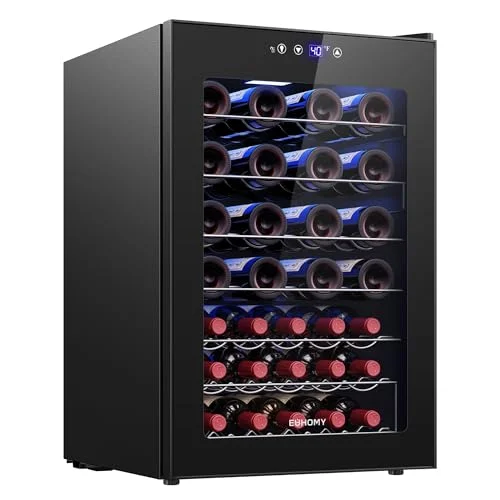
Wave shelves — contoured, scalloped shelving molded with a repeating curve — are built specifically to cradle a bottle at a slight angle rather than lay it dead flat, which lets the neck of one row nest into the gap left by the bottle below. That flexibility is what makes wave shelving the most forgiving of the three styles when bottle widths are mixed: a slightly wider bottle still has somewhere to sit, because the curve gives it room the way a flat shelf does not. The EUHOMY 45 Bottle Wine Cooler Refrigerator in this guide uses wave shelving throughout its 4.5 cu ft interior, which is the main reason its real-world capacity holds up better than its bottle count alone would suggest once a mixed collection goes in.
Flat shelves — simple pull-out trays, sometimes slatted wood, sometimes solid — are the middle case. They do not actively help irregular bottles nest the way a wave shelf does, but they also do not actively prevent it; a flat shelf will accept whatever diameter fits across it, so the loss from mixed bottles shows up mainly as unused gaps between bottles rather than bottles that cannot be loaded at all.
Chrome wire racks — individual wire slots, each sized for one bottle — are the least forgiving style for a mixed collection, for a structural reason rather than a design one. A wire slot is a fixed opening. A Bordeaux bottle sized correctly for the slot fits; a Champagne bottle sized a half-inch wider than the slot simply does not, regardless of how much open space exists elsewhere in the cabinet. Chrome racks are common on budget freestanding units and they are a perfectly reasonable way to hold a uniform collection — the problem only appears when the bottle mix stops matching the slot the rack was built for.
Shelf style is also one of the clearer places where brands diverge even at the same size and price point — our comparison of Yeego vs Ca'Lefort 24-inch wine fridges walks through how two cabinets with nearly identical bottle counts handle shelving differently enough to matter for a mixed collection.
The dual-rating trap: when a fridge is rated for bottles and cans
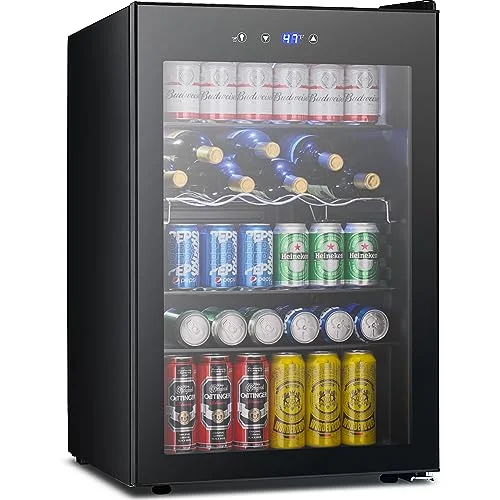
A specific version of the advertised-capacity problem shows up on combination units marketed with two separate numbers — a bottle count and a can count — on the same listing. The Electactic 37 Bottle Wine Fridge in this guide is rated exactly this way: 37 bottles, or up to 145 cans, in a 4.5 cu ft cabinet with smart temperature control and a child lock panel.
The trap is assuming those two numbers stack — that the fridge somehow holds 37 bottles and 145 cans at once, because both figures appear on the same page. They don't, and they can't: both numbers describe the same interior volume configured two different ways. The shelving that holds 37 wine bottles is not simultaneously holding 145 cans; you get one configuration or the other, or some split between them that yields fewer of each than either headline number. A dual rating is really answering two separate questions — "if I load this entirely with bottles, how many fit" and "if I load this entirely with cans, how many fit" — and a buyer who reads it as "this holds both totals at once" is heading for the same disappointment as the buyer who assumes every bottle is a slim Bordeaux.
The honest way to read a dual-rated listing is to decide which use case is primary before you buy, and plan the capacity math around that one number, not both. If wine is genuinely the primary use, the bottle-count rating is the one that matters, and it carries the same standard-bottle assumption as a wine-only cabinet. If the fridge is really going to live as a mixed beverage center, treat the bottle number as a secondary convenience, not the reason you bought it. This exact confusion — a shopper expecting a printed number to mean more than it measures — is one of the recurring themes in what wine fridge owners complain about most.
A realistic math check: three ratings from this guide, recalculated for a mixed collection
Here is what the gap actually looks like in bottles, using the three products referenced in this guide and a deliberately simple assumption: a collection that is roughly half standard Bordeaux-style bottles, a third Burgundy or Rhône-style bottles, and the remainder Champagne or sparkling. That mix is common enough among buyers who drink more than one style, and it is the mix where the advertised-versus-real gap is most visible. The percentages below are an illustrative estimate based on the diameter differences described above, not a measured fact about any specific unit's internal rack geometry — we have not disassembled these cabinets, and we are not claiming to have.
0125-bottle rating
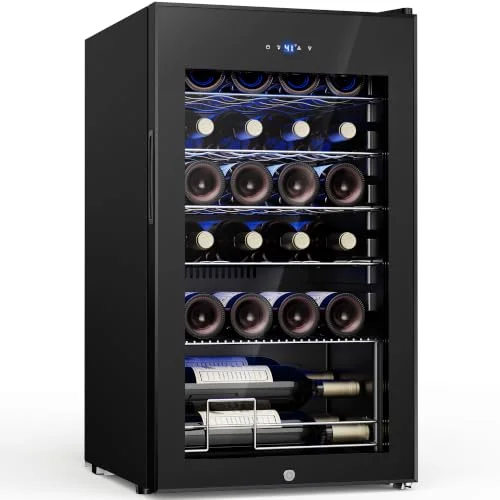
Feelfunn 25 Bottle Wine Cooler Refrigerator
Freestanding, black
25 bottles rated·17.5 x 18.9 x 31.2 in·Freestanding
A 25-bottle rating on a cabinet this size is already a tight pack of standard bottles. The listing does not specify a shelf style, so we won't guess whether it is wave, flat or wire — check the current listing images before assuming either way. Applying the mixed-collection assumption above to the rated figure puts realistic capacity in the high teens to low twenties rather than a full 25, with the gap landing hardest if more than a few bottles in the mix are Champagne-width.
The smallest cabinet in this check, which is exactly where losing even three or four bottles to bottle shape is most noticeable.
0237-bottle / 145-can dual rating
Electactic 37 Bottle Wine Fridge
Freestanding, 4.5 cu ft, dual-rated for bottles or cans
37 bottles or 145 cans rated·4.5 cu ft·Smart temperature control, child lock
This is the dual-rating case described above: 37 bottles is the all-wine configuration, 145 cans is the all-beverage configuration, and the two do not add together. Taking the 37-bottle figure as the relevant number for a wine-focused buyer and applying the same mixed-collection assumption puts realistic capacity in the high twenties — a meaningful drop, and one that compounds with the dual-rating confusion if a buyer expects both totals to be available simultaneously.
Decide which number is the real use case before you load it, not after.
0345-bottle rating, wave shelf
EUHOMY 45 Bottle Wine Cooler Refrigerator
Glass door, black, wave shelf
45 bottles rated·4.5 cu ft, wave shelf·Glass door
The headline example from the title of this guide, and the one case here where the shelf style is actually specified: wave shelving, which as covered above is the most forgiving of the three common styles for a mixed collection. Applying the same mixed-bottle assumption still removes a meaningful chunk of the rated 45 — realistically landing in the low-to-mid 30s rather than 45 — but the loss is smaller than it would be on an identical cabinet with flat shelving or chrome racks, because the wave contour gives wider bottles somewhere to nest instead of a flat surface that simply runs out of room sooner.
Same bottle-shape penalty as the other two, applied to a shelf that is built to absorb more of it.
The pattern across all three: the rated number is accurate for its assumed bottle, the real number depends on your collection and the shelf underneath it, and the gap is never zero. It is smallest on wave shelving and largest on chrome racks, and it grows every time a wide bottle displaces a slim one in the mix.
How to estimate real capacity for your own collection before you buy
You do not need the manufacturer's rack diagram to get a usefully accurate number. Five checks, done before you order, get you most of the way there.
- Sort your current collection by shape, not by color. Count what fraction is standard Bordeaux-style, what fraction is Burgundy or Rhône-style, and what fraction is Champagne, sparkling, or anything with a heavy punt. Color tells you nothing about diameter; shape tells you everything.
- Note your single widest bottle. If you own even one case of Champagne or a few bottles of a wide-shouldered Burgundy producer, that is the bottle that will determine whether a tight shelf spacing works at all, not your average bottle.
- Check whether you own, or plan to own, any magnums. If you do, confirm the shelves are adjustable or removable — a magnum needs the vertical space of roughly two standard bottles, and a fixed-shelf cabinet may not be able to free that space without discarding a shelf entirely.
- Read the shelf-style line on the listing, not just the bottle count. Wave shelving absorbs a mixed collection better than flat shelving, which absorbs it better than fixed chrome-wire slots. If the listing doesn't say, assume the least forgiving style until you can confirm otherwise from the product photos.
- Apply a conservative discount to the advertised number. For a collection that is almost entirely standard Bordeaux bottles, 85–90% of the rated figure is a reasonable planning number. For a genuinely mixed collection — the half-Bordeaux, third-Burgundy, remainder-Champagne split used in the math check above — plan on 65–75%. If Champagne or Burgundy is the majority of what you drink, plan closer to 60%.
One more sanity check worth doing at the end: compare cubic footage across the cabinets you are considering, not just bottle count. If two fridges share a nearly identical cu ft figure but one claims a dramatically higher bottle count, the higher number is coming from a more optimistic assumption about bottle shape, not from more usable space. When the capacity math still leaves you short, it is usually cheaper to size up one tier than to discover the gap after the fridge is already plugged in — our guides to wine fridges between $300 and $500 and wine fridges between $500 and $600 both lead with the real cu ft and shelf style for every unit, not just the headline bottle count.
How we compared these — and what we can't tell you
Everything above is built from published manufacturer specifications — bottle-count ratings, cubic footage, and shelf style where the listing specifies it — plus general, well-documented facts about standard wine bottle dimensions by style. Where a listing does not state a shelf style or a dimension, we said so rather than guessing, and the capacity-by-mix figures in the math check are a transparent estimate based on bottle-diameter differences, clearly labeled as such rather than presented as a measured fact about any specific cabinet's internal rack geometry.
We do not run a testing lab. We have not disassembled these units, counted how many Champagne bottles physically fit on a specific shelf, or published an invented score out of ten. What we can do honestly is read the specifications carefully, apply well-known bottle geometry to them, and tell you where a printed number is likely to be optimistic and by roughly how much.
Frequently asked questions
Why does my wine fridge hold fewer bottles than the box says?
Because the printed rating is calculated using a standard 750ml Bordeaux bottle — the narrowest common shape — stacked as densely as the shelving allows. If your collection includes wider Burgundy, Rhône or Champagne bottles, each one takes more shelf width than the reference bottle the rating assumed, and the shortfall compounds as the mix gets wider. It is not a defect in the fridge; it is a gap between the test bottle and your bottle.
What is a wave shelf, and does it really fit more bottle shapes?
A wave shelf is contoured shelving molded with a repeating curve that lets a bottle sit at a slight angle rather than dead flat, so the neck of one bottle nests into the gap left by the one below it. That flexibility makes it more forgiving of mixed bottle widths than a flat shelf, and considerably more forgiving than a fixed chrome-wire rack, where each slot is a rigid opening sized for one bottle diameter.
Can I trust the bottle-or-can dual rating on a combo fridge?
Trust each number on its own, not both together. A dual-rated unit's bottle count and can count describe two different ways of loading the same interior volume — one all-wine, one all-beverage — not two capacities you get simultaneously. Decide which use case is primary for your household before buying, and size the purchase around that single number.
How many bottles will a 45-bottle wine fridge actually hold if I collect Burgundy and Champagne?
For a collection that is mostly Burgundy and Champagne shapes rather than standard Bordeaux, plan on roughly 60% of the advertised rating — so a 45-bottle cabinet realistically holds somewhere in the high 20s. Wave shelving, where the listing specifies it, recovers some of that gap compared with flat or wire shelving, but it does not eliminate it.
Written by Ilane Tall. Research-based comparisons of published specifications and current prices — we do not physically test these units and we do not publish invented scores.