By Ilane Tall · Updated November 9, 2026 · Research-based.
Reader-supported: we may earn a commission when you buy through the links on this page, at no additional cost to you. It never changes which product we recommend. Prices quoted below were correct at the time of writing and move often.
The same three complaints, at every price
Read enough owner reviews across enough wine fridge listings — six-bottle countertop units, thirty-bottle freestanding cabinets, built-in units costing four times as much — and a pattern shows up that has nothing to do with price. The same three failure modes recur at every tier, because each comes from a different part of the appliance engineered to its own standard, regardless of the price tag.
The first is thermal: the cabinet runs warmer than the display suggests, or simply can't get cold enough for the room it's in. The second is physical: the door seal degrades, condensation fogs the glass, or the glass itself isn't built to the standard the rest of the cabinet implies. The third is acoustic: the compressor cycles on with an audible hum or vibration that's fine in a kitchen by day and not fine in a bedroom at 2 a.m.
None of these are mysteries. A wine fridge is a small, cheaply-insulated refrigerator with a glass door, and glass is a poor insulator and a poor seal substrate next to the foam-and-metal shell of a kitchen fridge. Every one of these complaints is a direct, predictable consequence of that design compromise — which means every one shows up, in some form, on the spec sheet before you plug the thing in. (If you're not sure a "wine cooler," "wine cellar," and "wine refrigerator" are even the same category, the naming is mostly marketing, not engineering — the specs below apply across all three.)
Not cold enough
The published low-end of the temperature range, read against your room.
Seal & glass failure
Whether the door is lock-rated and tempered double-pane, or single-pane and unlocked.
Noise
Thermoelectric or compressor — the two cooling methods trade silence for cold, directly.
Not cold enough: read the published low-end range before you buy
This is the single most common wine fridge complaint we find, and it is almost never a malfunction. It's a buyer who read "cools down to 41°F" and assumed that meant 41°F anywhere in their house, in any season, with the door opened daily. That assumption is wrong for a meaningful share of these units, and it is wrong in a specific, checkable way.
Every compressor-cooled wine fridge publishes a temperature range — something like "41°F to 64°F" — measured under test conditions: controlled ambient temperature, closed door, settled load. Put the same unit in a garage that hits 85°F in July, or a kitchen warmed by a nearby oven, and the achievable low end drifts upward; the compressor is fighting a bigger gap, and on a lot of units the published floor assumes a room nowhere near that hot. The complaint "it never gets below 58°F no matter what I set it to" is, in the overwhelming majority of cases, a room-temperature problem wearing a defect costume.
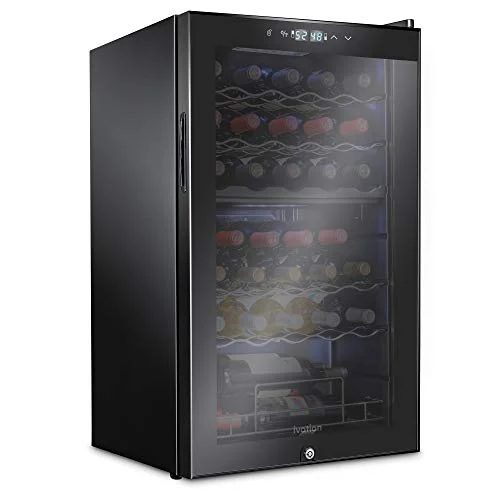
The fix is not a better thermostat — it's reading the published range before you buy and matching it to where the unit will live. A unit rated to a genuinely low floor, with digital control rather than a single dial, gives you the headroom a warm kitchen eats into. The Ivation 33 Bottle Dual Zone below publishes 41–64°F on both zones; a unit that only advertises "down to 54°F" has none of that margin.
If you already own a unit and the display disagrees with a thermometer on the middle shelf, that's a related but separate problem — the display and the actual temperature are reading two different places in the cabinet, and the gap between them is usually normal, not a fault.
01For the "not cold enough" complaint
Ivation 33 Bottle Dual Zone
Published 41–64°F, digital, with the headroom a warm room eats into
33 Bottle Dual Zone·41–64°F digital control·Lock·Glass door
A 41°F floor and a 64°F ceiling, set with digital control rather than a single dial, leaves room to spare once a kitchen's ambient heat eats into it. The lock and glass door are the other two complaints' specs, on the same unit. Freestanding installation; give it clearance at the back to breathe.
The spec to check first: not the headline range, but how far below your room's worst day it actually reaches.
Seal and glass failures: what a lock-rated, tempered double-pane door actually buys you
The second complaint cluster is physical rather than thermal: a seal that stops making full contact after a year of daily opening, a door that doesn't quite latch flush, condensation fogging the glass, or — less often, but loud when it happens — a pane that chips or cracks in delivery. All of it funnels back to one component a kitchen fridge doesn't have and a wine fridge can't avoid: the glass door.
A door seal is a gasket under constant mechanical stress, doing that job around a pane of glass instead of a solid insulated panel. Two things separate a door that holds up from one that doesn't: whether the glass is tempered — heat-treated for strength, and if it does fail, breaks into small granular pieces rather than long shards — and whether the latch includes a lock. A lock isn't a security feature here; it's a second point of compression that keeps the door seated fully against the gasket, instead of relying on a magnetic strip alone. Double-pane glass adds an insulating air gap that cuts the condensation that fogs single-pane doors from the inside — the specific complaint "I can't see my bottles anymore" traces back to.
None of that is marketing language you have to take on faith — it's either stated on the listing or it isn't. "Tempered glass" and "lock" are two of the few specs here that are binary and checkable before you buy, worth confirming before anything about bottle count or zone layout.
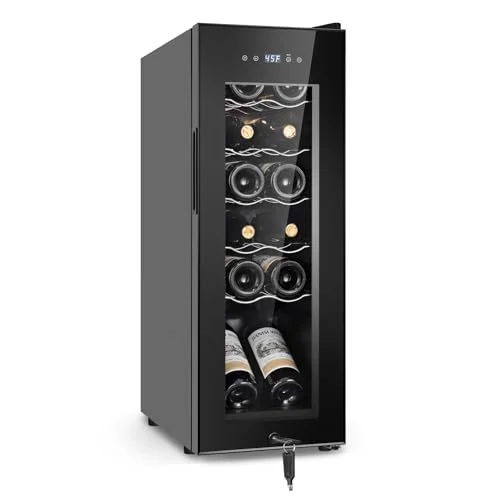
The Tylza 12 Bottle is built around exactly this pair of specs: a Low-E tempered glass door and a lock, on a compressor-cooled cabinet with digital touchscreen control. Low-E (low-emissivity) glass has a coating that reflects more radiant heat than plain glass — it slows the heat transfer that drives condensation and blocks more UV than untreated glass, which matters because UV degrades wine as surely as heat does.
If a unit arrives already failing or cracked, that's a delivery problem, not a design one — check the door and seal in the first ten minutes, while a damage claim is still simple to file.
02For the seal & glass complaint
Tylza 12 Bottle Wine Fridge
Low-E tempered glass, a lock, and a compressor to back it up
24" Depth·Low-E tempered glass door·Lock·Powerful compressor
Tempered glass and a lock on the door, LED touchscreen control, and a compressor doing the cooling rather than a thermoelectric module. The Low-E coating is easy to miss on a spec sheet and does real work: it cuts the UV that degrades wine and slows the heat transfer that fogs single-pane doors. At 24 inches of depth, confirm the counter or alcove before ordering — depth is the dimension buyers misjudge most.
Two checkable specs — tempered, and lockable — do more for door longevity than anything else on the listing.
Noise: why a thermoelectric cabinet sidesteps the complaint entirely — and what it costs you instead
The third complaint is the easiest to engineer around completely, because it comes down to a choice between two different cooling mechanisms, not a build-quality variable within one. A compressor-cooled wine fridge uses the same cycle as a kitchen fridge: a compressor pressurizes refrigerant, the refrigerant cycles through coils, and the compressor cycles on and off to hold temperature. Every part of that produces some vibration and audible hum — quieter than a decade ago, but never silent, and in a bedroom or small apartment a few feet from where someone sleeps, "quieter" is not "unnoticeable."
A thermoelectric wine fridge has no compressor and no refrigerant loop. It cools using the Peltier effect — current run through a junction of two conductive materials, moving heat from one side to the other — driven by a fan. There's no cyclical hum, no vibration transmitted into a cabinet or floor. For a bedroom nightstand or a studio apartment, that silence is the entire reason the category exists.
It's also, mechanically, why thermoelectric units show up disproportionately in "not cold enough" complaints — these two complaints aren't independent. The Peltier effect can only move heat across roughly a 20°F gap between the cabinet and the room; it has no compressor to work harder as the room warms. A 70°F room comfortably yields the low-50s; an 85°F garage tops out in the mid-60s regardless of the dial — not broken, just at the edge of what the physics allows. You are buying quiet at the direct cost of the cooling headroom a compressor gives you in a warm room.
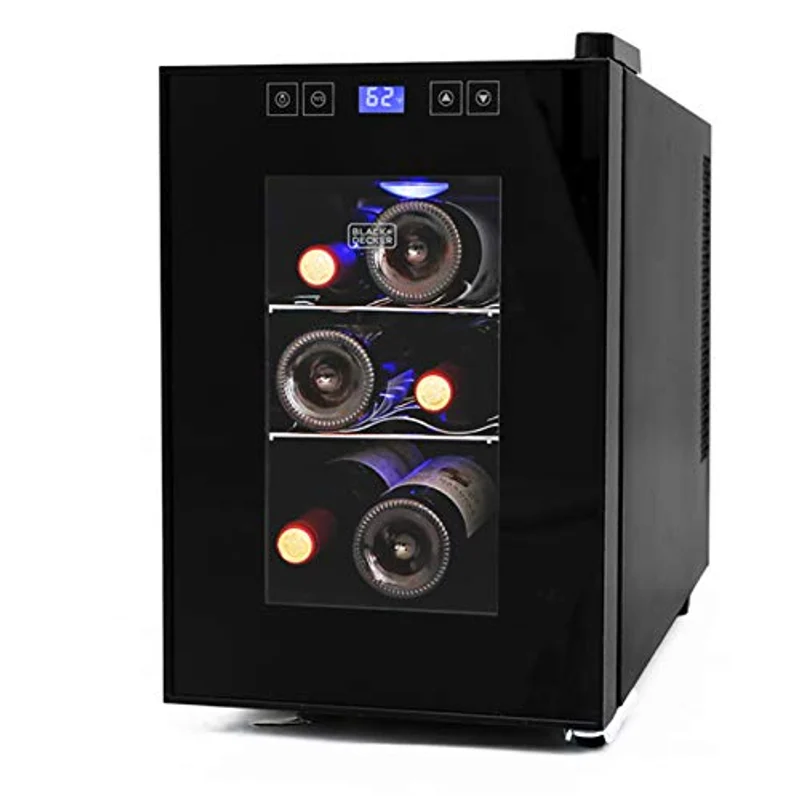
The BLACK+DECKER 6-Bottle Thermoelectric is the honest version of that trade: genuinely silent, genuinely small, limited to rooms that don't get hot. If the room runs warm, the fix isn't a bigger thermoelectric unit — it's a compressor unit, accepting the hum. NewAir, Whynter, and EdgeStar build almost exclusively on that side of the line, for exactly this reason.
03For the noise complaint
BLACK+DECKER 6-Bottle Thermoelectric
No compressor, no hum, and a hard ceiling on how hot the room may get
6 Bottles·Thermoelectric·No compressor vibration
No compressor means no cyclical hum and nothing transmitted into a nightstand or shelf — the specific trade a bedroom or small-apartment buyer is making this purchase for. The honest limit is thermal, not acoustic: it pulls roughly 20°F below the room it sits in, so it belongs somewhere climate-controlled, not a garage. Six bottles is a real-world starter size, not a collection size.
Buy the silence on purpose, knowing exactly what it costs you in a warm room.
The one complaint no spec sheet can prevent: buyer's remorse over size
Read far enough into owner reviews and a fourth complaint shows up constantly, and it has nothing to do with the thermostat, the seal, or the compressor. It's some version of "I wish I'd bought the bigger one" or, less often, "this is way more than I needed." Unlike the first three, no spec on any listing prevents this, because it isn't a defect — it's a mismatch between the appliance and a collection that is either growing or never going to be as large as the buyer imagined when they clicked "buy."
This complaint is predictable in one direction: people underbuy more often than they overbuy. A six-bottle countertop unit looks like plenty empty in a listing photo and feels cramped within months once wine becomes a habit rather than an occasional purchase. The honest advice is to buy for where your collection is heading over the next year or two, not where it sits today, and to budget a little extra capacity — advertised counts assume slim Bordeaux-shaped bottles racked perfectly, and a mixed collection of Burgundy, Champagne, and the odd magnum runs lower than the box suggests.
There's a practical floor and ceiling worth knowing. Below roughly twenty bottles, most households outgrow the cabinet within a year. Past about forty-five, price per bottle climbs for reasons unrelated to cooling quality — bigger compressors, heavier doors, more steel. Our guide to wine fridges with 20 to 45 bottles covers that middle band, where most households that buy once land. If counter space rather than bottle count is the constraint, 12-inch units built for a narrow gap are a different shape of the same problem. And if your collection has outgrown the budget-to-midrange bracket, the step up shows up clearly once you're looking above $800 — the $600-to-$800 tier is the more common landing spot in between.
None of this is a defect to engineer around — just a question only you can answer honestly: how much wine will actually be in this thing a year from now.
How we compared these — and what we can't tell you
We compared published manufacturer specifications — temperature ranges, glass and seal construction, cooling method, capacity — against current prices and the complaint patterns across these listings. Where a spec was ambiguous or unpublished, we said so rather than guessing.
We do not run a testing lab, own these units, or physically test them — no invented score out of ten here, and no star rating or review count either, since the retailer API we source from doesn't return that data for this category. What we can do, honestly, is read the specifications carefully, track the prices, and describe the pattern that recurs across owner complaints at every price tier.
Prices quoted here were correct at the time of writing and change frequently.
Frequently asked questions
What's the one spec that best predicts whether a wine fridge will run cold enough?
The published low end of its temperature range, read against the room it will actually sit in — not the room temperature on the listing's test bench. A unit rated down to 41°F with digital control has real margin in a warm kitchen; one that only claims "down to 54°F" has almost none, and will likely draw the "not cold enough" complaint from anyone whose room runs even slightly warm.
Does a lock on a wine fridge door actually matter if I'm not worried about security?
Yes, for a reason that has nothing to do with security: a lock is a second point of compression that seats the door fully against the gasket every time it closes, which a magnetic latch alone doesn't always guarantee. That's a meaningful part of why lock-rated doors tend to show up less often in seal-failure complaints.
Why are thermoelectric wine fridges so much quieter than compressor models?
Because they have no compressor and no refrigerant loop. They cool using the Peltier effect, moving heat across a junction with electrical current and a fan, which produces no cyclical hum or vibration. The trade is that they can only pull about 20°F below the room's own temperature, so they lose cooling headroom in a warm space exactly where a compressor unit gains it.
How do I avoid the "wrong size" complaint before I buy?
Buy for where your collection is heading over the next year or two, not where it sits today, and budget on roughly 70–80% of the advertised bottle count once a mixed collection of bottle shapes is actually racked. Most households that regret a purchase regret buying too small, not too large.
Written by Ilane Tall. Research-based comparisons of published specifications, current prices and the patterns in owner complaints — we do not physically test these units and we do not publish invented scores.