By Ilane Tall · Updated November 11, 2026 · Research-based.
Reader-supported: we may earn a commission when you buy through the links on this page, at no additional cost to you. It never changes which product we recommend. Prices quoted below were correct at the time of writing and move often.
The short version
$500 to $600 is where two different appliances start sharing a price tag. The FOVOMI 52-Bottle Dual-Zone ($569.96) and the Allavino KWR50S-1SR 50 Bottle ($583.00) are dedicated wine storage that cleared 50 bottles for the first time in this guide's price ladder. The Tylza 24 Inch Dual Zone ($541.49, 18 bottles plus 88-can capacity) and the Velivi 24" Dual Zone ($541.49) are wine-and-beverage hybrids that trade most of that bottle count for can storage instead.
Which one is worth it depends on one question: is wine the only thing competing for space in your kitchen, or are beer and soda fighting for the same shelf? Answer that before you compare prices, because at this tier the four units solve different problems for nearly identical money.
Two of the four — the big-capacity FOVOMI and Allavino — don't state an installation type or a cabinet width in their listings. If you're cutting cabinetry around one of these, read the build-quality section before you measure.
What actually changes once you cross $500
Under $500, a wine fridge is still mostly a freestanding box: 15 to 19 inches wide, capacity in the twenties or thirties. Our $300-to-$500 guide covers that tier, and every cabinet in it tops out at 33 bottles.
Cross $500 and the category pivots on two fronts at once. The first is footprint: two of the four cabinets here, the Tylza and the Velivi, state a 24-inch width outright — the same standard opening that under-counter dishwashers and most true built-in wine fridges use. That's a size class that barely appeared below $500. The second is capacity: the FOVOMI and the Allavino both clear 50 bottles, more than either sub-$500 cabinet we've reviewed, for $30 to $40 less than the cheapest 50-plus-bottle unit in our $600-to-$800 guide.
What ties those two shifts together is that they don't show up in the same products. Nothing in this guide is simultaneously a confirmed 24-inch footprint and a 50-plus-bottle wine-only cabinet. You get one or the other at this price, and which one you should buy depends on what's actually going into the cabinet — just wine, or wine plus the cans and bottles that used to live in a separate fridge.
There's a third thing that starts appearing here: a hybrid cabinet that names its can capacity as specifically as its bottle capacity. The Tylza's listing states "18 Bottles and 88 Count" in the title itself, not buried in a spec sheet. That level of specificity is worth noticing when a listing does, or doesn't, offer it.
Hybrid or dedicated: is an 18-bottle cabinet worth it next to a 50-bottle one at the same price?
This is the real decision in this band, and it's a sharper version of the question our $600-to-$800 guide raises about wine-only cabinets versus hybrids at that tier — except here the gap is even starker, because the dedicated units in this guide cost less than the hybrids.
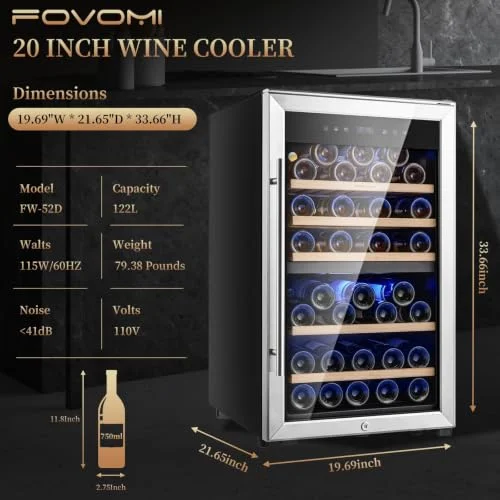
Put the numbers next to each other. The Tylza 24 Inch Dual Zone is $541.49 for 18 bottles plus roughly 88 cans, split across French doors with a lock and tempered glass, rated for under-counter or freestanding installation. The FOVOMI 52-Bottle Dual-Zone is $569.96 — thirty dollars less — for nearly three times the bottle count, with none of that capacity given up to cans. If your household's problem is purely wine, the FOVOMI wins that comparison on both price and capacity without qualification.
Dedicated wine storage (FOVOMI, Allavino)
Every shelf racked for bottles, split across two wine temperature zones. The right call if beer and soda already have a home elsewhere in the kitchen.
Wine & beverage hybrid (Tylza, Velivi)
One side racked for bottles, the other shelved for cans at a colder, drinking temperature. Worth the bottle-count trade only if cans are genuinely competing for fridge space too.
So why would anyone pay more for fewer bottles? Because the Tylza and the FOVOMI aren't answering the same question. The FOVOMI's 52 bottles are a cellar. The Tylza's 18 bottles plus 88-can capacity is a bar: wine at cellar temperature on one side, a working stash of beer and soda at drinking temperature on the other, in one 24-inch footprint instead of two appliances fighting for the same corner of a kitchen. Eighteen bottles is a real constraint if you're building a collection, and a non-issue if the real congestion in your kitchen is canned drinks.
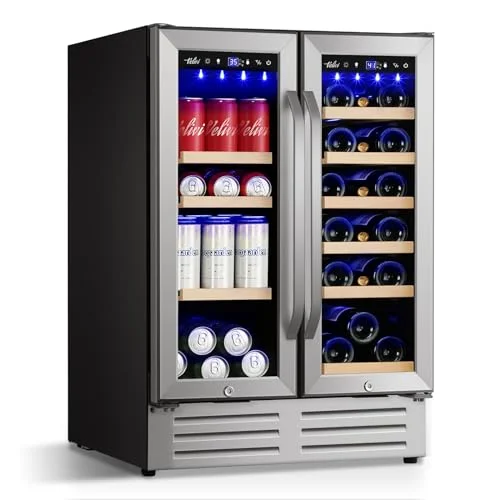
The Velivi 24" Dual Zone sits in the same hybrid category as the Tylza — its listing describes it as a dual-zone "Large Capacity Drink Cooler" for both beer and wine, built for an under-counter or built-in spot — but it doesn't state an exact bottle or can count the way the Tylza's does. We won't invent a number the listing doesn't give us. If capacity is the deciding factor between the two hybrids, the Tylza's "18 Bottles and 88 Count" claim is the one you can plan a kitchen around; the Velivi is the one to confirm directly against the current listing first.
The honest rule for this part of the band: if you're choosing between an 18-bottle hybrid and a 50-plus-bottle dedicated cabinet at nearly the same price, you're not really comparing wine fridges. You're deciding whether the appliance's second job — chilling cans — is worth more to you than the thirty-plus bottles of wine storage it costs.
The 50-plus-bottle options, and what you don't get in exchange
The FOVOMI and the Allavino are the two cabinets in this guide built purely around capacity, and they get there by spending the listing's words differently than the two hybrids do.
The FOVOMI Wine Fridge 52-Bottle Dual-Zone is $569.96, the cheapest unit in this guide, and the highest bottle count. Its name tells you the two things it's selling: 52 bottles and dual-zone cooling. What it doesn't tell you is a cabinet width, an installation type, or a finish material. That's not necessarily a flaw — a 52-bottle dual-zone cabinet at under $570 is a strong capacity-per-dollar number — but confirm the physical footprint and whether it's rated for built-in or freestanding use directly against the current listing before you plan a space for it.
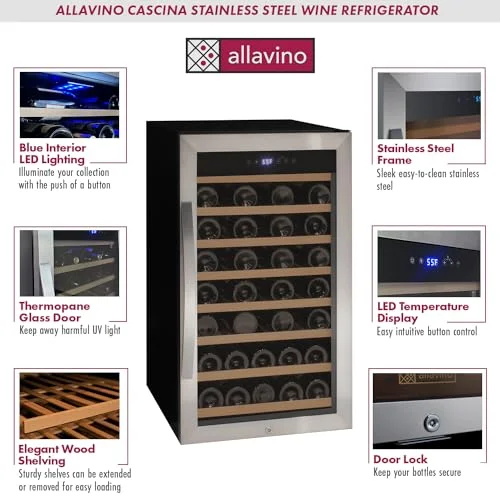
The Allavino KWR50S-1SR Wine Refrigerator, 50 Bottle, Stainless Steel is $583.00, thirteen dollars more than the FOVOMI for two fewer bottles. What it states instead is a material: stainless steel, named directly in the product title. Its listing doesn't state a zone count or an installation type either, so we won't assert single-zone or dual-zone for this one — check the current listing if that distinction matters to your household.
Line the two up and the trade is clear: the FOVOMI gives you two extra bottles and a lower price; the Allavino gives you a named exterior finish for roughly thirteen dollars more. Neither listing states everything a careful buyer wants before committing to a 50-bottle cabinet in a specific kitchen corner — capacity-first listings in the $500s tend to lead with the bottle count and leave the rest of the spec sheet to the full listing rather than the headline.
What neither of these buys is a confirmed built-in rating or a stated cabinet width. If your installation depends on either being certain rather than confirmed after the fact, that's the clearest reason to spend the extra hundred dollars rather than stretch a $570 unit into a job its listing never promised it could do.
Stainless steel and the build-quality details buyers notice at this price
Somewhere around $500, listings start naming finish and hardware details that budget cabinets mostly skip. Not every cabinet in this band names the same ones, which is itself informative.
The Allavino is the only one of the four that puts a finish material directly in its name: stainless steel. That's a build-quality claim you can rely on because it's stated, not implied — the kind of detail that, lower down the price ladder, tends to get left out of the title and sometimes out of the listing entirely.
The Tylza doesn't name an exterior material, but it states three other build details explicitly: French doors, a lock, and tempered glass. Tempered glass is the stronger, more shatter-resistant pane, and naming it specifically rather than just "glass door" is the kind of claim a listing makes because it costs more to spec than ordinary glass. A lock and French doors are furniture-grade details associated with a cabinet meant to sit on display, not get tucked into a closet.
The Velivi states a door lock and a "warm light" feature — interior lighting pitched at ambiance as much as visibility, a detail aimed squarely at a home-bar setting rather than a back-room cellar.
The FOVOMI is the one cabinet here that names none of these. That doesn't mean the build quality is worse; it means the listing chose to sell on bottle count and price instead, and a buyer who cares about finish, hardware, or glass type should read the full listing rather than assume parity with the other three based on price alone.
The picks across the range
Four units at $569.96 to $541.49, two of them answering a capacity question and two answering a kitchen-congestion question.
Why the next $200 buys quieter compressors, not just more bottles
It would be reasonable to assume that spending another $200, into the $600-to-$800 band, simply buys more of the same thing — a few more bottles, a slightly bigger box. That's not quite what happens.
Capacity in this $500-to-$600 band already tops out at 52 bottles with the FOVOMI, and our $600-to-$800 guide finds cabinets in that next tier landing in a similar 19-to-52-bottle range overall, not a dramatically higher one. What that extra $200 reliably buys instead is the thing you can't read off a bottle count: a compressor sized with enough headroom to hold a real spread between two zones without straining, and tempered or multi-pane glass as the default rather than a named exception.
That matters most on the zone question specifically. A dual-zone cabinet with a compressor sized for a single zone can only let its two halves drift a few degrees apart before the system starts working against itself — our thermostat accuracy guide covers why the number on the display and the number a thermometer reads on the middle shelf disagree, and that gap widens on an underpowered dual-zone system. None of the four cabinets in this guide publish per-zone temperature ranges, which is itself a reason some buyers spend the extra $200 for a listing that answers that question more directly.
The practical takeaway: if 50-plus bottles or an 18-bottle hybrid already covers what you need, and the installation details you can confirm are good enough, there's no capacity reason to spend more. The reason to cross $600 is quieter, steadier operation and a listing willing to state more of the specification up front — not a bigger number on the box.
How we compared these — and what we won't claim
We compared published manufacturer specifications and current listed prices for four wine fridges priced between $569.96 and $541.49 in our product database, chosen to cover both the dedicated wine-storage format and the wine-and-beverage hybrid format that split this band roughly in half. Where a listing didn't state a cabinet width, installation type, zone count or exact capacity — as with the FOVOMI's footprint, the Allavino's zone count, and the Velivi's bottle count — we said so directly rather than filling the gap with an assumption.
We do not run a testing lab. We don't own these four units and haven't physically tested any of them, so there's no invented score out of ten here, and no star rating or review count either — the retailer data we draw from doesn't supply either figure for this category. What we can do honestly is read what each listing actually states and tell you plainly which specification questions each one leaves for you to confirm before buying.
Prices quoted here were correct at the time of writing and change frequently. Confirm the current price before buying.
Frequently asked questions
Is it worth spending over $500 instead of staying under $500?
If you need either a confirmed 24-inch footprint or more than about 35 bottles of wine storage, yes — neither shows up reliably below $500. Our $300-to-$500 guide tops out at 33 bottles and 19 inches wide. If your collection and your cabinet opening both fit comfortably under those numbers, there's no need to spend more.
Should I buy a 50-bottle wine fridge or an 18-bottle wine-and-beverage hybrid at this price?
It depends on what's competing for space in your kitchen, not on which number looks bigger. A dedicated cabinet like the FOVOMI or Allavino puts its whole interior toward bottles, so it holds nearly three times the wine of a hybrid like the Tylza for a similar or lower price. A hybrid earns its smaller bottle count only if beer and soda genuinely need a cold home too, and you'd rather solve that in one footprint than buy a second appliance.
Why don't some of these listings state a cabinet width or installation type?
At this price, a listing tends to lead with whatever its strongest selling point is — for the FOVOMI and Allavino, that's bottle count and price. Width, installation rating and zone count aren't always stated alongside it. That's not unique to this tier; it shows up at $300-to-$500 and $600-to-$800 too. The fix is the same every time: check the current listing or ask the manufacturer directly for whatever spec matters to your specific installation before you buy, rather than assuming it matches a competitor at the same price.
Is it worth stretching to the $600-to-$800 tier instead?
Mainly for one reason: a compressor and dual-zone system with more headroom to hold a real spread between zones, plus tempered or multi-pane glass as the default. It's not primarily about bottle count — capacity in the $600-to-$800 band lands in a broadly similar range to what this guide already covers. If 18 to 52 bottles meets your needs and the installation details on your chosen unit check out, there's no capacity reason to spend the extra $200.
Written by Ilane Tall. Research-based comparisons of published specifications and current prices — we do not physically test these units and we do not publish invented scores.