By Ilane Tall · Updated November 16, 2026 · Research-based.
Reader-supported: we may earn a commission when you buy through the links on this page, at no additional cost to you. It never changes which product we recommend. Prices quoted below were correct at the time of writing and move often.
The short version
Ventilation and power are the only two things a wine fridge actually needs — not a cabinet cutout, not plumbing. If a spot has a grounded outlet and open air around the back and sides, it is a candidate, wherever in the house it happens to be.
A recessed hallway alcove, a closet behind a louvered or slatted door, and the open triangle under a staircase can all work. Each has one failure mode to watch for: the hallway needs real walking clearance, the closet needs the compressor's heat to escape past a closed door, and the stairs need headroom measured at the lowest point of the slant, not the tallest.
Shop width first. Measure the opening, then match a model's footprint to the space before you pick a bottle count — and if nothing freestanding clears it, a built-in undercounter unit is the actual fix, not a bigger freestanding one squeezed in tighter.
What actually decides where it can go
Four things determine whether an odd corner of the house can take a wine fridge. Get these right and the room itself stops mattering.
Why a wine fridge can leave the kitchen entirely
A dishwasher is tied to the kitchen because it needs a water supply, a drain, and usually a dedicated circuit. A wine fridge needs neither — electrically and mechanically it is closer to a dorm fridge than to a built-in kitchen appliance. The two real requirements are a nearby outlet on an ordinary household circuit, and open air at the back and sides of the cabinet so the compressor has somewhere to dump the heat it pulls out of the interior. No plumber, no new circuit, no proximity to the sink or stove.
That makes "the kitchen has no room" a weaker objection than it sounds. A wine fridge can go wherever power and airflow exist, which turns a hallway, a closet or the space under the stairs into real candidates rather than afterthoughts. Ventilation, not capacity, is also the complaint that shows up most often once a wine fridge is already installed — reason enough to settle the airflow question before the bottle-count one.
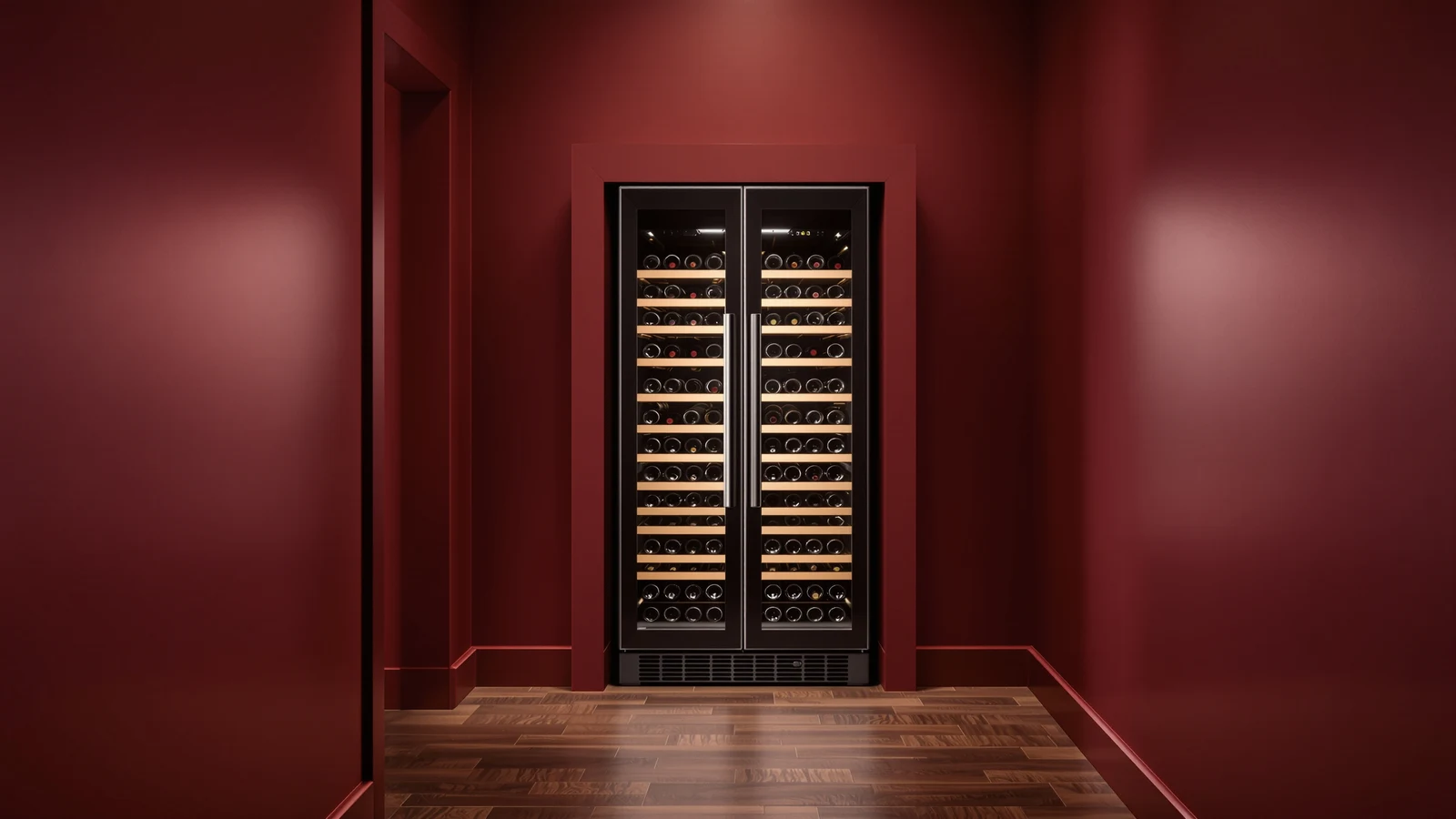
Hallway placement: minimum width clearance and why a recessed alcove beats a straight wall run
A hallway has two clearance problems that are easy to confuse: how much room people need to walk past the fridge, and how much room the fridge needs to breathe. Measure the narrowest point at the height the fridge will occupy — trim, a switch plate, a door that swings partway in — not just the open floor width. Whatever remains after the fridge's footprint has to still let someone pass without brushing the back vent, permanently, not just on delivery day.
This is why a recessed alcove beats a straight run of wall. A niche — an old doorway drywalled over, a nook between two structural walls — already has clearance built into the architecture, so the fridge doesn't eat into the walking path. Push the same unit flush against a straight hallway wall instead, and it narrows the usable hallway for as long as it sits there, and anything that brushes it over time can creep it toward the wall and choke the vent. An alcove also reads correctly to the eye, rather than looking like an appliance someone parked in a thoroughfare.
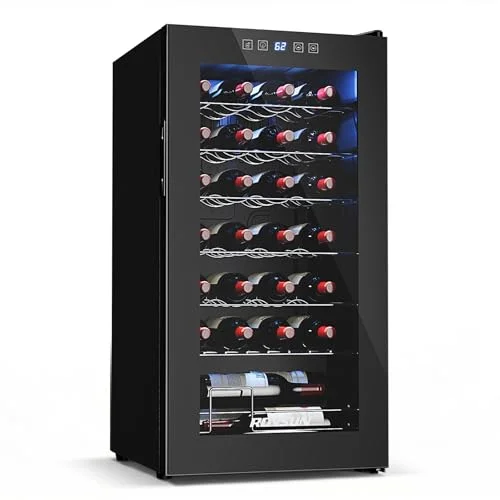
The ROVSUN 28 Bottle is a reasonable benchmark here: the smallest capacity of the three units in this guide, with a double-layer glass door and digital temperature control that's easy to read in a dim hallway. A smaller bottle count tends to track a smaller footprint, but confirm the width and depth on the listing before ordering — and remember it's freestanding, so it needs a few inches off the back wall, not a flush fit.
Closet conversion: venting a closed door and why a louvered or slatted door matters
A closet looks like free real estate until the door swings shut. A solid door does to a wine fridge what an enclosed cabinet does: it traps the heat the compressor is rejecting, with nowhere for it to go, so the fridge runs harder and the interior drifts warmer than its setpoint.
The fix is passive. A louvered or slatted door — horizontal slats running most of its height — lets warm air bleed out continuously, which matters because relying on someone to prop the door open rarely lasts past the first week. Swapping a solid door for a louvered one, or fitting a vented insert, solves it for good; removing the door or hanging a louvered screen does the same job less neatly.
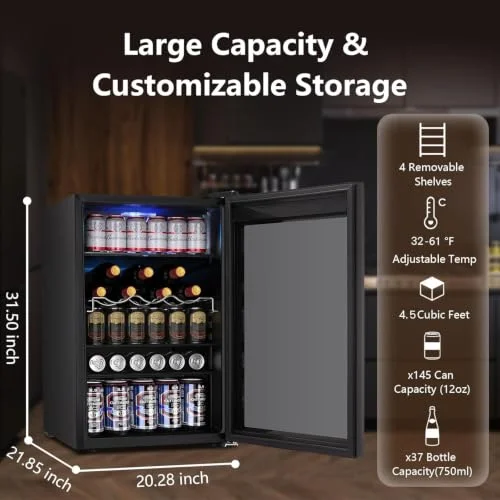
The Electactic 37 Bottle suits this well. At 4.5 cu ft it has the compact, upright shape of a mini fridge rather than a wide cabinet, so it fits a standard closet depth where a cabinet-style unit would stick out past the frame. Its smart temperature control and child-lock panel sit on the front, staying usable behind a door that only opens partway — and it's rated for up to 145 cans alongside the 37 bottles, worth knowing if the closet covers everyday drinks too.
Under the stairs: headroom, depth, and the slanted-ceiling clearance problem
The space under a staircase looks generous at the opening and disappears fast, because the ceiling follows the slope above it. The common mistake is measuring headroom at the mouth of the triangle and assuming the rest is just as tall.
Measure instead where the back of the fridge will sit, usually several inches further under the slant and therefore shorter than the opening suggests. Depth matters the same way: an understair space is often boxed in on three sides, with only the front open, so that's the fridge's only path to vent — leave more clearance there than you would with gaps on every side.
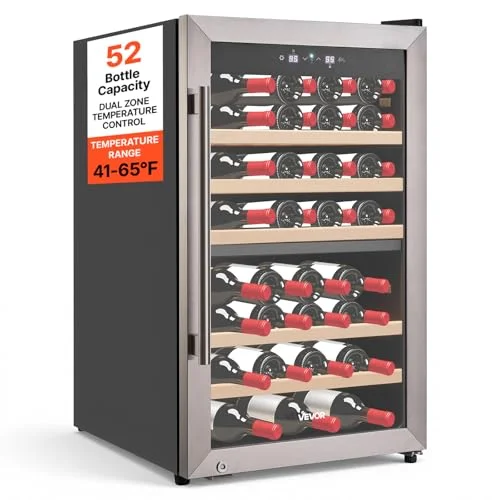
Of the three units here, the VEVOR 52 Bottle Dual Zone is the one to reserve for a nook with real headroom — an entry-adjacent understair space or a home-office corner, not a shallow pinch point. It's the largest capacity of the three, and capacity and cabinet height tend to move together, so measure before assuming the bigger pick fits. Its dual-zone range, adjustable 41–65°F, earns its keep if the nook doubles as somewhere people gather, much like the tight, multi-use corners in our guide to wine fridges for a home office or desk.
Match the cabinet width to the space before you match it to bottle count
The most common ordering mistake is shopping by bottle count first — settling on "around 40 bottles," picking the best one at that count, and only then discovering it's wider than the opening.
Flip the order: measure the space's narrowest clear width and depth first, subtract the clearance the maker recommends (or a conservative few inches if none is published), and that's your real shopping envelope. Only once models clear that measurement should bottle count break the tie between them.
Footprint tracks bottle count loosely, not precisely — a 52-bottle dual-zone cabinet isn't simply a scaled-up 28-bottle one, since the internal divider changes the proportions. The bottle number is a capacity claim, not a dimension, and often an optimistic one: our guide on why a wine fridge's advertised bottle count rarely matches what actually fits explains why. In a tight space, check the listing's width and depth, not the headline bottle count — that's the only real authority on whether it clears your doorway.
When the odd space is too tight for any freestanding unit
Sometimes the measurement comes back worse than hoped — the hallway, closet or stair triangle is narrower than every freestanding model worth buying. Resist forcing one in anyway: it's the same mistake as a closed closet door, just permanent, since the compressor cooks itself slowly rather than all at once.
The fix is a different category of appliance. A built-in or undercounter wine fridge vents through a grille on its front face instead of the back and sides, which is why the manufacturer is willing to rate it for an enclosed opening. Freestanding and built-in aren't two sizes of the same product; only one tolerates being surrounded on every side — at the cost of a higher price and a dedicated finished opening, with less flexibility to relocate it later.
Readers weighing that jump often compare specific built-in brands, which our NewAir vs Whynter vs EdgeStar built-in comparison covers, or check price bands like $300 to $500 and $500 to $600, where built-in-rated models commonly land. None of the three picks below are built-in rated — all three are freestanding, which is why they suit a hallway alcove, a vented closet or an open stair nook, and why none belongs forced into a sealed cutout. Measure twice, and check the return window before you buy: our breakdown of wine fridge warranties and return policies covers what's typically covered if a measurement turns out wrong.
Three freestanding sizes that fit odd spots
All three are freestanding compressor-cooled units pulled from the picks on our main wine fridge guide, sized differently enough from each other to match three distinct kinds of tight space.
How we compared these — and what we can't tell you
We compared the published dimensions, capacities and prices of freestanding wine fridges against the clearance and ventilation requirements manufacturers publish for compressor cooling, and matched them against the odd household spaces — hallways, closets, stair triangles — that come up again and again. Where a spec isn't published for a model, we say so rather than estimate it.
We do not run a testing lab. We haven't physically installed these three units in a hallway, closet or stair nook to confirm fit, and we don't publish invented scores or ratings we don't have the data for. What we can do is read the specifications carefully, track current prices, and explain the physics of airflow and clearance that apply to every freestanding compressor fridge regardless of brand — because that physics, not the specific model, decides whether an odd corner of your house will work.
Frequently asked questions
Does a wine fridge need a water line or a drain?
No. Unlike a dishwasher or a refrigerator with an icemaker, a wine fridge has no plumbing connection at all. It only needs a standard grounded household outlet, which is exactly why it can live somewhere a dishwasher never could.
Can a wine fridge go in an unheated hallway or a hallway near a garage?
Usually, but temperature extremes work against it either way. A compressor can still reach its setpoint in a cooler space, though it may run longer to get there; in a space that swings very hot, the same effective cooling range has less room to work with. A hallway that stays within a normal indoor temperature range year-round is the safer bet.
How much clearance does a freestanding wine fridge actually need behind it?
Manufacturers vary on the exact figure, so check the specific listing rather than assume a rule of thumb. What's consistent across freestanding compressor units is the principle: there must be continuous open air behind and beside the cabinet, not a sealed gap, and nothing may block it.
What if the only space I have is too shallow for any freestanding unit?
Don't force a freestanding model into a tighter enclosure than it's designed for; that starves the compressor the same way a closed closet door does, just permanently. A built-in or undercounter model, which vents through its front face and is rated for an enclosed opening, is the correct fix.
Written by Ilane Tall. Research-based comparisons of published specifications and current prices — we do not physically test these units and we do not publish invented scores.