0127″ depth
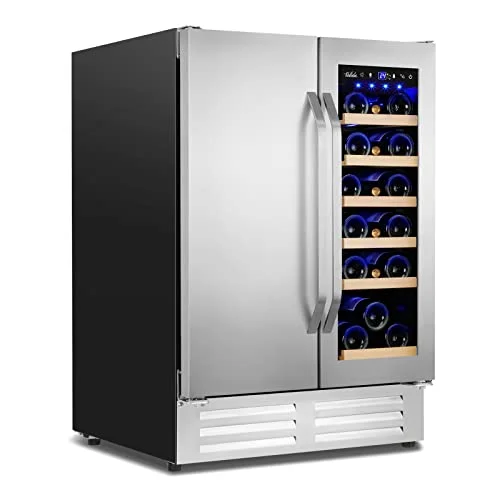
Velieta 24" Dual Zone, 20 Bottles + 88 Cans
Confirm depth before the return window closes
Most compressor wine fridge warranties cover the compressor itself for years longer than they cover the door seal or the control board — and almost none will reimburse the wine inside when the cabinet fails. What to check before checkout, using three similarly priced 24-inch cabinets as examples.
Reader-supported: we may earn a commission when you buy through the links on this page, at no additional cost to you. It never changes which product we recommend. Prices quoted below were correct at the time of writing and move often. As an Amazon Associate, we earn from qualifying purchases.
A typical compressor wine fridge carries a short full-unit warranty — often around a year — stacked under a much longer warranty on the sealed refrigeration system alone. The parts most likely to fail first in daily use, the door seal, the glass, and the control board, usually sit inside the short clock, not the long one.
Almost no manufacturer warranty reimburses the wine lost when a cabinet fails. That loss is treated as a consequential damage, which warranty language routinely excludes by name.
And the clock that actually protects you in the first weeks is not the warranty at all — it's the retailer's return window, which runs on its own schedule and closes long before most warranty terms even get registered.
Wine fridge warranties are not one document. They are almost always two overlapping clocks printed on the same card: a short full-unit term and a much longer sealed-system term.
The full-unit term is the broad one: the period during which the manufacturer agrees to repair or replace the appliance for defects in materials and workmanship, covering the unit as a whole — electrical components, cabinet, accessories. In this category that period is commonly measured in months to about a year, the same shape of coverage you'd expect on a dorm-room microwave, applied to an appliance that costs considerably more.
Layered underneath is the sealed-system or compressor-specific term, which manufacturers put in the headline because it sounds generous. Refrigeration brands treat the compressor and its sealed refrigerant loop as a different risk category, since a sealed-system failure is both the costliest thing that can go wrong and the hardest for an owner to cause through misuse — so that term routinely runs several years, well past the point the rest of the warranty has expired. It's standard practice across refrigeration generally, and it's why a brand can advertise "5-year warranty" on the box while the fine print underneath says one year on everything else.
The practical read: the compressor is the part the manufacturer is most confident will not fail, and the part they are least confident about is covered the least. That's the actuarial logic warranty terms are built on, and it's why the two headline numbers on a wine fridge's spec sheet rarely match.
If the compressor sits inside the long clock, nearly everything else a buyer actually touches sits inside the short one — and a few things are carved out of coverage entirely, regardless of which clock would otherwise apply.
The door seal (the gasket keeping the cabinet's cold, humid air inside) is treated as a wear item in most appliance warranty language, the same category as a light bulb or a filter — excluded on the reasoning that it degrades with normal use rather than fails from a defect. Even a generous compressor warranty typically has nothing to say about a gasket gone soft in year three. This is also the single most common complaint across wine fridge ownership generally; our roundup of what owners complain about most covers why a failing seal is both common and usually out of warranty by the time anyone notices the fogging.
Glass — the door panel, and any glass shelving — is routinely excluded outright, the way a cracked phone screen is treated differently from a dead battery: warranty language typically covers only a defect present at delivery, not glass scratched, chipped, or cracked afterward. That rewards unboxing and checking the cabinet immediately rather than letting it sit for a few weeks.
The control board — the small circuit running the display and thermostat logic — usually falls under the short full-unit term rather than the long sealed-system term, because it's an electrical component, not a refrigeration one. It's also one of the more frequent failure points on units with a digital display, exposed to the same temperature swings and condensation as everything else without the sealed system's isolation. A board failure a year and a half in lands in the gap between the two clocks, and the bill lands on the owner in full.
The pattern to remember: warranty length in this category correlates with how expensive and how rare a failure is to the manufacturer, not with how likely you are to actually experience it. The parts you interact with daily — the seal, the glass, the display — are the ones covered the least.
Almost nobody reads the fine print on this until it's too late. The answer is consistent across the category: essentially nothing happens, in the sense that the manufacturer will not pay for it.
Warranty language in consumer appliances excludes what is legally called consequential or incidental damage — loss that results from the product failing, rather than the cost of the product itself. A refrigerator warranty that pays to repair the compressor is not, by the same clause, agreeing to pay for the groceries that spoiled while it was broken. Wine fridge warranty cards use the same structure, and wine is the grocery in this analogy: expensive, genuinely degraded by a few days at room temperature, and explicitly outside what the warranty promises to make whole. It's not a wine-specific gap, but the dollar amounts sting more here: a 55-bottle cabinet that fails over a two-week vacation can represent several thousand dollars of wine with zero contractual path to reimbursement.
The closest thing to protection most owners have is homeowner's or renter's insurance, which sometimes covers appliance losses under a specific rider, plus a handful of third-party providers that sell "food and beverage spoilage" as a separate add-on precisely because the base warranty won't touch it. Neither is something to assume you have.
These two protections feel like the same thing. They are not.
The practical trap is timing: a buyer who leaves a cabinet against a wall for three weeks before the first wine run has often let the return window close before discovering whether the unit even cools properly. At that point the only recourse is the slower warranty process, which only promises a fix, not a refund.
The second trap is registration — several manufacturers make the longer term conditional on registering within a set period, sometimes 30 or 90 days, a step many owners never complete. Skip it and you may still hold a minimum statutory warranty in most states, but with no registration record tying the serial number to your purchase date, your case is harder to prove.
The fix for both: plug the unit in and run it for a few days inside the return window, and register it with the manufacturer the same week it arrives. Neither step costs anything.
To make this concrete, here are three 24-inch dual-zone cabinets that land within about $60 of each other on price — close enough that a buyer comparing them on spec sheets alone could reasonably assume the ownership protections are roughly interchangeable too. They are not, and the only way to know for certain is to read the specific warranty card and return policy on each individual listing, not to assume same price and same size means same paperwork.
| Model | Price | Depth | Before you rely on "same as the others" | Get it |
|---|---|---|---|---|
| Velieta 24" Dual Zone, 20 Bottles + 88 Cans | $599.99 | 27″ depth | Deeper than the other two — confirm it clears the cabinet opening before the return window closes, since a fit problem discovered in week five is a warranty question, not a return. | Get it |
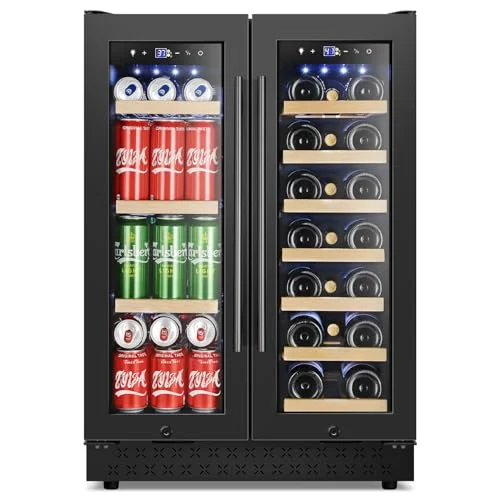
| Tylza 24" Dual Zone, Quiet Black | $586.61 | 24″ depth | Standard 24-inch depth, the dimension most 24-inch cabinet openings are built around — fit is less likely to be the thing that bites you here than the seal or the board further down the line. | Get it |
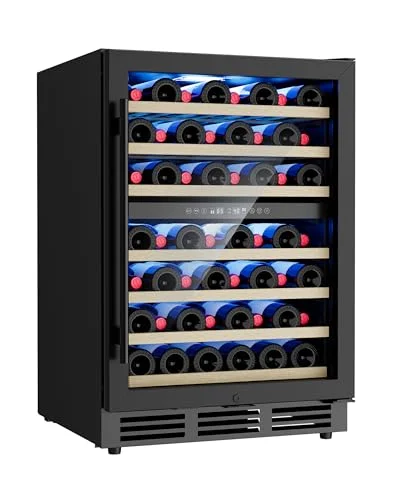
| 24" Dual Zone, 55-Bottle, Removable Wood Shelves | $659.99 | 24.0″ depth | Nearly triple the bottle count of the Velieta in the same nominal width — more racked weight on the same class of door seal and hinge, which is exactly the component the warranty covers least. | Get it |
Two of the three list within a dollar of each other, and the third is $60 less — close enough that price alone tells a buyer almost nothing about warranty length, registration requirements, or who answers the phone for a service claim. That information is rarely summarized in the bullet points at the top of the listing; it lives further down, in a "Product guides and documents" section or a card inside the box nobody reads until something has gone wrong.
That generalizes past these three cabinets: at a given price and nominal size, assume nothing until you've read that specific listing's documentation. Our comparison of NewAir, Whynter, and EdgeStar covers how differently three established brands structure written warranties on comparable hardware, and the same caution applies to any 24-inch cabinet in the $600-to-$800 band or the $500-to-$600 band just below it.
Confirm depth before the return window closes
Standard depth; register it the week it arrives
More weight on the same seal and hinge
None of this requires a lawyer — just doing these seven things in the first two weeks, while the return window is still open.
We compared published prices, published dimensions, and the general structure of appliance and refrigeration warranty terms as they're commonly written across the category — the full-unit versus sealed-system split, the standard treatment of wear items like seals and glass, and the standard exclusion of consequential damage. We did not have, and have not invented, specific warranty-term lengths or registration deadlines for the three listings above; those vary by brand and seller and are published on the listing itself, not in a database we can query. Where this piece says "check the listing," that's a literal instruction.
We do not run a testing lab, and we have not owned these cabinets long enough to watch a seal degrade or a board fail, so there's no invented score out of ten here. What we can do honestly is explain how warranty and return protections are generally structured in this category, and point to exactly where in each listing a buyer needs to look before checkout.
Almost never. Manufacturer warranties on appliances, wine fridges included, are written to exclude consequential or incidental damage — loss caused by the product failing, as opposed to the cost of fixing the product itself. The wine inside falls squarely into that excluded category. The only realistic paths to reimbursement are homeowner's or renter's insurance with the right rider, or a separate spoilage add-on purchased at checkout — neither of which is automatic.
No, and confusing the two is the single most common mistake buyers make. The return window is set by the seller (commonly around 30 days for this category) and lets you send the unit back for any reason, no defect required. The manufacturer's warranty is set by the brand, only applies to defects, runs much longer, and only ever offers repair or replacement — never a straightforward refund.
Usually not for long, if at all. Door seals and gaskets are typically classified as wear items in appliance warranty language — parts expected to degrade with normal use — which puts them outside the long sealed-system warranty and often outside the short full-unit warranty once it expires. A seal that fogs or stops sealing a year or two in is, in most cases, an out-of-pocket repair.
Because the sealed refrigeration system is both the most expensive component to fail and, from the manufacturer's side, the one they have the most confidence in. Compressor failures are comparatively rare and costly, so brands use a long compressor-specific term as a marketing differentiator, while the parts that fail more often in ordinary use — seals, glass, control boards — sit under a much shorter, less headline-friendly term.
See all six of our wine fridge picks or browse every guide on the site.
Written by Ilane Tall. Research-based comparisons of published specifications, prices, and warranty structure — we do not physically test these units and we do not publish invented scores.