By Ilane Tall · Updated November 18, 2026 · Research-based.
Reader-supported: we may earn a commission when you buy through the links on this page, at no additional cost to you. It never changes which product we recommend. Prices quoted below were correct at the time of writing and move often.
The short version
"24 inch," "15 inch" and "12 inch" in a wine fridge's title describe its width — the measurement that has to match a cabinet cutout. They say nothing about depth, the front-to-back measurement that decides whether the door clears a walkway, an island overhang, or the swing of the door next to it.
Full-size kitchen refrigerators advertise "counter-depth" as a selling point. Wine fridges almost never use the term, not because the dimension doesn't matter, but because most of the category is already shallow enough that the distinction rarely needs a label. That doesn't mean you can skip checking it.
The only place the real number lives is the product dimensions line on the listing — not the title, and not the photo. Measure your own space before you trust either one.
"24 inch," "15 inch," "12 inch" — all three are a width, not a depth
Every wine fridge sold for a kitchen falls into one of a handful of standard widths, because the appliance has to drop into a cabinet opening built to a handful of standard sizes. 24 inches is the full base-cabinet slot, the same width a dishwasher or a trash-pullout uses. 15 inches is the narrow undercounter slot increasingly common next to a sink or an island end. 12 inches is the slim column that fits where nothing else will. When a listing title says "24 Inch," it is answering exactly one question: will this unit fill a 24-inch cabinet opening side to side. It is not making any claim about how far the cabinet reaches back toward the wall.
This is easy to miss because width is the dimension manufacturers lead with, for a practical reason: it's the one measurement that makes or breaks whether the unit can go into the opening at all. Get the width wrong and the fridge simply won't fit between the cabinet sides. Get the depth wrong and the fridge will physically fit into the space — it will just stick out further than you expected, or sit flush when you needed clearance for a door to swing past it. That failure mode is quieter, which is exactly why it ends up in the title less often and in the fine print more often.
The same habit — reading the headline number as the whole spec — causes a nearly identical mistake with bottle counts. Our guide to advertised bottle count vs real capacity walks through why a "45-bottle" rating on the box routinely holds ten to fifteen fewer bottles once you load anything other than slim Bordeaux. Depth works the same way: the number that's easiest to market is not the number that determines whether the thing fits your kitchen the way you pictured it.
What the title tells you
The width class — 12, 15 or 24 inch — and therefore which standard cabinet opening the unit is built to fill side to side.
What the title doesn't tell you
How far the cabinet projects front to back, whether the door adds to that figure when open, and whether it will clear what's nearby.
What "counter-depth" means on a kitchen refrigerator — and why wine fridges rarely bother with the word
On a full-size kitchen refrigerator, "counter-depth" is a real marketing category with a real engineering trade-off behind it. A standard-depth refrigerator is built for maximum interior capacity and typically projects several inches past the edge of the counter and surrounding cabinets — the familiar look of a fridge that juts out from the row of cabinets on either side. A counter-depth refrigerator trims that projection, usually by shrinking the interior slightly, so the front face lines up close to flush with the countertop edge. Buyers pay a premium, and lose some capacity, for that flush look and for not having a refrigerator door stick a foot into the kitchen's main walkway.
Wine fridges rarely advertise "counter-depth" as a feature, and the reason isn't that the dimension stops mattering — it's that the baseline is different. A full-size refrigerator's standard depth is roughly 30 to 36 inches, deep enough to visibly overhang a typical 24-to-25-inch base cabinet. A wine fridge, by contrast, is built from the start to sit inside that same roughly 24-inch cabinet depth, because that's the opening it's designed for. There usually isn't a "deep" version of a 24-inch wine fridge the way there's a standard-depth version of a refrigerator, so there's rarely a meaningfully shallower "counter-depth" version to market against it. The category mostly starts out closer to flush by necessity, not by premium feature.
"Mostly" is the word that matters. Closer to flush is not the same as flush, and it is not the same across every brand. A built-in-rated unit is engineered specifically to sit inside a cabinet run with its face close to the surrounding cabinetry, venting through the front rather than the back. A freestanding unit has no such constraint — it's designed to stand on its own, with clearance at the back and sides for airflow, and nothing stops its manufacturer from making the case a few inches deeper than a built-in competitor's, because it was never meant to sit flush with anything.
Where the real depth number actually lives
If the title won't tell you, and there's no reliable "counter-depth" label to look for, the number has to come from somewhere else: the product dimensions field on the listing itself, not the hero photo and not the bullet points above it.
Two details are worth checking specifically, because listings are inconsistent about both:
- Whether the stated depth includes the door and handle. Some manufacturers publish the depth of the insulated cabinet body alone; others include the door in its closed position, handle and all. A unit listed at "22 inches deep" by one measurement convention and "24 inches deep" by another can be the same physical object described two different ways — and if you're matching it to a 24-inch-deep cabinet opening, the gap between those two numbers is the difference between flush and proud of the surrounding cabinetry.
- Whether the figure is the cabinet's resting depth or its open-door depth. Almost every listed depth measurement describes the unit with the door shut. It says nothing about how far the door swings outward when opened, which is a second, usually larger number you won't find on the spec sheet at all — more on that below.
None of the three units we discuss later in this guide publish a depth figure in their listing titles, which is normal — depth almost never makes the headline for this category, the way "24 Inch" or "Dual Zone" does. That's not a flaw specific to those three listings; it's the pattern across the category, and it's exactly why this guide exists. When a spec isn't stated where you'd expect it, the honest move is to go find it in the dimensions tab rather than guess from a photo shot at a flattering angle.
Where the extra few inches actually bites
Depth is forgiving right up until it isn't. A couple of extra inches rarely stops a wine fridge from physically occupying a space — it stops the space around it from working the way you expected. Three situations account for almost every complaint we'd expect to see about this:
A walkway behind the unit. In a galley kitchen, a narrow hallway nook, or anywhere a wine fridge sits across from another run of cabinets or an opposite wall, the number that matters isn't the fridge's depth alone — it's the fridge's depth plus whatever clearance is left for a person to pass. A cabinet-depth unit that reads "fits fine" on paper can turn a 36-inch walkway into something uncomfortably tight once its actual case, not its width spec, is standing in it. Our guide to where to put a wine fridge when your kitchen has no room goes through exactly this kind of odd-space math for hallways, closets and under-stair nooks, and depth is the dimension that trips people up most often there.
An island overhang. Kitchen islands often have a run of cabinets on one face and an overhanging countertop with seating on the other, or a decorative end panel nearby. Because an island has no back wall, any unit installed into it exposes more than one side to view and to foot traffic — there's no hidden rear to absorb an extra inch or two of depth the way a wall-backed run can. Depth that would be invisible against a wall becomes a corner someone's hip catches walking past a seating overhang. We cover the island-specific version of this problem, including why rear-venting units are the wrong call there regardless of depth, in our guide to wine fridges for a kitchen island.
A doorway swing. This is the one almost nobody checks until it's a problem: not the wine fridge's own door, but a nearby door — a pantry door, a cabinet door, an appliance door — that swings through the same floor space the wine fridge now occupies. A cabinet-depth fridge installed a few inches deeper than the unit it replaced can clip a dishwasher door at the top of its swing, or force a pantry door to stop short of fully opening. None of that shows up by comparing width specs; it only shows up by measuring the swing arc with the new unit's actual depth in place.
The pattern across all three: none of these problems come from the wine fridge being too wide for its cabinet. All three come from the wine fridge being deeper than whoever measured the space assumed — because the only number they checked was the one in the title.
Built-in vs freestanding: why one has more room to be deep
Installation type and depth tolerance are connected, and it's worth understanding why before you shop by depth alone.
A built-in-rated unit is engineered to live inside a cabinet run, with its face sitting close to the surrounding cabinetry and its ventilation routed through a grille at the front rather than through gaps at the back and sides. Because the cabinet opening itself is a fixed, standardized depth — base cabinets across the industry run close to 24 inches deep, with the countertop overhanging slightly beyond that — a built-in wine fridge's manufacturer has a strong incentive to design the case to fit comfortably within that same roughly 24-inch envelope. Build it noticeably deeper than the cabinet it's meant to slide into, and it simply won't install the way it's marketed to.
A freestanding unit carries no such constraint. It's designed to stand on its own with open air on every side it isn't backed against, which means its manufacturer is free to make the case as deep as the internal shelving and compressor placement call for, without worrying about matching a cabinet cutout's depth at all. That extra freedom is often a genuine advantage — freestanding units can use slightly deeper shelving for taller or wider bottles — but it also means two wine fridges of the same width class, one built-in and one freestanding, can have meaningfully different depths, even though their titles both just say "24 Inch."
The practical takeaway: installation type is a faster first filter than depth is. If a unit isn't rated for built-in use, assume it was designed with no particular ceiling on depth, and go check the dimensions line before you commit to a tight cabinet opening. If it is rated for built-in use, it was very likely designed around the standard cabinet envelope — but "very likely" still isn't "confirmed," and the dimensions line is where confirmation lives.
Three 24-inch cabinets, and what each one's listing actually tells you about depth
All three of the units below are sold in the 24-inch width class, which makes them a useful set for this exact question: same stated width, three different listings, three different answers to what's actually known about depth before you open the dimensions tab.
0124" dual zone, depth unstated
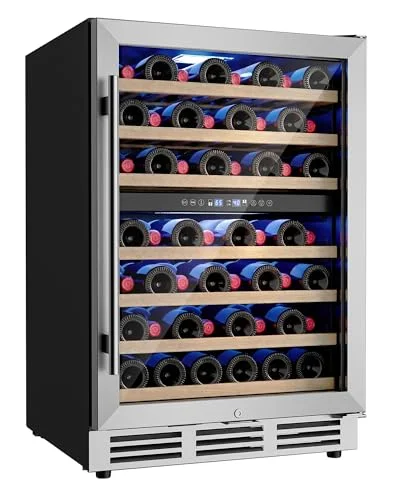
Icyglee 24" Wine Cooler Refrigerator, 54 Bottle Dual Zone
The depth question, honestly: not in the title — check the listing
24-inch width·54 bottles·Dual zone·Silver
The title confirms the width class, the bottle count, the dual-zone configuration and the finish — a cleaner spec sheet than most at this price. What it does not state is depth or installation type. Neither is unusual for this category, but it means you cannot assume this unit is built-in-rated or that its case sits within the standard roughly 24-inch cabinet envelope discussed above. Before measuring it against a tight cabinet run, pull up the listing's own dimensions field rather than estimating from the product photo.
The width is confirmed. The depth is a question only the listing's dimensions tab can answer.
0224" built-in or freestanding
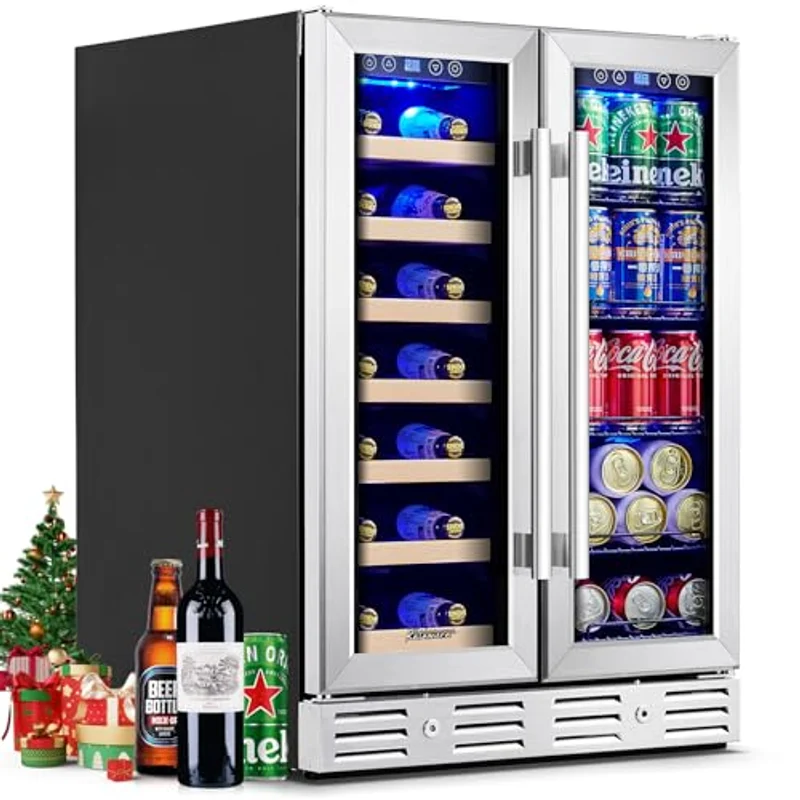
Kalamera 24 Inch Wine Fridge, 21 Bottles and 75 Cans, Dual Zone
Rated for either installation — which changes what depth tolerance to expect
24-inch width·20–21 bottles + 78 cans·Dual zone·Built-in or freestanding
This one is rated for both built-in and freestanding installation, which is the single most useful depth-adjacent fact a listing can give you: a dual-rated unit has to satisfy the tighter of the two constraints, so its case depth was very likely designed to clear a standard cabinet opening even when you run it freestanding. That's a reasonable signal, but it's still not a substitute for the actual number — the dimensions field doesn't publish a depth figure separate from the overall case size here, so measure your cabinet opening's depth, not just its width, before ordering.
Dual-rated for installation is a good sign on depth. It is not the depth number itself.
0324" built-in by name
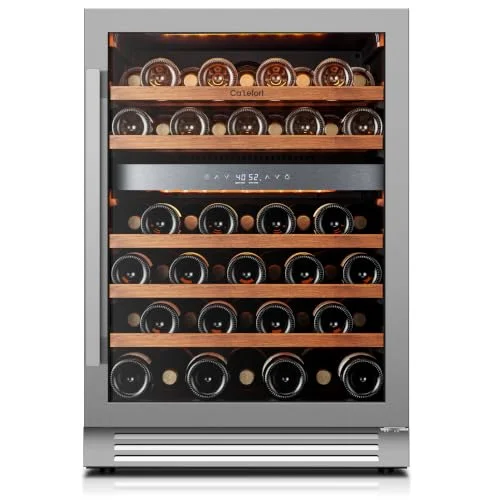
Ca'Lefort 24 Inch Wine Fridge, 51-Bottle Built-In Wine Cooler
"Built-in" is in the product name itself — the strongest depth signal of the three
24-inch width·51–52 bottles·Dual zone (per size variant)·Built-in
Of the three, this is the only one that states "Built-In" directly in the product title rather than leaving installation type to the fine print — and per the earlier logic, a built-in-rated 24-inch unit has the strongest reason of the three to have been designed inside the standard cabinet-depth envelope. The listing's size variant adds "5.65 cu.ft" as a volume figure, which is useful for sizing the interior but is not a substitute for a front-to-back measurement. Built-in status narrows the likely range; it doesn't hand you the number.
"Built-in" in the name is the best depth clue any of these three listings gives you — and it's still a clue, not a measurement.
One more honest note on all three: the prices above move, and so can a listing's stated dimensions as a manufacturer updates its catalog page. If you're shopping on price specifically, our breakdowns of wine fridges between $500 and $600 and the Ca'Lefort comparison against Yeego's 24-inch lineup are worth reading alongside this one — neither changes the depth answer above, but both are useful for weighing price against what each brand actually states in writing.
Measure your own space before you trust a listing photo
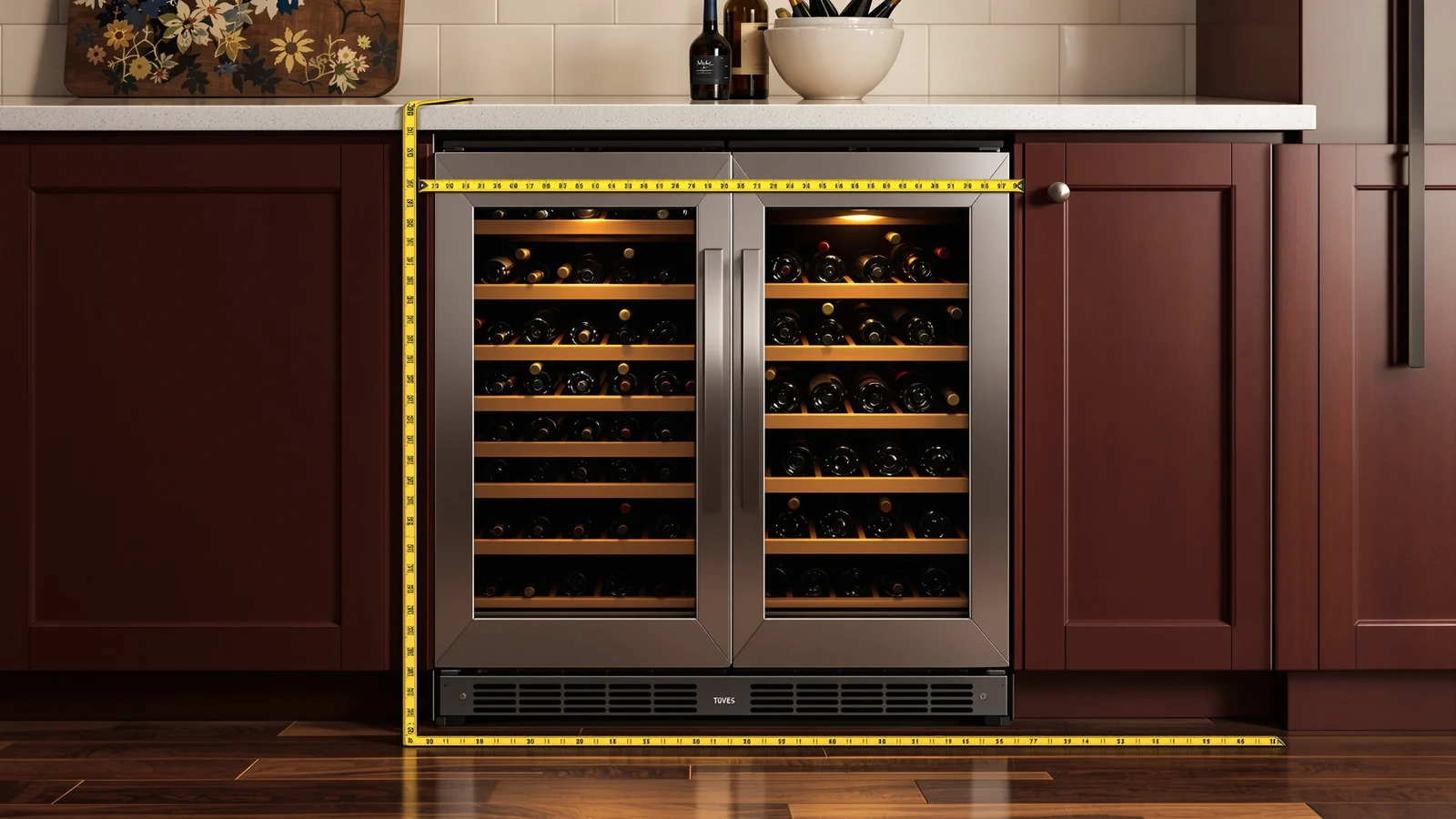
A product photo is staged to flatter the unit, not to communicate its footprint accurately, and a cabinet rendering on a listing page is frequently a stock illustration rather than a to-scale drawing of the specific model. The only reliable fix is to measure the space you actually have and compare it to the number on the dimensions tab, not the picture above it.
- Measure the opening's width, depth and height at the narrowest point, not the widest — a cabinet that looks square can be slightly out of true, and the tightest point is the one that decides whether the unit fits.
- Measure the door's full open swing, not just the closed-door depth. A wine fridge's own door adds meaningfully to its footprint once it's open, and that figure almost never appears on the spec sheet.
- Check what's left of the walkway or aisle once the door is open, especially in a galley kitchen or next to an island, where that leftover clearance is the whole point of the exercise.
- Compare your own numbers to the listing's stated dimensions — specifically the depth figure, and whether it's noted as including the door — rather than estimating from the hero photo.
It's a five-minute task with a tape measure, and it's the only step in this entire guide that actually answers the question for your kitchen specifically, because no listing, however detailed, knows the width of your walkway or how far your pantry door swings.
How we compared this — and what we cannot tell you
We compared the published product titles, size-variant fields and current listed prices for the three units above, and cross-checked each installation-type claim against how it's described elsewhere in the same brand's own listing data. Where a listing states depth, installation type, or any other spec directly, we report it; where it doesn't, we say so rather than estimating from a photo or filling the gap with a typical figure for the category.
We do not run a testing lab. We do not own these three units and we do not physically test them, so you won't find a measured depth figure here that didn't come from the manufacturer's own listing, and you won't find an invented score out of ten. You also won't find a star rating or a review count on this page: the retailer data we use does not return those figures for this category, and paraphrasing review sentiment we don't actually have would be the same kind of invention as making up a number. What we can do honestly is read each listing's stated specifications carefully, flag exactly where they go quiet, and tell you where to look next.
Frequently asked questions
If a wine fridge's title says "24 inch," does that include the depth?
No. The number in a wine fridge title is almost always the width — the measurement that has to match a standard cabinet opening side to side. It does not describe how far the unit projects front to back. The actual depth, when a listing states it at all, lives in the product dimensions field, not the title.
What's a typical depth for a 24-inch built-in wine fridge?
There isn't one reliable industry-wide figure we can state, because depth varies by brand and model and few listings publish it prominently. What we can say in general terms is that standard base cabinets run close to 24 inches deep with the countertop overhanging slightly beyond that, and a built-in-rated wine fridge is generally designed to fit within roughly that envelope. For the exact figure on any specific unit, check that listing's own dimensions field rather than assuming a category average.
Do freestanding wine fridges stick out further than built-in ones?
Often, though not always. A freestanding unit isn't designed to match a cabinet opening's depth, so its manufacturer has more latitude to make the case deeper if that suits the shelving or compressor layout. A built-in-rated unit has a practical incentive to stay within the standard cabinet-depth envelope, since that's the opening it's built to install into. Installation type is a useful first signal, but it's not a guarantee — always confirm the stated depth for the specific model.
How do I know if a wine fridge will clash with an island overhang or a nearby doorway?
Measure the actual space, not the listing photo: the opening's width, depth and height; the fridge door's full open swing, not just its closed depth; and whatever clearance is left in the walkway or aisle once that door is open. Compare those numbers to the listing's stated dimensions, including whether the depth figure includes the door. Photos and renderings on listing pages are for illustration, not for measurement.
Written by Ilane Tall. Research-based comparisons of published specifications and current prices — we do not physically test these units and we do not publish invented scores.