By Ilane Tall · Updated November 19, 2026 · Research-based.
Reader-supported: we may earn a commission when you buy through the links on this page, at no additional cost to you. It never changes which product we recommend. Prices quoted below were correct at the time of writing and move often.
Quick answer
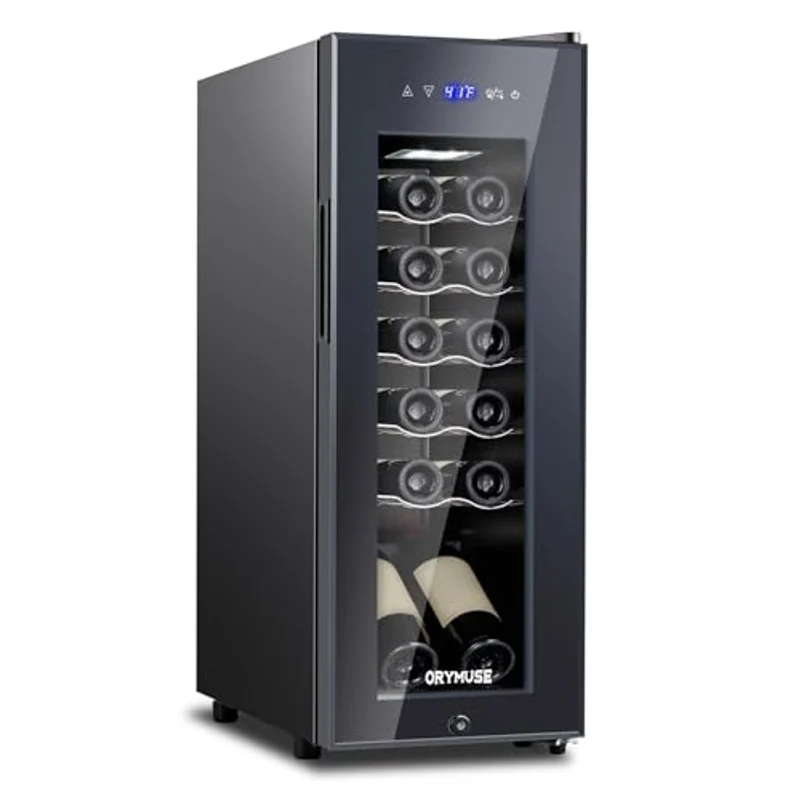
Sulfites are added to conventional wine partly as a chemical buffer against oxidation, and natural and low-sulfite bottles are made with less of that buffer by design. That leaves the storage conditions doing more of the work a preservative would otherwise handle, which is why a steady single setpoint under 60°F matters more here than a wide dual-zone range built for serving two colors at once. Our pick is the ORYMUSE 12 Bottle Mini Wine Fridge at $219.99 — a freestanding compressor cooler, the one unit here whose listing states compressor cooling outright, with a lock and a single 41–64°F zone you can park at 55°F and leave alone.
All three picks below are single-zone, countertop-sized units, which is the right shape for this use: a small natural-wine rotation rarely needs two temperatures, and the fewer moving parts a cabinet has, the fewer places a setpoint can drift. If your bottles are meant to sit for years rather than a season, read what a home cabinet still can't do before you count on one for long-term aging.
Why a lower-sulfite bottle has less room for error
Sulfur dioxide (SO₂) does two jobs in a bottle of wine: it suppresses unwanted microbial activity, and it acts as an antioxidant, mopping up the oxygen that would otherwise react with the wine's pigments and aromatics over time. Conventional winemaking generally adds enough SO₂ to give the finished bottle a meaningful cushion against both problems. Natural and low-sulfite wine is defined by deliberately skipping most or all of that addition, which is the entire point of the category for the winemakers who make it and the drinkers who seek it out — but it also means the bottle is carrying less of its own chemical insurance against the two things that damage wine fastest: heat and light.
Heat accelerates almost every chemical reaction happening inside a closed bottle, oxidation included, and a wine with less antioxidant buffer has less margin before that acceleration shows up as a "cooked" or flat character. Light, particularly the UV end of the spectrum, drives a related set of reactions that can produce off-putting sulfur-adjacent aromas in white and sparkling wine especially — a problem conventional winemaking also fights partly with sulfites, and one a low-sulfite bottle is again less equipped to resist on its own. None of this is a reason to treat natural wine as fragile or precious. It is a reason to treat the box it lives in as doing a slightly bigger share of the preservation work than it would for a heavily sulfured bottle from the supermarket shelf, which is the entire premise of this guide.
One steady setpoint is the right tool here, not a compromise
A dual-zone wine fridge exists to solve a specific problem: serving a cold white and a cellar-temperature red from the same cabinet at the same time, without an ice bucket. That is a real convenience for a mixed, drink-tonight collection, and it is also a feature that does nothing for a natural-wine rotation built around one storage goal — holding a steady number until the bottle is opened. A single zone set once and left alone has one thermostat, one setpoint and nothing managing a second compartment against the first, which is fewer places for a number to drift away from where you put it.
It is also the honest fit for the sizes involved. All three cabinets in this guide hold 12 to 25 bottles, a range built for a rotating stock you are actively drinking through rather than a long-term archive split by color. A compact countertop cooler sized for a desk, a kitchen counter or a small bar — the same class covered in our guide to wine fridges for a home office or desk — gets more usable capacity and a simpler control panel by skipping the divider a dual-zone unit needs, and that capacity matters more at this size than the ability to park two bottles at two different temperatures.
Keep it below 60°F, and away from a sunny kitchen window
The cabinet does half the job; where you put it does the other half. A wine fridge set correctly but placed on a counter that gets direct afternoon sun is fighting two heat sources at once — the ambient air in the room, and solar gain straight through the glass door onto the bottles themselves, which is a more direct and more damaging exposure than the room's overall temperature. All three units here use a glass door for visibility, and the Icyglee specifically lists a double-paned, UV-resistant pane as a feature against that exact problem; the Antarctic Star's listing describes a reinforced, air-tight glass door but does not make the same UV claim, so treat that one as more light-exposed and keep it further from a window as a result.
Setpoint matters as much as placement. All three cabinets here cover a range that reaches below 60°F — the ORYMUSE and Icyglee both quote roughly 40–41°F up to 64°F, and the Antarctic Star quotes 40–61°F — which means any of them can be set in the mid-50s and left there, well clear of the 60°F ceiling worth treating as a hard line for a bottle with less buffer protecting it. If the room the cabinet sits in runs warm — a kitchen near a range, an office with afternoon sun, a garage in summer — the setpoint has to work harder to hold that number, which is exactly the scenario the next section is about. For cabinets that genuinely have nowhere cooler to go in a cramped kitchen, our guide on where to put a wine fridge when your kitchen has no room covers the hallway, closet and under-stair spots that keep a unit out of direct light without needing a dedicated cabinet cutout.
Why compressor cooling is worth paying for here
Thermoelectric cooling has no compressor and no moving refrigerant — it uses a solid-state plate to pull heat out of the cabinet, which makes it quiet and vibration-free, but it can only cool to roughly 20°F below whatever temperature the room already is. Set it in a 75°F kitchen and it tops out somewhere in the mid-50s on a good day; let that kitchen warm into the 80s over a long afternoon and the cabinet warms right along with it, because a thermoelectric unit does not hold a number against the room — it offsets the room by a roughly fixed amount. A compressor-cooled cabinet works the opposite way: it cycles on and off to hold its setpoint against whatever the room is doing, the same basic mechanism as a kitchen refrigerator, which is why its duty cycle stays stable while a thermoelectric unit's output rides up and down with the ambient air around it.
For a bottle with less sulfite buffer, that difference is the whole argument. A wine that already has less chemical cushion against heat is the wrong bottle to trust to a cooling method whose own ceiling moves with the room. Of the three units in this guide, the ORYMUSE 12 Bottle states this directly — its listing calls out "quiet compressor cooling" by name — which is the detail to look for on any similar listing before buying. The Icyglee and Antarctic Star listings describe a working temperature range and a digital control panel, but neither one states the cooling technology behind it in the features we could verify, so we are not asserting compressor or thermoelectric for either — that is a question worth putting to the seller directly, or confirming on the full spec sheet, before you count on either cabinet to hold a number through a warm afternoon.
The detail worth hunting for on any listing: the word "compressor." A genuinely compressor-cooled unit tends to say so, the way the ORYMUSE listing does, because it is a feature worth advertising. If a listing describes only a temperature range and a digital display with no mention of the cooling method, do not assume compressor — ask, or check the full spec sheet, before you plan on it holding a setpoint through a hot room.
Shelf orientation: lying flat regardless of closure type
Horizontal racking — bottles lying on their side rather than standing upright — is the default shelf layout in all three cabinets here, and it earns its place for reasons that apply whether a bottle is sealed with a traditional cork or one of the alternative closures natural winemakers often reach for instead, including crown caps, screwcaps and glass stoppers chosen partly to sidestep cork-related faults. For a corked bottle, lying flat keeps the cork in contact with the wine, which stops it from drying out and shrinking away from the glass — the classic argument for horizontal storage. For a bottle under a crown cap or screwcap, that particular mechanism does not apply, since the seal has nothing to do with moisture contact, but the layout still earns its keep on space alone: horizontal racks let a cabinet nest bottles neck-to-shoulder in rows, which is how a 1.3-to-1.4-cubic-foot cooler fits 12 bottles at all, and it keeps labels facing out and readable from the glass door instead of hidden on top of a standing row.
The one caution worth building in before you buy: natural wine bottles are notoriously inconsistent in shape and shoulder height, often more so than the standard Bordeaux profile a manufacturer's bottle-count rating is calculated against. A 12- or 25-bottle rating on any of these listings assumes a fairly uniform bottle shape, and a mixed case of natural wine from different producers will rarely rack as neatly as the number on the box suggests. Our guide to why a wine fridge's advertised bottle count rarely matches what actually fits goes through that gap in detail — worth a read before you assume a 25-bottle cooler will hold 25 bottles of whatever idiosyncratic natural wine is already in your fridge.
The picks
All three are freestanding, countertop-sized, single-zone units — the right shape for a rotating natural-wine stock rather than a mixed, two-color cellar. The differences between them are cooling technology as stated on the listing, capacity, and price.
01Best overall
ORYMUSE 12 Bottle Mini Wine Fridge with Lock
The one listing here that states compressor cooling outright
12 bottles / 1.4 cu.ft·Single zone·Compressor·41–64°F, lock
This is the cabinet built around the exact argument this guide is making. ORYMUSE's own listing calls out "quiet compressor cooling" by name, which means it is designed to hold its setpoint against the room rather than offset it — the detail that matters most for a bottle with less sulfite buffer protecting it. The digital panel covers 41–64°F, wide enough to set and leave at 55°F, well under the 60°F ceiling worth treating as a limit. A built-in cylinder lock is a genuine extra at this size, worth having if the cabinet sits somewhere other than a private kitchen, and the 10.7-inch width keeps it to a true countertop footprint. Twelve bottles is a modest rotation, but it is twelve bottles held at one number you can trust the cabinet to actually hit.
The pick if "will it actually hold the setpoint" is the question you care about most.
02Most capacity
Icyglee 25 Bottle Wine Cooler Refrigerator
The largest rotation of the three, with a UV-resistant door
25 bottles·Single zone·40–64°F·Double-paned, UV-resistant glass
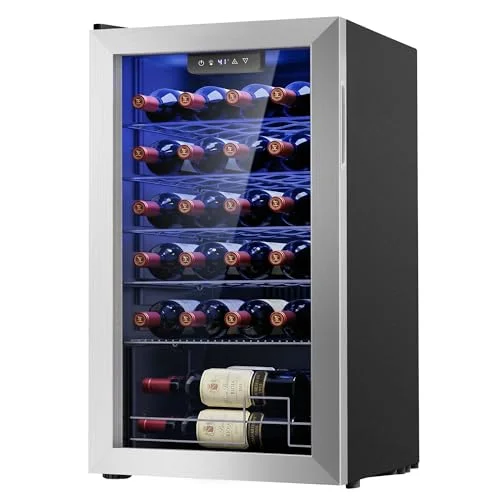
More than double the capacity of the other two picks in a cabinet still sized for a kitchen counter or bar top, with adjustable shelves and a stated 40–64°F digital range that reaches comfortably below the 60°F line. The double-paned, UV-resistant glass door is the one feature on this listing that speaks directly to the light-exposure half of this guide's argument — it is explicitly built to block the UV component of light that a bottle with less sulfite buffer is worse equipped to shrug off. What the listing does not state is the cooling technology behind that range, so we are not calling this one compressor or thermoelectric; if that distinction matters to you as much as it should for a low-sulfite rotation, confirm it on the full spec sheet or with the seller before ordering.
The capacity leader, with one open question worth closing before you buy.
03Lowest price
Antarctic Star 12 Bottle Wine Cooler
The entry point, with the same caveat as the pick above
12 bottles / 1.3 cu.ft·Single zone·40–61°F·Clear glass door, blue LED
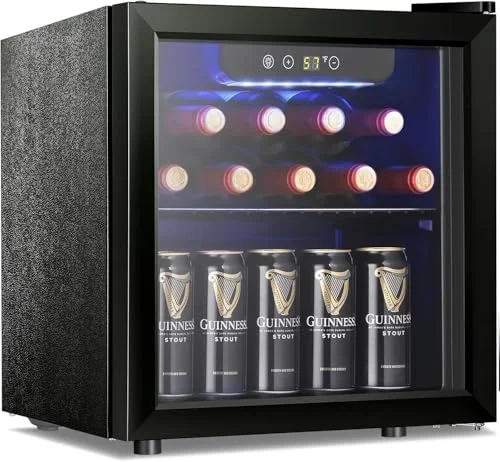
At $122.82 this is the least expensive way into a dedicated cabinet for a small natural-wine rotation, with horizontal racking for 12 bottles in 1.3 cubic feet and a 40–61°F digital range — narrower at the top than the other two picks, but still wide enough to set near 55°F and stay well clear of 60°F. The glass door is described as reinforced with an air-tight seal, but the listing does not make a UV-blocking claim the way the Icyglee's does, so treat this one as more light-sensitive and keep it further from any window than you otherwise might. As with the Icyglee, the cooling technology is not stated in the listing we could verify — a reasonable trade at this price, but worth confirming directly if a warm room is a real possibility where this will sit.
The right call on price alone, as long as it lives somewhere the room stays cool and dim.
What still needs a wine shop's cold storage, not a home cabinet
Everything above is about a cabinet that holds a rotating stock of bottles you expect to open within the next several months — which describes most natural and low-sulfite wine, since a lot of it is made to be drunk relatively young rather than cellared for a decade. A 12-to-25-bottle countertop cooler, run at a steady setpoint away from light, is a genuinely good fit for that use.
It is not a substitute for a wine shop's dedicated cold storage if what you actually have is a handful of library bottles meant to sit for years rather than months — an early, more experimental low-sulfite release you are curious to see age, or a producer's bottle you want to hold for a special occasion well down the road. A specialist cold room is built for that timeline specifically: steadier long-run temperature than a compressor cycling in a kitchen that itself swings with the seasons, essentially no vibration, zero light, and often humidity control a home cooler's small footprint was never designed to manage. A kitchen counter cooler also gets its door opened constantly as you rotate bottles in and out — fine for wine you are drinking soon, a real source of temperature and light exposure for a bottle you are trying to leave alone for years.
The practical split: if a bottle is part of what you are actively working through this season, any of the three picks above does the job well. If it is a bottle you specifically do not want to touch for a long stretch, a wine shop's or merchant's paid cold storage service is the more honest answer than asking a countertop compressor to do a decade of undisturbed, climate-controlled aging on top of its regular job. If your real need is simply more everyday capacity rather than archival storage — a bigger rotation, not a longer hold — our guide to wine fridges between $500 and $600 covers the 24-inch, higher-capacity cabinets that category calls for instead of a second countertop cooler.
How we compared these — and what we cannot tell you
We compared the published titles, feature lists, temperature ranges and current prices for these three units, reading each listing specifically for what it does and does not state about cooling technology and light protection — the two questions this guide turns on. Where a listing named compressor cooling or a UV-resistant door outright, we said so; where it did not, we said that too, rather than assuming one brand's silence meant the same thing as another's.
We do not run a testing lab, we do not own these units, and we have not measured how any of them actually perform against a low-sulfite bottle over time — so you will not find a numeric oxidation or light-exposure score on this page, because no such verified figure exists for these products. Sulfite chemistry and the general effects of heat and light on wine are established, widely documented facts about wine itself, not claims about these specific coolers. What we can do honestly is explain that background, read each listing for what it confirms, and flag plainly where a spec is simply not stated rather than fill the gap with a guess. None of these listings currently carry a published rating or review count we can source, so none appears here — a star rating we could not verify is the same offense as a testing claim we did not run.
Prices quoted here were correct at the time of writing and change frequently. Confirm the current price, and the cooling technology if it matters to you, directly on the listing before ordering.
Frequently asked questions
Does natural or low-sulfite wine really need a dedicated wine fridge?
Not strictly, if you are drinking it within a few days of buying it — a kitchen fridge or a cool pantry shelf is fine for the short term. The case for a dedicated cabinet grows with how long a bottle sits before you open it: a kitchen that swings between a cold fridge and ambient room heat, or a pantry shelf near a window, gives a lower-sulfite bottle more heat and light exposure over weeks than a cabinet held at one steady number in the mid-50s.
Single zone or dual zone for a natural wine rotation?
Single zone, in almost every case. Dual zone exists to serve a cold white and a cellar-temperature red from one cabinet at once, which is a serving convenience, not a storage upgrade. A natural-wine rotation generally wants one steady storage number rather than two serving temperatures, and a single zone gets there with fewer parts that can drift.
Is a thermoelectric cooler ever fine for this?
Only if the room it sits in stays reliably cool — thermoelectric cooling pulls roughly 20°F below the ambient temperature and no further, so its ceiling rises and falls with the room instead of holding a fixed number. For a bottle with less sulfite buffer against heat, that ambient-dependent swing is the opposite of what you want, which is why this guide favors compressor cooling where a listing confirms it.
What if I have a few bottles I actually want to age for years, not months?
Treat those separately from your everyday rotation. A countertop compressor cooler is built for a stock you are actively drinking through, opened often, with the door cycling regularly — not for undisturbed, multi-year aging with humidity control, which is what a wine shop's or merchant's paid cold storage is actually designed to provide. Keep the fast-moving bottles in the cabinet and the true library bottles somewhere built for the long hold.
Written by Ilane Tall. Research-based comparisons of published specifications and current prices — we do not physically test these units and we do not publish invented scores.