By Ilane Tall · Updated November 22, 2026 · Research-based.
Reader-supported: we may earn a commission when you buy through the links on this page, at no additional cost to you. It never changes which product we recommend. Prices quoted below were correct at the time of writing and move often.
The short version
A thin, even layer of frost on the rear interior wall after a humid stretch or a run of entertaining is normal condensation meeting the coldest surface in the cabinet, not a fault.
Ice that keeps thickening, or shows up on a shelf or the cabinet floor instead of the back panel, points to something specific: blocked drainage, poor airflow clearance, or most often a worn door gasket feeding the cabinet a constant trickle of humid air.
Manual defrosting resets the cabinet, but it's a reset, not a cure. If the same ice is back within a week or two, stop defrosting and call for service instead.
In almost every compressor-based wine fridge, the evaporator — the coil that does the refrigeration work — sits directly behind a flat panel forming the rear interior wall. That panel is the coldest surface inside the cabinet, routinely several degrees colder than the air temperature you've set. Moisture in the air that touches it condenses, and once the panel is cold enough, that condensation freezes in place instead of beading up and running off.
Two things decide how much moisture reaches it: how humid the cabinet's air is, and how often that air gets replaced from the room. A unit in a damp basement or humid coastal climate pulls in wetter air every time the door opens than the identical model in a dry room — our guide on where to put a wine fridge when your kitchen has no room covers which overlooked spots run drier. Door-opening frequency matters just as much: a cabinet opened once a day sees a fraction of the exchange of one opened five or six times for a dinner party, which is why frost often thickens after a stretch of entertaining with nothing about the fridge itself having changed.
Put plainly: a thin, even, frost-white coating across the rear panel after a humid week, or heavier door use, is the cabinet behaving exactly as designed — condensation meeting a cold surface, not a malfunction.
Automatic defrost cycles: what they do, and how to tell if you have one
An automatic defrost cycle periodically pauses the compressor and briefly warms the evaporator panel — usually with a small heating element triggered by a timer or sensor — just long enough to melt accumulated frost. The meltwater runs down a drain channel into a shallow pan near the compressor, where the compressor's own waste heat evaporates it off. Done well, an owner never notices anything beyond an occasional short pause in the usual hum.
Not every wine fridge has this. Household refrigerators have run automatic defrost as standard for decades, but wine fridges — especially smaller or more affordable compressor models — often use a simpler "static cooling" design with no defrost heater, relying on the owner to clear frost by hand.
The only reliable way to know which design you own is the listing or manual for your model. The Yeego 24" 52 Bottle Dual Zone referenced later states automatic defrost directly — worth checking for on any dual-zone unit, since two cooled compartments mean two evaporator surfaces that can each build frost on their own schedule. Neither the Yeego 46 Bottle nor the Icyglee 15" dual-zone unit here lists a defrost feature; check the manual rather than assume, and treat those as static-cooling until confirmed otherwise. A practical test: frost that stays roughly level over months unattended means you're likely cycling automatically; frost that keeps visibly building means a static-cooling design, or a failed automatic defrost.
Ice on a shelf or the floor instead of the rear wall: what that location means
Frost on the back panel is the pattern above. Ice turning up anywhere else — a shelf, the inside of the glass door, or especially the floor — is usually meltwater behaving badly rather than fresh condensation freezing where it lands.
Floor ice almost always means blocked drainage, not cooling: a small channel at the base of the rear panel normally carries meltwater to the drip pan, and if it's blocked by a cork crumb, dust, or leftover ice chips, water pools on the floor and refreezes — which is why it keeps reappearing in the same spot.
Shelf ice usually means that shelf sits close enough to the evaporator or circulation fan to act as a second cold surface, most often because bottles are loaded too tightly against the back wall; an inch or two of clearance usually fixes it. Ice on the inside of the door points forward to the gasket problem below.
The short version: rear wall means a normal condensation cycle, floor means blocked drainage, a shelf means airflow clearance, the door means a seal.
The usual suspect behind runaway ice: a worn door gasket
When frost keeps growing rather than clearing on its own cycle, the single most common cause is a worn, compressed, or torn door gasket — the rubber seal around the inside edge of the door.
A compromised gasket doesn't just let in a burst of air the way opening the door does; it creates a continuous, low-grade leak that feeds humid room air into the cabinet around the clock, door opened or not. The compressor and any defrost cycle are sized to handle normal door-use humidity, not a 24-hour drip of damp air, so frost accumulates faster than the system was designed to clear and never catches up. That's the difference between a little frost and ice that's visibly worse every week.
Checking a gasket takes two minutes and no tools: close the door on a strip of paper — a dollar bill works fine — then pull it out. A good gasket resists noticeably; if the paper slides out with little resistance, especially near the hinge corners, the seal has lost its grip. Look for rubber that's gone flat, cracked, or stiff, or a door that's slightly bowed and no longer sits flush, more common on glass doors that have spent years catching direct sun.
Gaskets are a wear item, not a design flaw, and most manufacturers sell a replacement on its own — often cheaper than replacing the cabinet. If you're unsure what your model's coverage looks like before shopping for a part, our guide to wine fridge warranties and return policies covers what's typically included.
Manual defrosting: when it's worth it, and how to do it without ruining the wine
Manual defrosting is worth doing when the unit has no automatic defrost cycle, or when frost has clearly outpaced whatever cycle it does have. Once frost on the rear wall passes roughly a quarter inch, it insulates the evaporator from the air it's cooling — the compressor runs longer and louder to hold the setpoint, and past a certain point can't reach it at all. At that stage, defrosting is a reset the system needs, not optional. It's also worth doing before diagnosing a gasket or drainage issue, so you're inspecting a clean cabinet instead of guessing under a sheet of ice.
Here's how to do it without putting the wine at risk:
- Move the bottles out first — a box, an insulated bag, or any other cool, dark spot. A few hours at room temperature won't meaningfully damage wine stored correctly the rest of the year; what harms wine is sustained heat and light over weeks, not an afternoon off.
- Unplug the unit at the wall rather than the control panel, so the compressor and any defrost heater genuinely stop drawing power. If that outlet is awkward to reach or shares a circuit with other appliances, our guide to wine fridge electrical requirements covers what to expect from it.
- Prop the door open and line the floor with towels — more water comes off a frosted panel than expected.
- Let it melt on its own rather than chipping or prying at it with a knife or hard tool; the refrigerant tubing usually runs directly behind that panel, and puncturing it turns a frost problem into a dead compressor. A bowl of warm (not boiling) water inside, or a hair dryer on a low, cool setting held well back, safely speeds up the hour or two it usually takes.
- Dry the panel and drain channel completely once clear — a damp channel is how floor ice comes back within days.
- Plug it back in and wait two to three hours to reach setpoint before reloading the wine, so bottles go into stable cold air rather than a cabinet still pulling down from room temperature.
The picks used in this guide
The three fridges referenced above, chosen to show how the defrost question plays out across capacity, zone count, and price.
01States automatic defrost
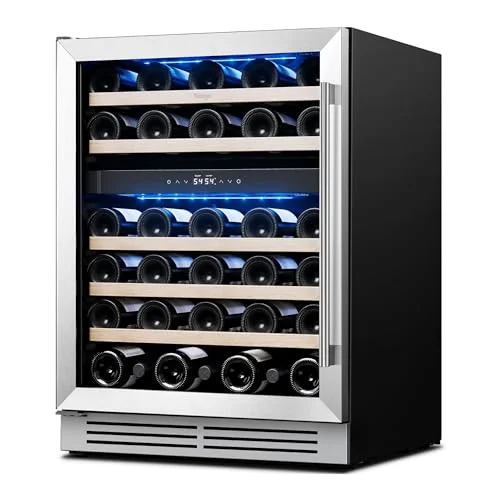
Yeego 24" 52 Bottle Dual Zone
The one to check first if you'd rather not think about defrosting
52 bottles·Dual zone·Automatic Defrost·40–65°F
The only one of the three whose listing states automatic defrost by name — worth paying attention to on a dual-zone unit, since two independently cooled compartments mean two evaporator surfaces that can each build frost on their own schedule. Glass door, adjustable shelves, 24-inch footprint for an under-counter opening or freestanding use.
The specification to look for if you want one less thing to maintain.
02Budget capacity
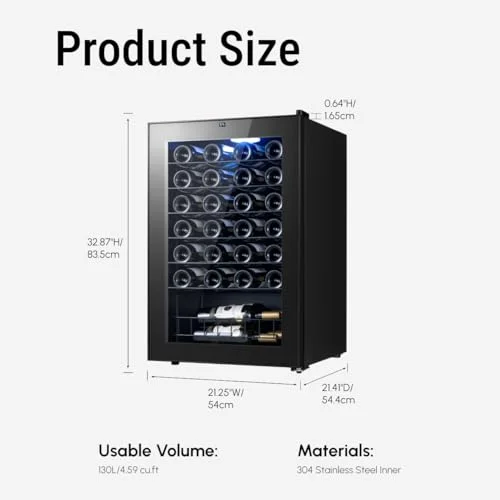
Yeego 46 Bottle Wine Fridge
Real capacity at an affordable price — budget for occasional manual defrosting
46 bottles·Touch control·38–65°F·Freestanding
The lowest-cost route to real bottle count here, with touch temperature control and LED lighting. Its listing doesn't call out automatic defrost the way the Yeego dual-zone model above does, so check the manual rather than assume — and build an occasional visual check of the rear panel into owning it, since a static-cooling design relies on you to notice frost before it gets thick.
The affordable route to capacity — just don't forget the rear wall exists.
03Compact dual zone
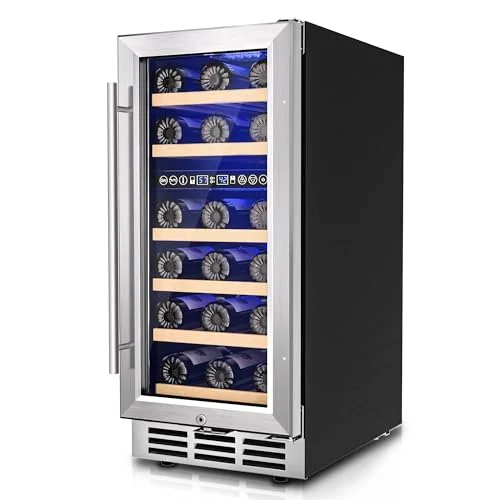
Icyglee 15" 30 Bottle Dual Zone
For a tight undercounter opening, where gasket condition matters most
30 bottles·Dual zone·15" width
A 15-inch footprint puts this in the standard undercounter opening category, exactly the size class where a worn gasket on a long-serving unit tends to show up first — the door gets opened often and the seal does continuous work. Its listing doesn't state automatic defrost, so the same rule applies: confirm against the manual rather than assume, and don't skip the paper-and-door gasket test even on a unit that's only a year or two old.
Compact enough that a bad seal is felt fast — check it accordingly.
When persistent ice means a service call, not another defrost cycle
Manual defrosting is a reset, not a cure — it's easy to fall into a routine of defrosting every month or two and treat that as normal maintenance when it's actually a symptom going unaddressed.
A few signals mean it's time to stop defrosting and get the unit looked at instead:
- Ice reappears within days of a full defrost, despite a gasket that passes the paper test and a drain channel confirmed clear.
- The cabinet can't hold its set temperature even with the door closed and undisturbed, on top of visible ice — that points past the seal to the cooling system itself.
- Frost shows up where a sealed cabinet shouldn't allow it, such as outside the unit around the door frame, usually meaning an insulation failure rather than a simple air leak.
- A unit advertised with automatic defrost — like the Yeego 24" above — stops clearing frost on its own. That generally means the defrost heater, timer, or sensor has failed.
At that point, a technician is the right next step, not another defrost cycle. Before paying for a service call or a part out of pocket, check what the manufacturer actually covers — our guide to wine fridge warranties and return policies covers how long coverage typically runs, and what usually voids it.
How we compared these — and what we can't tell you
We compared published manufacturer specifications and current listed prices for the models referenced here, and anchored the mechanical explanations — evaporator behavior, defrost cycles, gasket wear, drainage — in general refrigeration principles that apply across the category rather than to any single unit's undocumented internals.
We do not run a testing lab. We don't own these units and we don't physically test them, so we can't tell you exactly how many weeks a specific gasket lasts before it needs replacing — that depends on the unit, the room, and how it's used. What we can do is read the specifications carefully, report only what a listing actually states (automatic defrost, here, is only ever claimed for the model that lists it), and explain the mechanism clearly enough to diagnose your own unit rather than guess.
Frequently asked questions
Is some frost on the back wall of a wine fridge normal?
Yes. The rear panel sits in front of the evaporator coil and is the coldest surface in the cabinet, so it's the first place airborne moisture condenses and freezes. A thin layer that doesn't keep visibly growing is the fridge working as designed.
Why does my wine fridge frost up more in summer?
Ambient humidity runs higher in most climates during summer, and doors tend to open more often for entertaining. Both feed more moisture into the cabinet, which means more frost on the next cold cycle.
Can I use a hair dryer to defrost a wine fridge?
Yes, on a low, cool setting held well back from the panel. Avoid a hot setting aimed directly at it, which can warp a plastic interior liner.
Will a few hours without cooling during a defrost hurt my wine?
No, not for an occasional defrost. Wine is damaged by sustained heat and light over weeks, not an afternoon at room temperature while you clear ice. Move the bottles to another cool, dark spot during the process and they'll be fine.
Written by Ilane Tall. Research-based comparisons of published specifications and current prices — we do not physically test these units and we do not publish invented scores.