By Ilane Tall · Updated November 21, 2026 · Research-based.
Reader-supported: we may earn a commission when you buy through the links on this page, at no additional cost to you. It never changes which product we recommend. Prices quoted below were correct at the time of writing and move often.
Quick answer
Most wine fridges, including an 80-bottle compressor cabinet, plug into a standard 15-amp household outlet and run fine on a circuit that's already carrying a few other things. The electrical question only gets serious in three situations: a large cabinet sharing a circuit with other major appliances, an installation near a sink or outdoors where GFCI code applies, and a built-in that's enclosed tightly enough to trap heat. Check the nameplate amperage, check what else is on that circuit, and check whether the outlet is already GFCI-protected before the unit arrives — not after it trips the breaker for the first time.
If you're shopping across sizes, the picks below span the range where the electrical question actually changes: a 33-bottle built-in, an 80-bottle freestanding cabinet, and a 154-bottle tall cabinet.
What a wine fridge actually draws from a standard outlet
Start with the number that makes most of this a non-issue. A standard US household outlet is wired to a 15-amp or 20-amp circuit at 120 volts, which works out to roughly 1,800 watts of continuous capacity on a 15-amp circuit (and code generally treats a continuous load as limited to 80% of that, so around 1,440 watts in practice) — before anything else sharing the circuit is counted. A wine fridge's compressor is a small, intermittent motor, not a space heater. It does not run anywhere near that ceiling.
Nameplate ratings on wine fridges in this category typically fall between about 0.7 and 1.5 amps running, with a brief higher draw — usually 3 to 6 amps — for a fraction of a second when the compressor motor first kicks on. That startup spike is the number that occasionally matters (more on that below), but the steady running draw is small enough that a wine fridge sits comfortably alongside a few lamps, a phone charger, and a television on the same 15-amp circuit without anyone noticing.
This holds across most of the category sold today, including larger compressor units. The nameplate current is what to check — it's printed on a sticker on the back or inside the unit, usually near the compressor compartment or door hinge, and it's the actual number for your specific model rather than a category generalization. If you can't find it on the unit, the listing or manual will have it; don't guess from the bottle count alone, since a tall cabinet and a wide one with the same capacity can carry different compressors.
What a wine fridge does not need, and what nobody should install for one: a dedicated 20-amp or 30-amp circuit "just in case," a hardwired connection, or a 240-volt line. Every unit in this category, at every size we've seen sold for home use, runs on a standard 120-volt household outlet. If a listing or an installer suggests otherwise, that's a red flag worth questioning before you pay for unnecessary electrical work.
When a dedicated circuit starts to matter
The nameplate amperage on an individual wine fridge is small. The circuit it's plugged into is not always so forgiving, and this is where the real-world problems start — not from the fridge itself, but from what it's sharing a breaker with.
A typical kitchen or finished-basement circuit can be shared with a microwave, a coffee maker, a space heater in winter, or — in a wet bar setup — an ice maker and a beverage cooler on the same run. Add up the running amps of everything plugged into one 15-amp circuit (nameplate amps, not wattage divided carelessly) and if it starts approaching 12 amps continuous, you're near the practical ceiling even though no single device looks demanding on its own. The symptom is a breaker that trips intermittently, often when the wine fridge's compressor cycles on at the same moment the microwave or coffee maker is running — which looks like a fridge problem but is actually a circuit-sharing problem.
Cabinet size is a reasonable proxy for when to start paying attention, even though amperage is what actually decides it. A countertop 12-bottle thermoelectric cooler draws so little that circuit sharing is rarely worth thinking about. Once you're in 80-to-150-bottle compressor territory — the size where a cabinet is doing real continuous cooling work, not just taking the edge off room temperature — it's worth walking the breaker panel (or asking an electrician to) and confirming what else shares that circuit before the unit is plumbed into its final spot behind a counter or in a built-in run, where unplugging it to test is no longer a five-second job.
The other situation where a dedicated circuit genuinely earns its keep: a built-in installation where the fridge is the last thing wired on a run that already feeds other kitchen appliances, and where troubleshooting a shared breaker later would mean pulling the unit back out of its cabinet. At that point, running a dedicated 15-amp circuit during a remodel — while the walls are already open — is a small cost for avoiding a much bigger one later. It is a convenience decision, not a code requirement, for the vast majority of residential wine fridges.
The practical test: if the breaker has never tripped and nothing else heavy shares the outlet, you almost certainly don't need to do anything. If it has tripped, the fix is usually moving the fridge to a different circuit or moving something else off the shared one — not buying a smaller fridge.
GFCI near a wet bar, a sink, or outdoors
This is the one electrical question in this category that's genuinely about code, not just convenience, and it's the question a landlord, a home inspector, or a municipal inspector will actually ask.
The National Electrical Code requires GFCI (ground-fault circuit interrupter) protection for outlets serving countertops within a defined distance of a kitchen or wet-bar sink, for outlets in unfinished basements and garages, and for any outlet installed outdoors. A wine fridge itself is not what triggers the requirement — the location of the outlet it plugs into is. If the outlet near your wet bar is within the sink-proximity zone the code defines (commonly measured in feet from the sink edge, with specifics set by local jurisdiction), that outlet needs GFCI protection whether a wine fridge, a blender, or nothing at all is plugged into it.
Three practical situations come up constantly with wine fridges specifically:
- Wet bar with a sink nearby. If the fridge's outlet sits within the code-defined distance of the bar sink, it needs GFCI protection — either a GFCI outlet at that location or a GFCI breaker at the panel feeding it. This is the single most common reason a home inspector flags a wine fridge installation.
- Basement installations. Many jurisdictions require GFCI protection for all outlets in unfinished basement areas regardless of proximity to water. A wine fridge in a basement rec room or storage area may need it even with no sink anywhere nearby — check local code, since this varies more by jurisdiction than the sink-proximity rule does.
- Outdoor and patio installations. Any outlet feeding an outdoor kitchen or patio wine fridge needs GFCI protection and, in most code cycles, a weatherproof, in-use cover rated for the outlet to stay protected while something is plugged in and exposed to the elements. This is also where the compressor's moisture tolerance matters — not every wine fridge is rated for outdoor humidity and temperature swings, a separate question from the electrical one but one that compounds it.
A GFCI outlet is not expensive or disruptive to add — it's a straightforward swap for an electrician, and in many cases a competent DIYer can do it, though pairing it with a new circuit or confirming it's wired correctly for a specific jurisdiction's code is where hiring out starts to make sense. What a GFCI protects against is specifically a ground fault — current leaking to an unintended path, often through moisture — and it will trip faster and more sensitively than a standard circuit breaker. That's a feature near water, not a flaw, even though it can occasionally produce a nuisance trip on an older or slightly degraded appliance cord.
Extension cords and power strips: why the manual says no
Every wine fridge manual we've reviewed across this category says the same thing in roughly the same words: do not use an extension cord or a power strip. It's one of the most consistently ignored instructions in home appliances, and it's ignored because the reasoning isn't obvious from the warning alone.
A compressor motor's startup current spike — that brief 3-to-6-amp jump mentioned earlier — needs a clean, low-resistance path to the wall. A lightweight extension cord, especially a long one or one with thin-gauge wire not rated for the appliance's draw, introduces resistance that the cord's own insulation has to dissipate as heat. Run that repeatedly, every few minutes for years as the compressor cycles on and off, and the failure modes are the cord overheating at the point of highest resistance (often a loose or cheap connector), or the voltage reaching the fridge dipping low enough on each startup spike to stress the compressor's start winding over time — a slower failure that shows up as a compressor that runs hotter and dies earlier, with no single dramatic event to point to.
Power strips carry a second problem on top of the first: many are rated for steady loads well under what even a brief compressor startup spike asks for, and surge-protected strips in particular are not designed to be a appliance's primary power path for years of continuous use. A power strip built for a desktop computer and a monitor is not built for a refrigeration compressor cycling for a decade.
The fix, when the fridge's final location is simply too far from an outlet, is not a longer extension cord — it's moving the outlet. A licensed electrician can run a new outlet to the location for a fixed cost, and that cost is small compared to replacing a compressor that failed early, or compared to the fire risk of an overloaded cord hidden behind a cabinet where nobody checks on it. If the fridge is built into cabinetry, this is also the moment to confirm the outlet sits where the installation instructions specify — usually inside the cabinet cutout itself or in an adjacent accessible compartment, not routed through a hole drilled for a cord to reach a wall outlet across the room.
Built-in installations: permits, inspections, and what's realistic
Plugging a wine fridge into an existing, already-GFCI-compliant outlet is not electrical work that requires a permit anywhere we're aware of — it's exactly like plugging in a toaster. The permit question comes up when a built-in installation involves adding or moving an outlet, running a new circuit, or doing anything inside a wall or cabinet that a kitchen remodel typically involves.
Realistically, here's how that breaks down:
- Existing outlet, no electrical changes. No permit needed. Confirm the outlet is accessible for the installed unit (most built-in wine fridges still need the plug reachable for service, even once the cabinetry is closed up) and that it meets GFCI requirements if the location calls for it.
- New outlet or new circuit added during a remodel. This is electrical work, and in most US jurisdictions, adding a new branch circuit or relocating an outlet does require a permit and an inspection — the same as it would for any other kitchen appliance. Many homeowners skip this step because a wine fridge feels minor compared to range hoods and dishwashers in the same remodel, but if an electrician is already pulling a permit for the larger project, folding the wine fridge's circuit into that same permit costs little extra and avoids an unpermitted-work problem showing up at resale.
- DIY electrical work with no permit. We'd steer away from this specifically for anything involving a new circuit, GFCI wiring, or work near a water source. A mis-wired GFCI that fails to trip when it should is a safety device that only matters the one time it's needed — not a place to guess.
A practical note that applies whether or not any new wiring is involved: a wine fridge rated as "built-in" is designed to vent through the front, through a grille, so it can tolerate being enclosed on the sides and back. A fridge not rated for built-in use needs airflow at the back and should never be enclosed, regardless of what the electrical side of the installation looks like — a unit that overheats because it can't vent will draw more current as the compressor works harder and runs longer, which brings the electrical and ventilation questions back together even though they start out separate. Our guide to wine fridge depth and cabinet clearance covers the physical side of that in more detail.
The picks, across the sizes where the electrical question changes
Three cabinets at three points on the scale where the questions above actually shift — from "plug it in and move on" to "check the circuit first."
01Smallest draw, easiest install
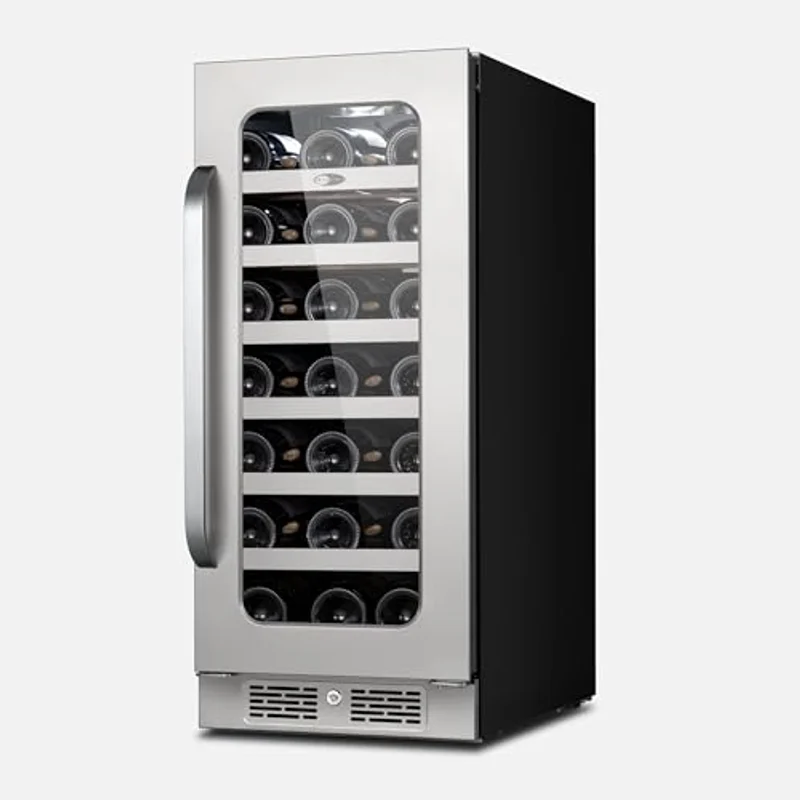
Whynter BSR-033SW 15" Built-In
33 bottles, built-in rated, lowest electrical complexity of the three
33 bottles·Single zone·Compressor·Built-in or freestanding
At this capacity, the electrical side of a built-in installation is close to a non-event: a standard household outlet, no special circuit, and because Whynter rates this specifically for built-in use with front venting, it won't run hotter — and won't draw harder — from being enclosed in a 15-inch cabinet opening the way a non-rated freestanding unit would. The one thing worth confirming before the cabinetry closes up: that the outlet inside the cutout is reachable for service and, if it's near a wet bar sink, that it's GFCI-protected.
The size where the electrical questions in this guide are mostly academic.
02Where circuit-sharing starts to matter
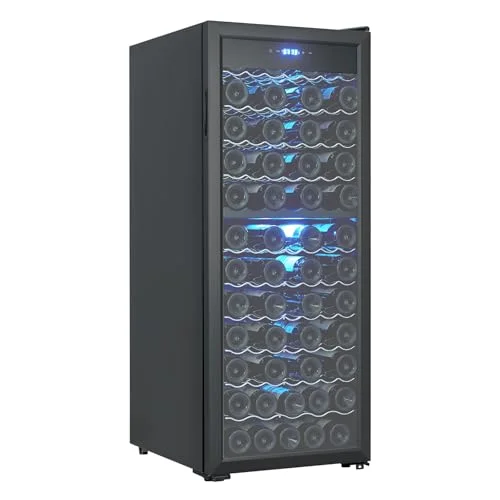
GarveeHome 80 Bottle Compressor
80 bottles, freestanding, the size where checking the breaker is worth the five minutes
80 bottles·Compressor·41–64°F range·Freestanding
Still a standard 120-volt plug and still well inside what one household circuit can carry on its own — but at 80 bottles this is a cabinet running its compressor more continuously than a small countertop unit, and it's the size where it's worth knowing what else shares the circuit it's plugged into, especially if it's landing in a kitchen or bar area already feeding a microwave or an ice maker. It's freestanding, so it also needs clearance at the back for airflow — enclosing it would make the compressor work harder and draw more, compounding whatever circuit load is already there.
Not a demanding appliance electrically — but the first size where it's worth a two-minute check of the breaker panel.
03Largest here, dedicated circuit worth considering
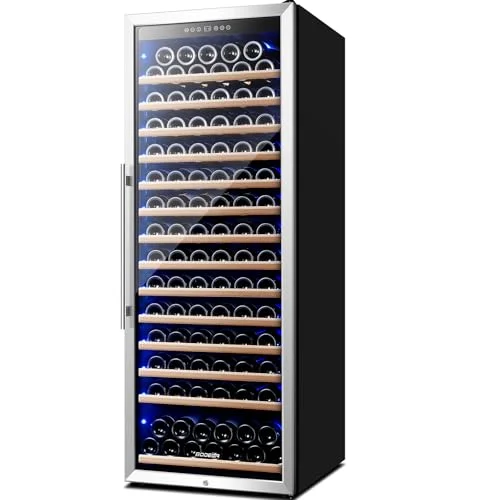
BODEGA 24" 154 Bottle
154 bottles, tall freestanding cabinet, the clearest case for a conversation with an electrician
154 bottles·Compressor·Intelligent temperature memory & humidity control·Freestanding
This is the largest cabinet in this guide, and the one where a dedicated circuit moves from "nice to have" toward "worth asking the question" — particularly if it's going into a finished basement, garage, or bar area that's sharing wiring with other appliances. Still a standard household plug, not a special voltage or amperage, but the compressor here is sized for a tall, large-capacity cabinet and runs for longer stretches than a small unit's does. If this is landing somewhere during a remodel where walls are already open, that's the moment to ask about a dedicated 15-amp line.
Nothing about the plug is unusual — the circuit it shares with is where the planning actually happens.
When to just call an electrician instead of guessing
Most of this guide describes situations a homeowner can resolve by reading a nameplate and counting what's on a circuit. A few situations are worth paying for a licensed opinion rather than guessing:
- The breaker has already tripped more than once. Repeated trips mean the circuit is genuinely overloaded or something is wrong with the wiring — not a problem to work around by resetting the breaker and hoping.
- The installation is near water and you're not certain whether GFCI protection is already in place. Testing a GFCI outlet is simple (most have a test button), but confirming whether a non-GFCI outlet near a sink actually needs one under your specific local code is a five-minute question for an electrician and a genuine safety question otherwise.
- Any new circuit, any outlet relocation, or anything behind a wall or inside a cabinet during a remodel. This is the work that needs a permit in most jurisdictions regardless of how simple it looks, and it's the work where a mistake is expensive to find later.
- An outdoor or patio installation. Outdoor electrical work combines GFCI requirements, weatherproofing requirements, and code variation by jurisdiction — enough variables that a local electrician who knows the applicable code is worth the call rather than assuming a generic answer applies.
- The fridge's nameplate amperage seems unusually high for its size, or the manual specifies a dedicated circuit rather than recommending one. Take the manufacturer's stated requirement as the floor, not a suggestion to negotiate down from.
None of this is intended as a substitute for the specific code in your jurisdiction, which varies by state and sometimes by municipality, particularly around GFCI distance requirements and basement rules. It's a map of the questions worth asking before the unit is installed, not after.
How we compared these — and what we cannot tell you
We compared published manufacturer specifications — nameplate amperage where listed, capacity, cooling type and installation rating — against general National Electrical Code provisions for GFCI protection and circuit loading that apply broadly across US residential installations. We did not physically test any unit's electrical draw, and we do not own these cabinets.
Electrical code varies by state and municipality, and a licensed electrician familiar with your local code is the authority on any specific installation — this guide is meant to help you ask the right questions, not to replace that conversation. Prices quoted here were correct at the time of writing and change frequently; confirm the current price before buying.
Frequently asked questions
Can I plug a wine fridge into a regular household outlet?
Yes, for essentially every residential wine fridge sold today, including large 80-to-150-bottle compressor cabinets. These run on standard 120-volt power and draw a small enough current that a dedicated circuit is rarely required — check the nameplate amperage on your specific unit to confirm, and check what else shares that circuit if the cabinet is large.
Does my wine fridge need a GFCI outlet?
Only if its location falls under a GFCI requirement in your local electrical code — typically outlets near a kitchen or bar sink within a specified distance, outlets in unfinished basements or garages, and any outdoor outlet. The wine fridge itself doesn't trigger the requirement; the outlet's location does. If you're unsure whether your installation location qualifies, a licensed electrician can confirm against your local code in a few minutes.
Why does the manual say not to use an extension cord?
A compressor's brief startup current spike needs a clean, low-resistance path to the wall. A lightweight or long extension cord adds resistance that generates heat at connection points and can stress the compressor's start winding over repeated cycles for years, shortening its life. If the final location is too far from an outlet, the fix is having an electrician add an outlet there, not extending the cord.
Do I need a permit to install a built-in wine fridge?
Not if you're plugging into an existing, code-compliant outlet with no new wiring — that's no different from plugging in any other appliance. A permit typically becomes necessary if the installation involves adding a new circuit, relocating an outlet, or other electrical work inside a wall or cabinet, which is common during a larger kitchen remodel. Check with your local building department if you're unsure which category your project falls into.
Written by Ilane Tall. Research-based comparisons of published specifications and current prices — we do not physically test these units and we do not publish invented scores.