By Ilane Tall · Updated November 28, 2026 · Research-based.
Reader-supported: we may earn a commission when you buy through the links on this page, at no additional cost to you. It never changes which product we recommend. Prices quoted below were correct at the time of writing and move often.
Quick answer
A vacation home fridge needs to survive weeks of nobody checking on it, not just keep a good setpoint while someone's home to notice if it drifts. That means a compressor unit that restarts cleanly on its own after a power interruption, enough capacity that you aren't restocking every visit, and an honest look at what a lock can and can't protect against when a cleaner or a renter has the keys. Go straight to the picks if that's the part you came for.
The harder question this guide answers is the one most buying advice skips: what actually happens during the outage you weren't there for, and what a fridge's recovery feature does — and doesn't — undo once the power comes back. If a house has a camera or a smart plug already, here's what that can and can't tell you before you make the drive.
Why an unattended house turns a minor outage into a season-ending problem
In a house somebody lives in, a power interruption is a small event with a short half-life. The lights go out, somebody notices within minutes, and if a breaker tripped rather than the utility itself going down, somebody walks to the panel and resets it that same evening. The appliance that briefly lost power is back to its setpoint before anyone would have thought to check on it specifically. The outage and its fix happen inside the same few hours, usually without the homeowner ever connecting the two events.
A vacation home or second house removes the person who does that walk to the panel. A storm that knocks out a local grid for a day, a utility maintenance window, a breaker that trips on a GFCI-protected kitchen circuit and simply stays tripped — any of these is a minor, forgettable event in an occupied house and an open-ended one in an empty house. Nobody is there to notice the hum has stopped, and nobody resets anything until the next time someone walks through the door. If that next visit is six weeks or four months away, the outage's effective duration isn't however long the actual blackout lasted — it's however long the house sat empty afterward, because nothing short of a person flipping that breaker back on was ever going to end it sooner.
That's the real risk profile worth shopping around, and it's a different one than the "does it hold 55°F" question most wine fridge advice focuses on. The question for this house specifically is what happens when the thing that interrupts cooling isn't a few minutes long, and nobody is standing there to shorten it.
What temperature memory actually restores — and what it can't
Digital compressor units in this category commonly include some version of a memory function: when power comes back after an interruption, the control board reapplies whatever temperature was set before the outage, rather than reverting to a generic factory default and waiting for a person to reprogram it. That's a genuinely useful feature, and it's the reason a dual-zone unit with digital controls is a better fit for an unattended house than an older-style mechanical dial that has to be re-set by hand after anything knocks it off its mark.
But be precise about what that feature is doing. It restores a number — the target the compressor is told to chase once it has power again. It does not restore the hours, days or weeks that already happened at ambient temperature while the power was out. There is no retroactive fix built into any control board: once the cabinet has warmed to room temperature, the wine inside has already spent that time at room temperature, and the chip remembering "55°F" the moment electricity returns does not undo the exposure that already occurred. The memory function is entirely forward-looking. It saves you the trip to the unit to reprogram it, and it means the fridge resumes correct behavior unattended rather than running however a default setting happens to run — but it is solving the "what happens when power comes back" problem, not the "how long did the wine sit warm" problem.
The distinction that matters here: a short outage during an occupied stretch is exactly what temperature memory is built for — power blips while you're home, overnight breaker trips, the fridge quietly correcting itself before you'd ever have known to check. A long outage that runs the length of an entire vacancy is a different problem that a memory feature was never going to solve, because by definition nobody was there for it to help.
This is also where capacity and zone count intersect with the outage question in a way that's easy to miss. A cabinet holding a case bought for the season has more wine exposed to any given outage than one restocked every week, simply because there's more in it and it sits unopened longer between checks. That isn't a reason to buy a smaller fridge — it's a reason to treat a long, unattended power interruption as the scenario that actually matters for this house, rather than the brief kitchen blip that dominates most buying guides written for a primary residence. If you want the mechanics of how a compressor actually holds a setpoint zone by zone, our explainer on dual-zone cooling covers what the compressor and the control board are each responsible for.
Humidity and mold risk in a sealed cabinet nobody opens for months
A wine fridge is designed to run sealed, and that's normally a feature: a stable, closed cabinet is what keeps a cork from drying out. In a house that's opened regularly, that same sealed cabinet gets a door-opening every few days, which lets a little air exchange happen and gives anyone nearby a chance to notice a smell, a puddle, or a seal that isn't closing flush. In a vacation home, the cabinet can go unopened for the entire length of a vacancy — which is precisely the condition that turns a sealed, dark, humid space into a mold risk rather than a storage asset.
The mechanism is ordinary refrigeration physics, not anything specific to wine. Every time the compressor cycles, warmer air inside the cabinet meets cold surfaces and some of its moisture condenses out. In regular use, that condensation evaporates and re-circulates as the door opens and the room's drier air mixes in. In a cabinet that stays shut for weeks, especially one that also rode out a power interruption and cycled between ambient and cold a few times, that condensation has nowhere to go and nothing disturbing the still air inside. A closed, dark, humid cabinet left alone for months is a textbook environment for mold to establish itself on a damp shelf, a label, or a wine-soaked cork — general information worth planning around, not a defect specific to any model here, since none of the units in this guide publish a mold-resistance or anti-condensation spec one way or the other.
The practical response isn't a special fridge feature — it's a visit-day habit. Open the cabinet door for a few minutes on arrival before deciding anything looks or smells wrong, rather than assuming a sealed cabinet that's been fine for a year will stay that way indefinitely without ever being aired out. If a bottle ever leaked or a shelf shows standing moisture, treat that as this specific kind of long-dwell-time problem rather than a one-off accident, and check the door gasket is still seating flush — a seal that's drifted slightly out of alignment lets in exactly the kind of intermittent humid air that feeds this cycle. A visible frost pattern on arrival, separate from the mold question, usually points to something with the seal or the defrost cycle rather than the room; our guide to frost and ice buildup walks through when that's normal and when it isn't.
Leaving a lock engaged for a house sitter, cleaner or short-term renter
A vacation home routinely hands a house key, a door code or full run of the place to people who aren't the owner: a cleaning service between stays, a sitter checking on the pipes in winter, a short-term renter who booked the place for a week. A locking wine fridge is the obvious-sounding answer to "I don't want everyone who has a key also having access to what's inside the cabinet" — and it's worth being honest about what that actually buys you before it becomes a deciding factor in a purchase.
Here's the honest part: none of the three products in this guide list a locking mechanism among the specifications we have for them. That's not unusual for the category at these price points and capacities, but it means we can't tell you any of them locks, and we won't claim one does to make the pitch cleaner. If a lock is a genuine requirement — because the house is rented out short-term and you want the cabinet secured between bookings, or because a sitter has access to areas you'd rather keep separate — confirm that specification directly on the current listing before you buy, rather than assuming a cabinet this size includes one as standard.
It's also worth being realistic about what a cabinet lock protects against even when a unit does have one. It's a deterrent against casual access, not a security feature in the way a locked exterior door is — a determined person with the house in their care for a week has more effective ways to get into a glass-doored cabinet than picking its lock. Where a lock earns its place in a vacation-home plan is lower-stakes than theft: keeping a curious guest or a child from opening and closing the door repeatedly (which works against the compressor and the seal over a short-term stay), or simply keeping the contents feeling separate from whatever else is stocked for renters. Decide what job you actually need the lock to do before treating its presence or absence as the whole decision.
Capacity planning for a house you stock a few times a year, not weekly
Most capacity advice for wine fridges assumes a household that replenishes regularly — a bottle or two added most weeks, a cabinet that's always somewhere near full because someone's shopping for it routinely. That math doesn't apply to a second house. A vacation home more commonly gets restocked in bursts: you drive up with a case or two for the season, or you buy locally on arrival and the cabinet needs to hold whatever you bought until the next visit, with no quick top-up run to the store in between the way there would be at home.
That pattern argues for sizing up rather than sizing to the day-to-day minimum. A cabinet that's merely adequate for a typical week at a primary residence can feel undersized the moment you show up with a full case and nowhere to put the overflow, or run dry two visits before the next one because nobody was there to notice it running low. It also argues for thinking in terms of a full season's rough bottle count rather than a weekly average — if you know roughly how many visits a year the house sees and roughly how much you drink or serve per visit, that number is a better sizing input than "how many bottles does a typical fridge hold."
The math only works, though, if you're honest about what you'll actually keep in it. A big cabinet bought for a house that gets used three weekends a year is still a good idea if those three weekends involve entertaining; it's an oversized, half-empty appliance running at cost for no benefit if the house mostly sits closed and a modest cabinet would have covered every visit anyway. Our side-by-side math on one big fridge versus two smaller ones walks through that trade-off in more detail if you're weighing whether to split capacity across a kitchen unit and a separate bar unit rather than buying one larger cabinet for everything.
The picks
Three cabinets, each suited to a different pattern of occasional use. None carries a published rating or review count in our data, so none is claimed here — judge them on the specification, not on invented stars.
01Most capacity for a once- or twice-a-year restock
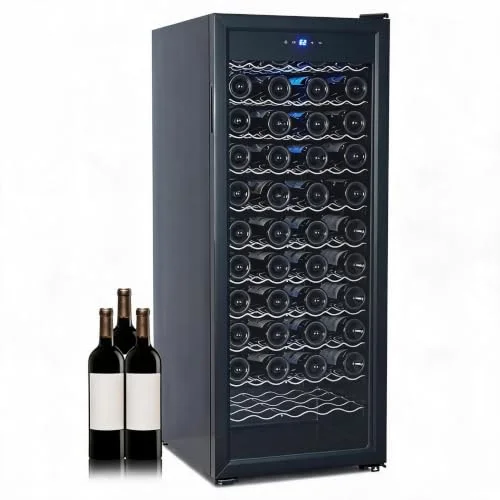
Fancihabor 80 Bottle Wine Cooler Refrigerator
Best for a house you stock heavily and visit rarely
80 bottles·48" cabinet·41–64°F adjustable
Eighty bottles in a 48-inch glass-door cabinet with adjustable shelves is the kind of headroom that makes sense when a visit means arriving with a trunk full of wine rather than a weekly top-up — fewer trips, less chance of coming up short two weekends before the next drive up. The listing gives one adjustable 41–64°F range rather than stating a dual-zone split, so plan to run it as a single setpoint unless you confirm otherwise on the current listing. The adjustable shelves are worth using to match the cabinet to however unevenly a seasonal case actually arrives — a mix of case boxes and loose bottles, rather than a uniform rack of identical shapes.
The pick if the problem is "we only stock this twice a year, so make it count."
02Best for a house used across a full season
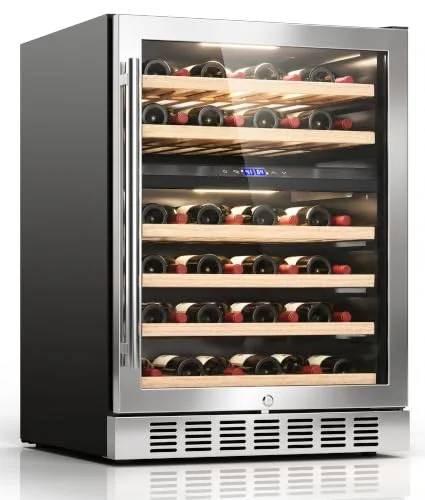
OYLUS 24" Wine Fridge, 46 Bottles Dual Zone
Best for reds and whites held at once between visits
46 bottles·Dual zone·41–64°F both zones
A middle-capacity dual-zone cabinet suits a house that gets real, repeated use across a season rather than one big seasonal haul — enough bottles to cover several visits without restocking every time, and two independently settable zones so reds and whites can each sit at the right number between trips rather than compromising at one temperature for months at a stretch. Amazon lists this specific unit as the L-Single Door variant; confirm that configuration matches what you expect before ordering, since the listing is the only authority on which door style ships.
The pick if the house sees enough visits that both colors are worth keeping ready.
03Best for a home-bar second house with guests
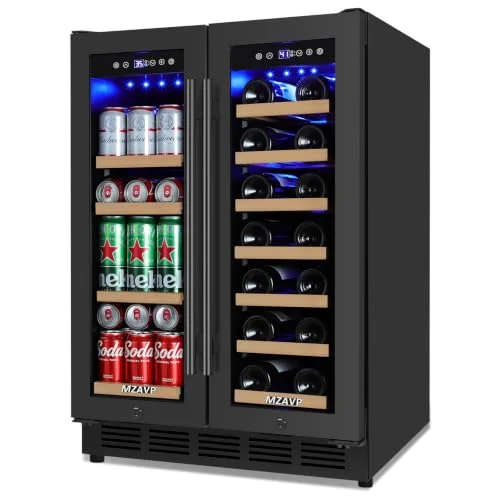
MZAVP 24" Wine and Beverage Refrigerator
Best when the cabinet needs to serve wine and non-wine guests alike
21 bottles + 88 cans·Dual zone·Glass door & French door
A second house that hosts weekend guests often needs a cabinet that does more than hold wine — someone always wants a cold beer or a soda that isn't wine at all, and this one dedicates real space to that instead of treating it as an afterthought: 21 bottles alongside room for 88 cans, in a dual-zone layout with a glass door and French door configuration. Amazon lists this model's size variant as 34.25 inches; that figure is the one the listing gives, so measure your intended spot against the exact current listing rather than assuming which dimension it refers to.
The pick if the fridge needs to work for everyone staying at the house, not just the wine drinker.
What to check by phone or camera before the next visit, if the house has one
If the house already has a security camera, a smart plug, or some other remote-monitoring setup installed for general home-security reasons, it's worth knowing exactly what a quick phone check can and can't actually tell you about the wine fridge before you make the drive — because it's easy to over-trust a green light on an app.
A smart plug or an energy-monitoring outlet showing the fridge is drawing power tells you the unit has electricity and the compressor is cycling. That's genuinely useful: it rules out "the breaker tripped and it's been off since Tuesday," which is exactly the unattended scenario this whole guide is about. What it does not tell you is whether the interior is actually at the correct temperature — a unit can draw power, run its compressor, and still be failing to hold its setpoint for reasons a power reading alone won't surface. If a camera happens to have a clear view of the unit's own control panel, a lit display showing the set temperature (rather than a blank screen or a blinking error indicator) is a further, useful signal — but reading a number off a tiny display through a camera feed is a stretch for most home setups, and none of the three units in this guide are listed with their own app connectivity or remote temperature reporting, so don't assume a purchase here comes with that feature built in.
The more reliable way to actually know what happened inside the cabinet during a vacancy, if that matters enough to you to act on, is a separate, inexpensive temperature or humidity logger placed inside the fridge — a small battery-powered sensor that records its own history independent of whether the fridge's own display survived the outage, and that you can check on the next visit rather than relying on an external camera to infer internal conditions it was never positioned to measure. That's a deliberate add-on purchase, not a feature to go shopping for in the fridge itself.
How we compared these — and what we cannot tell you
We compared the published capacity, zone count, temperature range, door configuration and current listed price for each product against its own listing, and did not fill in a specification — lock presence, mold resistance, app connectivity, built-in temperature logging — that the listing doesn't state. Where a detail mattered specifically to an unattended second house and the listing was silent on it, we said so directly rather than guessing in the product's favor.
We do not run a testing lab. We have not installed any of these units in an actual vacation home and measured how they behave through a real multi-week power interruption, and none of the manufacturers here publish independent data on that scenario either. You will also not find a star rating or a review count on this page: the retailer data we draw from does not return them for this category, and we do not publish numbers we cannot verify. What we can do honestly is reason from the published specifications and from general, verifiable facts about refrigeration, condensation and how digital control boards behave after a power interruption — and keep that reasoning clearly separate from anything that would require us to have actually tested the product ourselves.
Prices quoted here were correct at the time of writing and change frequently. Confirm the current price before buying.
Frequently asked questions
Does a wine fridge's temperature-memory feature undo damage from a long power outage?
No. It restores the target setpoint the compressor chases once power comes back — it does not undo the time the cabinet already spent at ambient temperature while the power was out. For a brief outage during an occupied stretch, that's exactly the problem it solves. For an outage that runs the length of an entire vacancy, the memory feature only controls what happens after power returns, not what already happened while nobody was there.
Should I leave the wine fridge's lock engaged between visits?
Only if the unit actually has one — none of the three products in this guide list a locking mechanism in their specifications, so confirm that directly on the current listing rather than assuming a cabinet this size includes it. Where a lock genuinely helps is keeping a curious guest or a renter from opening and closing the door repeatedly, not as a substitute for the security of the house itself.
How many bottles should I plan for if I only stock the fridge a few times a year?
Size to a rough season's worth rather than a typical week, since there's no quick top-up trip between visits the way there is at a primary residence. A house that gets restocked once or twice a year with a full case benefits from a larger cabinet like an 80-bottle unit; a house that sees regular visits across a season is often better served by a mid-capacity dual-zone cabinet that holds reds and whites ready at once.
Can a security camera tell me if the wine fridge is actually working before I drive up?
Only partially. A smart plug or energy monitor confirms the unit has power and the compressor is cycling, which rules out a tripped breaker sitting untouched for weeks. It cannot confirm the interior is actually holding its setpoint. None of the units in this guide ship with their own app connectivity or remote temperature reporting, so a dedicated battery-powered temperature logger placed inside the cabinet is the more reliable way to know what actually happened during a vacancy.
Written by Ilane Tall. Research-based comparisons of published specifications, current prices and general domain facts — we do not physically test these units and we do not publish invented scores or review sentiment.