By Ilane Tall · Updated November 23, 2026 · Research-based.
Reader-supported: we may earn a commission when you buy through the links on this page, at no additional cost to you. It never changes which product we recommend. Prices quoted below were correct at the time of writing and move often.
The short version
Two freestanding units in the 30-to-45-bottle range can cost about $100–$120 more combined than a single built-in-capable cabinet half their size — and get you nearly triple the bottle capacity in return.
What the pair doesn't win on: dual-zone control, a built-in option, floor space, or electricity draw. Need those more than the extra bottles? The single cabinet is the better buy, not the cheaper one.
Before you commit to a pair, check the clearance math below — placing two compressor units close together is the detail that trips people up.
The combined-price math: two cabinets against one
Take two realistic freestanding compressor units: the Yeego 34 Bottle at $223.42 and the Icyglee 45 Bottle at $296.49. Bought together, that is $519.91 for a combined 79 bottles of advertised capacity — about $6.58 per bottle. Set that against the BODEGA 15" 30-Bottle Dual Zone, a single built-in-capable cabinet at $408.49 for 30 bottles, or about $13.62 per bottle.
The pair costs $111.42 more in total, for 49 more bottles of capacity — more than double what the single cabinet holds. On a dollars-per-bottle basis the two small units are not close: the dual-zone cabinet costs more than twice as much per bottle, and that premium is buying a temperature divider and a built-in-rated cabinet, not extra space.
| Model | Capacity | Zones | Install | Price | $ / bottle | Get it |
|---|
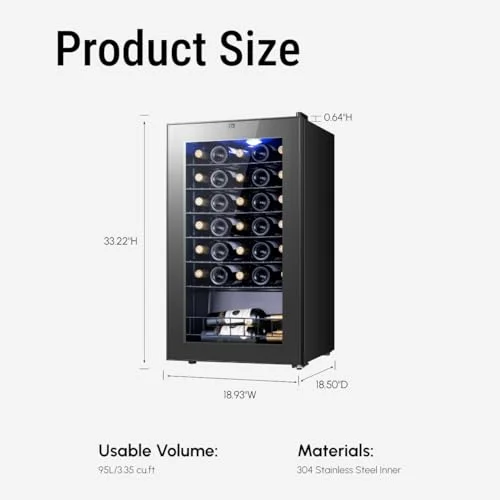 Yeego 34 Bottle |
34 bottles |
Single |
Freestanding / under-counter |
$223.42 |
$6.57 |
Get it |
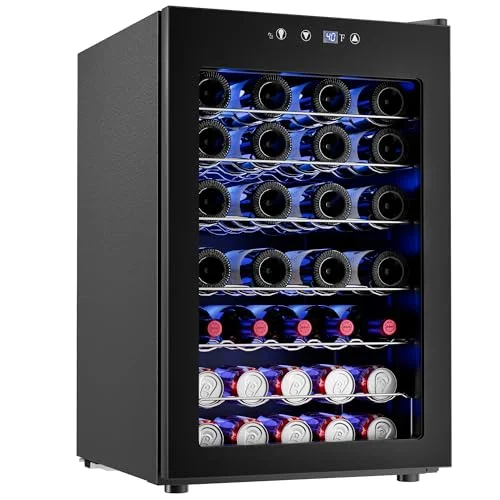 Icyglee 45 Bottle |
45 bottles |
Single |
Freestanding / under-counter |
$296.49 |
$6.59 |
Get it |
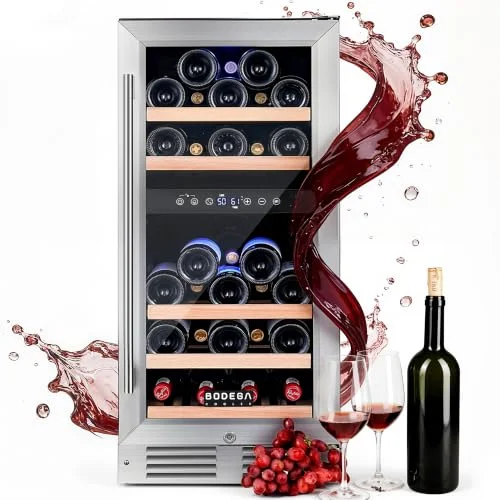 BODEGA 15" 30 Bottle Dual Zone |
30 bottles |
Dual |
Built-in or freestanding |
$408.49 |
$13.62 |
Get it |
Worth noticing: a single Icyglee alone already beats the BODEGA on both price and capacity. So the honest framing isn't "two small fridges vs. one big fridge" — it's "do you need dual-zone control and a built-in option badly enough to pay more for less space," because raw capacity was never the single cabinet's selling point here.
Splitting storage by purpose, not just by volume
The case for two cabinets gets stronger once you stop treating them as one 79-bottle pool and start treating them as two different jobs.
A practical version: the Icyglee 45 Bottle goes wherever your working cellar lives — a basement, a garage, anywhere with stable temperature and room to spare — holding the bulk of a growing collection. The Yeego 34 Bottle goes in or near the kitchen, stocked with whatever gets opened this week. That matters if your kitchen genuinely has no space for a 79-bottle appliance; we cover that constraint in where to put a wine fridge when your kitchen has no room.
It also solves a placement problem a single big cabinet can't: a kitchen island has no back wall for a rear-venting unit to breathe against, which rules out most freestanding fridges from that spot. Keeping the kitchen unit compact and putting the larger-capacity unit somewhere with real airflow sidesteps that. Our guide to wine fridges for a kitchen island covers the venting rules if that's where one unit is headed.
What you gain by going dual-cabinet
Three advantages are real, and worth naming plainly rather than treating "buy two" as simply the cheaper option.
Redundancy. If one compressor fails, you lose half your storage, not all of it. A single 79-bottle cabinet that stops cooling puts the entire collection at risk at once; a failure in the Yeego leaves the Icyglee running normally. That's a real argument for splitting storage if the collection matters to you — and it's worth knowing what a manufacturer actually covers before you need it, which our breakdown of wine fridge warranty and return policies walks through.
Flexible placement. Two 34-to-45-bottle units fit through doorways and into odd corners that one appliance sized for 79 bottles would not, and can go in different rooms entirely rather than needing one long stretch of wall.
Easier moving. A compact 34-bottle unit is something one person can walk down a hallway. A single cabinet holding what two of these hold combined needs a dolly and a second person for a move or a resale. If you rent, or expect to relocate, two smaller units are simply more portable, one trip at a time.
What you lose: two of everything that can go wrong
None of the above is free. Two cabinets means two compressors, two door seals, two thermostats, two power cords, and two warranty periods to track instead of one.
Two compressors draw continuous power instead of one, though the actual difference on your electricity bill depends heavily on ambient temperature and how often each door gets opened — too variable to put a number on. What is predictable is two independent points of failure: a worn gasket or a compressor that finally gives out is a known risk for any compressor fridge, and owning two means managing that risk twice, on two different purchase dates.
There is also the footprint itself: two separate patches of floor or counter, usually in two different rooms. A single cabinet, even a tall one, has one footprint and one set of clearance requirements to plan for once, not twice.
Ventilation clearance for two freestanding units placed near each other
This is the detail that actually causes problems, and it's easy to get wrong precisely because people assume two small fridges need less planning than one big one. They need the same planning, twice.
A freestanding compressor wine fridge rejects heat through the back and sides. Both the Yeego and the Icyglee are built and sold as freestanding or under-counter units, not sealed built-in cabinets with a front vent, so each needs clear air around it. Manufacturers of this class of appliance generally call for a couple of inches of open space along every vented surface — and that requirement doesn't shrink just because the unit next to it is small too.
The mistake we see is pushing two compact fridges flush against each other to save floor space, or wedging a pair into an alcove sized for one appliance. Do either, and both compressors work harder against their own trapped heat — the same failure mode as enclosing a single freestanding unit in cabinetry, just doubled. Leave a real gap between the two cabinets, not only behind and beside the pair as a block.
The other detail two cabinets force you to confront twice is electrical: two always-on compressor appliances is two loads to account for, and if either unit sits near a sink or wet bar, the GFCI question comes up for each outlet individually. Our guide to wine fridge electrical requirements covers what a 15-amp household circuit can support and when that's worth a call to an electrician.
The picks: two to pair, one to buy once
If you're leaning toward two cabinets, this is the pair we'd buy. If the single-cabinet route fits better, this is the realistic one-and-done alternative at a comparable budget.
01Buy a pair — everyday unit
Yeego 34 Bottle Wine Fridge
The kitchen-or-closer unit of the pair
34 bottles·Single zone·Compressor·Freestanding or under-counter
A compact 18.5"D x 18.93"W x 33.22"H cabinet with 1°F precision adjustment across a 38–65°F range, six removable shelves, and power-failure memory. It's built for freestanding or under-counter placement — the manufacturer is explicit it's not rated for a fully enclosed built-in install, so give it the same clearance any freestanding compressor unit needs.
The smaller half of the pair: easy to place, easy to move, nothing fancy to go wrong with.
02Buy a pair — the working cellar
Icyglee 45 Bottle Wine Cooler Refrigerator
The higher-capacity half of the pair
45 bottles·Single zone·Compressor·Freestanding or under-counter
Forty-five bottles on removable shelves, adjustable legs, and a one-touch digital panel covering a 40–61°F range. Like the Yeego, it's sold as freestanding or under-counter rather than a sealed built-in, and at $6.59 per bottle it's essentially tied with the Yeego on value — the point of pairing them: neither is the compromise pick, each just does a different job.
The unit that does the heavy lifting if you split storage by purpose rather than location alone.
03Buy once
BODEGA 15" 30 Bottle Dual Zone
The single-cabinet alternative, if zones and built-in matter more than bottles
30 bottles·Dual zone·Compressor·Built-in or freestanding
Independent upper and lower zones across a 41–72°F span, a tempered glass door, five adjustable wood-look shelves, and — the detail that separates it from the pair above — a cabinet rated for built-in installation in a 15-inch opening, not just freestanding use. You pay for that with a higher price and 49 fewer bottles. Buy this if you need a divider between reds and whites or a cabinet that slots into existing cabinetry; buy the pair if you need more total storage.
The right call only when the feature list, not the bottle count, is what's driving the decision.
The BODEGA's upper and lower zones are managed by one compressor with cooling split between compartments, not two independent refrigeration systems — the same approach almost every dual-zone cabinet uses. If a second temperature zone is the feature pulling you toward the single cabinet, it's worth understanding what that divider can and can't do before paying the premium for it; see how dual-zone wine fridge cooling actually works.
The actual break-even point, in bottles and dollars
The pair costs $111.42 more than the single BODEGA cabinet and delivers 49 more bottles of capacity. Divide one by the other and the premium for dual-zone control plus a built-in-rated cabinet works out to about $2.27 for every bottle of capacity you give up by choosing the single cabinet instead of the pair.
Buy the pair
$519.91 total for 79 bottles across two freestanding units. Best when the goal is maximum storage split across two locations or purposes, and you don't need a temperature divider or built-in rating.
Buy once
$408.49 for 30 bottles in one dual-zone, built-in-capable cabinet. Best when a divider between reds and whites, or fitting an existing cabinet opening, matters more than raw capacity.
That $2.27-per-bottle figure is the number to hold onto. If dual-zone control and the built-in option are worth more than that to you per bottle given up, the single cabinet is the better buy — a different purchase, not a worse deal. If they aren't worth that much, there is no version of this comparison where the single 30-bottle cabinet beats two freestanding units on value: a single Icyglee alone already costs less and holds more. The two-cabinet strategy really only earns its keep once your target is north of 45 bottles total and you have a genuine use for splitting storage across two locations or purposes.
Who should buy two, and who should buy one
Buy the pair if: you want more than about 45 bottles of total storage, you can genuinely use two locations or purposes, you're comfortable managing two warranty periods and two compressors, and you have clear ventilated space for both units rather than one tight spot that has to fit everything.
Buy one cabinet if: your target is at or under about 30–35 bottles, you specifically want a divider between reds and whites, the appliance needs to sit flush in an existing cabinet opening, or you'd rather manage one compressor and one warranty than two of each.
One rule applies regardless: never enclose a freestanding unit — including either half of the pair — in cabinetry it wasn't rated for. Built-in-rated cabinets like the BODEGA vent through the front by design; freestanding units like the Yeego and Icyglee need open air at the back and sides to work at all, and that doesn't change because the appliance is smaller.
How we compared — and what we can't tell you
We compared published manufacturer specifications and current listed prices for all three units, plus the general engineering facts about compressor cooling, zone dividers, and appliance ventilation that apply to wine fridges as a category. Where a spec wasn't published for a given model, we didn't estimate one.
We do not run a testing lab. We don't own these units and haven't physically tested them side by side, so you won't find a staged demonstration or an invented score out of ten here. We also don't publish star ratings or review counts: the retailer data for these listings doesn't include them, and we don't fabricate sentiment we haven't sourced. What we can do honestly is the arithmetic above, sourced entirely from the prices and capacities each manufacturer publishes.
Prices quoted in this guide were correct at the time of writing and change frequently. Confirm the current price on Amazon before buying either strategy.
Frequently asked questions
Is it actually cheaper to buy two small wine fridges than one big one?
Not always, and it depends what "one big one" means. In this comparison, the two freestanding units total $111.42 more than the single dual-zone cabinet but deliver 49 more bottles of capacity — see the price math above for the full breakdown. On raw storage, the pair is the better dollar value; the single cabinet earns its higher per-bottle price with dual-zone control and a built-in option, not with more space.
What happens to my wine if one of two fridges fails?
Only the bottles in that cabinet are at risk while it's down for repair — the second unit keeps running, so a failure affects half your storage instead of all of it. A single large cabinet with the same total capacity puts the whole collection at risk at once. Check what the manufacturer's warranty actually covers before you need it; our warranty and return policy guide breaks that down.
How much space do I need between two wine fridges placed next to each other?
Freestanding compressor wine fridges reject heat from the back and sides, so manufacturers generally want a couple of inches of clearance along each vented surface. Pushing two cabinets flush together, or wedging a pair into an alcove sized for one appliance, makes both compressors work harder against their own trapped heat. Leave a real gap between the units themselves, not just behind and beside the pair as a block.
Can I plug two wine fridges into the same outlet?
A standard 15-amp circuit usually has headroom for two small compressor fridges, but a shared power strip isn't the right way to do it for appliances that stay on continuously. Give each its own wall outlet, and if either sits near a sink or wet bar, check the GFCI question for that outlet before you commit to the spot. Our electrical requirements guide covers what to check first.
Written by Ilane Tall. Research-based comparisons of published specifications and current prices — we do not physically test these units and we do not publish invented scores.