By Ilane Tall · Updated October 13, 2026 · Research-based.
Reader-supported: we may earn a commission when you buy through the links on this page, at no additional cost to you. It never changes which product we recommend. Prices quoted below were correct at the time of writing and move often.
The short version
Every wine fridge genuinely built to travel is thermoelectric, not compressor-cooled — and that is not an accident. A compressor cabinet is designed to sit level and still; a moving vehicle is neither.
The trade for that road-worthiness is a cooling ceiling: thermoelectric units pull a fixed amount below whatever the cabin is holding, so they work well in a climate-controlled rig and struggle in one baking in a parking lot.
Go straight to the picks if you already know you need a small, 12-volt-friendly, silent unit — the only open question left is bottle count and whether it fits a low cabinet or a narrow galley countertop.
Why a compressor and constant motion don't mix
A compressor wine fridge works like a kitchen refrigerator: a sealed loop circulates refrigerant and a thin film of lubricating oil through a compressor, a condenser and an evaporator. That system is engineered to sit level, on a stable floor, more or less permanently. An RV violates both halves of that assumption — it drives at highway speed over uneven pavement, brakes and corners, and is routinely parked on a pad that is not perfectly level even with leveling blocks under the tires.
The mechanism that actually suffers is oil migration. The lubricating oil in a sealed refrigeration circuit is meant to return to the compressor after circulating with the refrigerant. Tilt the cabinet, and gravity can leave oil pooled somewhere it is not supposed to be — away from the compressor's bearings, or sitting in a section of coil instead of cycling back. Vibration compounds it: constant road shake is a sustained stress a kitchen appliance was never designed to tolerate for hours at a time. We will not invent a specific tilt angle or g-force threshold, since manufacturers do not publish one universal number — but this is well-established territory in mobile refrigeration generally, which is exactly why dedicated RV refrigerators use absorption or 12-volt compressor designs engineered and warrantied specifically for vehicle use, while a standard household compressor wine cooler is neither.
That gap shows up in the fine print more than the marketing copy. Household compressor wine fridges are built, tested and warrantied as stationary kitchen appliances. None of the thermoelectric units in this guide ask you to take that risk, because none of them have a compressor, oil or refrigerant loop to begin with. If you are shopping for a house or apartment instead, a compressor unit is the better choice, for the reasons in choosing a wine fridge width — it is only the moving-vehicle case that flips the recommendation.
Thermoelectric's real trade-off on the road
Thermoelectric cooling has no compressor, no refrigerant and no oil to migrate. It cools with a solid-state element — current passes through it and one side gets cold while the other gets hot, with a fan moving air across each side. Nothing inside depends on sitting level or on a liquid returning to a specific place by gravity, which is exactly why it is the only cooling technology that shows up across every wine fridge actually marketed for RV use, including every product in this guide.
The trade is a hard physical ceiling. A thermoelectric element pulls the cabinet down to roughly 20°F below whatever temperature the surrounding air is holding — not to a fixed low number the way a compressor can. Park the rig in a shaded, climate-controlled interior at 72°F, and a thermoelectric cooler can comfortably hold a cellar-range temperature. Leave the same unit in a camper that has baked at 95°F in direct sun for an afternoon, and it plateaus well above where wine should be stored, no matter the dial setting — not broken, just doing exactly what the physics allows. We cover this ceiling in more depth, including why it applies identically across brands, in our brand comparison of Ivation, NewAir, Euhomy and Koolatron, which singles out Koolatron's RV-marketed thermoelectric units for exactly this reason.
What you get in exchange matters more in a vehicle than almost anywhere else: near silence and genuine vibration tolerance. No compressor cycling on and off means no hum competing with road noise, and no compressor vibration adding to the vibration the vehicle is already generating. For a cabinet mounted a few feet from where someone is trying to sleep, that is the difference between an appliance that fits camper life and one that fights it.
The honest summary: thermoelectric is not a compromise forced on RV owners by cost-cutting. It is the correct technology for a moving, tilting, variably powered box, and the compressor units you would otherwise consider for a kitchen are built around assumptions a vehicle simply does not meet.
Standard household power versus what actually comes out of a campsite pedestal or an inverter
A wine fridge's plug looks the same everywhere, but what is behind the outlet changes constantly in an RV, and that matters more for this category than for almost any other kitchen appliance you own.
Plugged into a full-hookup campground pedestal, an RV draws standard 120-volt AC power through its shore-power cord — electrically indistinguishable from a wall outlet at home. Away from a pedestal, the picture changes: running off the rig's own electrical system means drawing from a battery bank through an inverter, which converts stored 12-volt DC power into AC. Inverters are not interchangeable — a modified-sine-wave inverter produces a rougher approximation of household AC than a pure-sine-wave one, and some electronics run less efficiently on it. A thermoelectric element and fan are comparatively simple loads, but the broader principle holds for everything plugged in while boondocking: know which kind of inverter is feeding the outlet.
Battery capacity is the other constraint a kitchen never has to think about. A wine fridge running continuously is a small but steady draw on a bank also running lights, a water pump and a furnace fan overnight. None of the products in this guide publish the wattage figures that would let us state a runtime, and we will not estimate one — check the current listing before assuming it fits a boondocking power budget, especially for multi-night stays without shore power or a generator.
One side effect worth flagging: a controller can occasionally throw an error code or a blinking display after a voltage sag or a rough inverter transfer. That usually means the control board reset after a power event, not that the unit has failed. If a display starts flashing after a drive or a power-source switch, our guide to wine fridge error codes and blinking display lights is the faster read before assuming the worst.
Counter space and horizontal units for a low cabinet or a narrow galley
RV galleys are not scaled-down kitchens; they are a genuinely different design problem. Counter space is scarce, overhead cabinets sit lower than a house kitchen's, and there is often a specific gap — under a counter, beside a stove, in a dinette nook — that a wine fridge has to fit into rather than the other way around. A tall, narrow cabinet that would disappear into a kitchen island can be the one shape that does not fit anywhere in a camper.
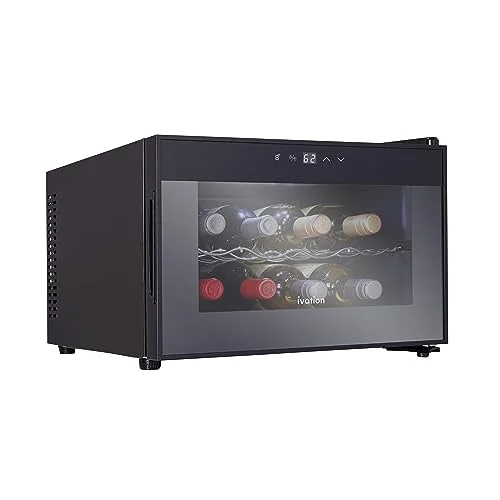
That is where a horizontal-format unit earns its keep. The Ivation Premium 8 Bottle Horizontal is built wider and lower than a conventional upright cooler — the shape that slides under a low overhead cabinet or sits flush on a narrow galley countertop without blocking a cabinet door above it. It holds its 8 bottles lying on their sides in a single tier, trading cabinet height for countertop depth. If the spot you have in mind is wide and shallow rather than tall, that distinction decides whether a wine fridge fits your rig at all, before cooling technology or bottle count even enter the conversation — the same footprint logic covered, for a house-sized version of the same question, in our width guide.
Whatever shape you land on, leave genuine clearance on every side the unit is not flush against. A thermoelectric cooler still rejects heat through a fan and a heat sink, and a unit wedged into a cabinet nook with no airflow will run harder and recover more slowly after every door-opening.
The picks
All four of the units below are thermoelectric, for the reasons above — nothing with a compressor belongs in a vehicle that actually drives. The differences that matter here are footprint, bottle count and whether you want one temperature zone or two.
01Best for a low cabinet or narrow galley
Ivation Premium 8 Bottle Horizontal
The horizontal format that fits where an upright cooler can't
8 bottles·Horizontal·Thermoelectric·Freestanding
A wide, low cabinet built to lie flat rather than stand tall, with a digital temperature display and thermoelectric cooling that stays quiet and vibration-tolerant on the road. Eight bottles on their sides is modest, but the format is the point: it slides under a low overhead cabinet or sits on a shallow galley countertop where an upright cooler won't fit. At $144.49, it's also the cheapest entry here.
Measure the gap before the bottle count — this is the pick for the rig where the gap is wide and short.
02Smallest footprint
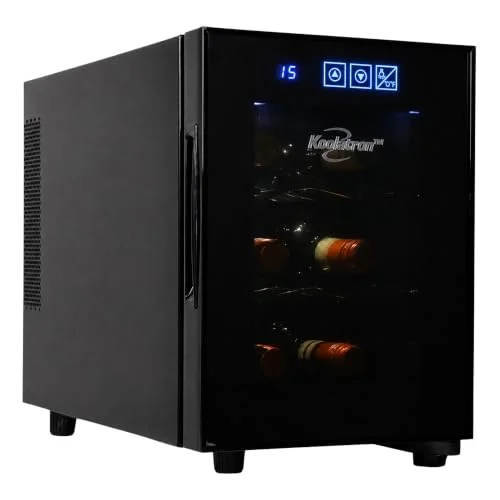
Koolatron 6 Bottle Wine Cooler
For the rig with the least counter and the least power to spare
6 bottles·0.65 cu. ft. (16L)·Thermoelectric·Freestanding
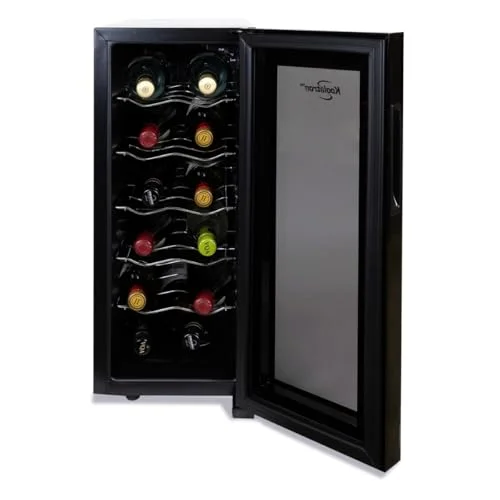
The smallest cabinet of the four, at 0.65 cubic feet, and the listing names RVs directly alongside small kitchens, apartments and condos as the spaces it is built for. Six bottles won't stock a long trip, but in a van or truck camper with genuinely minimal counter space, a compact cooler that fits a narrow strip of countertop beats a larger unit you never had room to install.
The pick when the honest constraint is square inches, not bottle count.
03Best if reds and whites both come along
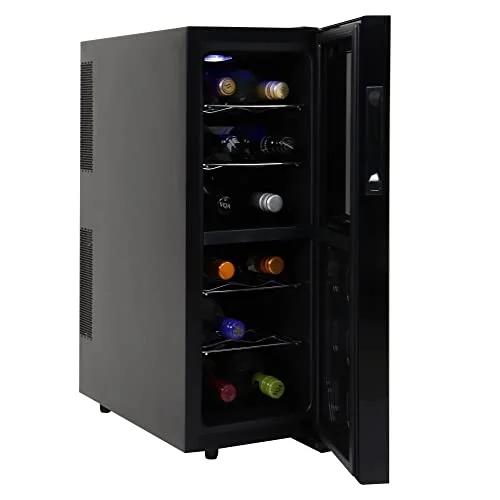
Koolatron Urban Series 12 Bottle Dual Zone
Two thermoelectric zones, still built for a moving rig
12 bottles·Dual zone·Thermoelectric·Freestanding
The only dual-zone unit in this guide, explicitly stated as dual zone and thermoelectric in its own listing — useful if the trip means packing both a red and a white rather than committing to one. The two-compartment layout costs flexibility, the same way it does in a stationary kitchen cabinet: twelve bottles split across a fixed divider realistically means a handful per side. It carries the same ambient-temperature ceiling as every pick here.
The only reason to pay for two zones on the road is the same reason you'd pay for them at home: you actually drink both colors.
04Most straightforward 12-bottle option
Koolatron Urban Series 12 Bottle
The same capacity, one less thing to manage
12 bottles·1 cu. ft.·Thermoelectric·Freestanding
Same brand, same 12-bottle count and nearly the same price as the dual-zone model above, but this one keeps all twelve bottles at a single temperature rather than splitting the cabinet — its listing does not carry the "dual zone" language its sibling does. For a collection that leans one color, that's one less control to monitor while the rig is also handling an inverter and a battery bank.
One zone, one number to check — sometimes that's exactly the feature you want on the road.
What changes once the rig is parked for the season instead of actually driving
Everything above assumes the fridge has to survive being driven. A lot of RV and camper ownership is not that — a trailer settled into a seasonal site, a camper van parked long-term, a fifth-wheel hooked to shore power for the winter and barely moving. Once the vehicle stops being a vehicle in any day-to-day sense, two of the constraints behind every recommendation above loosen considerably.
The oil-migration and vibration risk that rules out compressor cooling is a function of motion, not of being inside an RV. A trailer leveled, chocked and parked for the season is, mechanically, no longer tilting and shaking the way it does at highway speed. If it will realistically never be driven again with wine inside — or only rarely, emptied first — a compressor-cooled cooler becomes legitimate, and it buys back what thermoelectric cannot: a stable setpoint regardless of how hot the cabin gets. Our guide to the best wine fridges under $500 covers that tier of compressor-cooled cabinet, sized for the same kind of small space.
Power reliability improves too — a seasonal site is almost always full-hookup, so the inverter and battery-bank questions above mostly stop applying once the rig is plugged into a pedestal full-time. What does not change is the galley's footprint: a fridge that fit a low cabinet or narrow counter while mobile still has to fit once parked, and upgrading to a compressor unit only makes sense if that cabinet can also give it the rear or side airflow clearance a thermoelectric unit never needed. Our wine fridge buying checklist walks through installation type and venting before bottle count, the right order in a space this constrained.
How we compared these — and what we cannot tell you
We compared the published manufacturer listings and current prices for wine fridges explicitly marketed for RV, camper or mobile use, cross-checked cooling technology, bottle count and stated format (horizontal versus upright, single zone versus dual zone) against each listing, and reasoned from general principles of mobile refrigeration and RV electrical systems about why thermoelectric cooling is the only technology that belongs in a moving vehicle. Where a spec was not published — power draw in watts is the clearest gap across all four products here — we said so rather than estimating a number to fill it.
We do not run a testing lab. We have not driven these units across the country to confirm vibration tolerance firsthand, and we will not publish an invented score out of ten pretending that we have. What we can do honestly is read the specifications carefully, track the prices, and explain the engineering reasons — oil migration, tilt sensitivity, ambient-temperature ceilings, inverter power quality — that separate a wine fridge built for a kitchen from one built to travel. There are no star ratings or review counts here because the retailer data does not provide them for this category; we would rather say that plainly than paraphrase sentiment we cannot verify.
Prices quoted here were correct at the time of writing and change frequently. Confirm the current price before buying.
Frequently asked questions
Can I run a compressor wine fridge in an RV while driving?
We would not recommend it. Compressor cooling depends on a sealed oil-and-refrigerant loop that is engineered to sit level and still; the constant tilt and vibration of a moving vehicle risks migrating the lubricating oil away from the compressor over time. Every unit genuinely marketed for RV and camper use that we found is thermoelectric rather than compressor-cooled, which has no oil or refrigerant loop to put at risk in the first place.
Will a thermoelectric wine cooler keep wine cold in a hot RV in summer?
Only within its physical limit. Thermoelectric cooling pulls the cabinet down to roughly 20°F below whatever the surrounding air is holding, not to a fixed low number. In a climate-controlled rig at 72°F that is a workable cellar range; in a camper that has baked in direct sun, the same unit will plateau well above ideal wine-storage temperature no matter the dial setting. That ceiling applies to every brand, not just the ones in this guide.
Can I run a wine fridge off my RV's inverter or battery bank?
Generally yes, but check two things first: whether the inverter produces pure or modified sine-wave power, and whether the battery bank has the capacity to run the fridge continuously alongside everything else on board. None of the products in this guide publish a specific wattage draw, so we will not estimate a runtime — confirm the current listing's power specifications, and lean on shore power at a campsite pedestal when it is available rather than relying on the battery bank for a wine fridge running around the clock.
Does a wine fridge still make sense once the RV is parked for the season?
It can make even more sense, and it opens up compressor cooling as an option. Once the rig is leveled and parked rather than actually driving, the tilt and vibration risk that rules out compressor units mostly disappears, and full-hookup shore power removes the inverter and battery-capacity questions that apply while mobile. The one constraint that does not go away is the galley's physical footprint — a compressor unit typically needs airflow clearance a thermoelectric cooler does not.
Written by Ilane Tall. Research-based comparisons of published specifications, current prices and general refrigeration and RV-electrical principles — we do not physically test these units and we do not publish invented scores.