By Ilane Tall · Updated November 26, 2026 · Research-based.
Reader-supported: we may earn a commission when you buy through the links on this page, at no additional cost to you. It never changes which product we recommend. Prices quoted below were correct at the time of writing and move often.
The short version
All three units here hold 25 bottles, stand freestanding, and cost within thirty dollars of one another. The Feelfunn 25 Bottle is the cheapest at $189.99 and the only one with a confirmed R600a compressor and a double-door design. The Icyglee 25 Bottle at $229.99 bundles UV protection and LED lighting into the same price as the EUHOMY. The EUHOMY 25 Bottle, also $229.99, leads with a double-layer glass door and a stated 3.2 cubic foot interior.
None of the three publishes a confirmed temperature range, zone count, or lock specification in the data we have — which is itself the most useful finding in this comparison. At this tier, the differences that exist are narrower and more specific than the listing photos suggest.
If you only read one section, make it what is genuinely identical across all three — it is longer than the differences section, and it is where most of the thirty dollars actually goes.
Why 25 bottles under $230 is the most crowded shelf in the category
Twenty-five bottles sits at an awkward, popular size: big enough to feel like a real wine fridge rather than a dorm-room novelty, small enough to fit in a kitchen corner or under a counter without a renovation. That makes it the single most contested capacity in the freestanding compressor tier, and the result is a shelf of listings that look almost interchangeable at a glance — similar height, similar width, a black or silver cabinet, a glass door, a price somewhere in the low-to-mid $200s.
The three units in this comparison — EUHOMY, Icyglee and Feelfunn — are a representative slice of that shelf. Each lists 25 bottles of capacity. Each is freestanding. Each costs between $189.99 and $229.99, a $40 spread that narrows to $0 between two of the three. On paper, picking between them looks like it shouldn't matter.
It is worth saying plainly why the brands blur together: in this price band, the compressor, the insulation, and the basic cabinet are commodity components sourced from a small pool of manufacturers, then badged and marketed differently. That is not a criticism unique to these three — it is simply how the budget-to-mid compressor tier works, and our wine fridge weight guide shows the same pattern in listed dimensions across dozens of similarly sized units. What differs between brands at this size is rarely the cooling engineering. It is the door construction, the lighting, the stated interior volume, and a handful of marketing claims that range from genuinely useful to mostly decorative. That is what this comparison is actually about.
EUHOMY: the double-layer glass door claim, and what it actually blocks
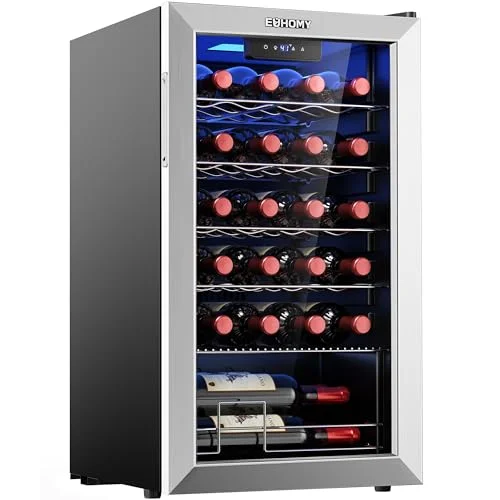
The EUHOMY 25 Bottle Wine Cooler Refrigerator, Wine Fridge Glass Door (ASIN B0FLKGJJMZ) is priced at $229.99 and ships in a silver finish. Its headline specification is a double-layer glass door, and the listing states a 3.2 cubic foot interior — a useful number on its own, since "25 bottles" tells you nothing about whether that capacity comes from a tall narrow cabinet or a shorter wide one. EUHOMY also lists a "Wave Shelf" variant, which is the size/configuration detail confirmed for this listing.
A double-layer glass door is a real construction choice, not a marketing phrase invented for this listing — two panes of glass with an air gap between them insulate better than a single pane, and a double-paned door is standard on most mid-tier wine fridges for exactly that reason. What it blocks is heat transfer through the door, which matters because a wine fridge's door is its largest and least-insulated surface. A single-pane glass door lets more of the compressor's work leak back out through the front, especially in a warm kitchen; a double-pane door narrows that gap.
What the double-layer glass does not do, based on the specifications we have, is anything about UV exposure specifically — EUHOMY's listing does not make a UV-blocking claim the way Icyglee's does below. If direct sunlight on the cabinet is a concern in your kitchen, that is worth checking on the current listing rather than assuming it from "double-layer glass" alone; the two properties, thermal insulation and UV filtering, are related but not the same thing, and a listing can have one without stating the other.
Icyglee: UV protection and LED lighting, bundled into the same price as the EUHOMY
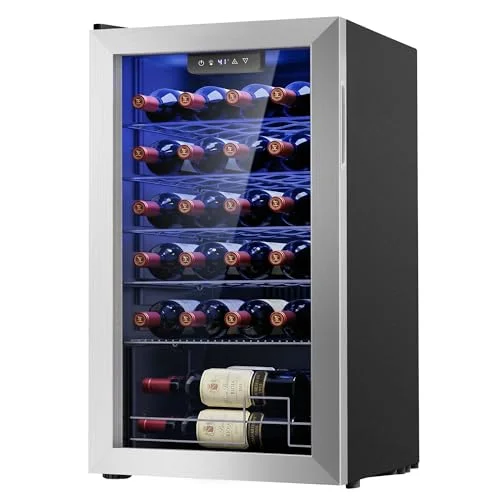
The Icyglee 25 Bottle Wine Cooler Refrigerator (ASIN B0G4N7P4HQ) is also priced at $229.99, in a silver finish, and the two headline specifications on its listing are UV protection and LED lighting — bundled into exactly the price the EUHOMY charges for its double-layer glass claim.
UV protection on a wine fridge door matters because ultraviolet light degrades wine chemically over time, not just through the heat that comes with direct sun — it is one of the few label-lawsuit-proof claims in this category, because UV-filtering glass or film is a well-understood, testable property rather than a vague adjective. If your cabinet is going to sit near a window or under a kitchen skylight, a confirmed UV-protective door is a genuine point in Icyglee's favor over a listing that does not make the same claim.
LED lighting is the second half of the pitch, and it is worth being honest about what it is and is not. Interior LED lighting makes the bottles inside visible and photogenic when the door is opened or the light is left on — a real convenience, and notably more energy-efficient and lower-heat than older incandescent interior lights, which matters slightly for a compressor that is trying to hold a setpoint. It is not a wine-preservation feature on its own; the fridge's insulation and door seal do that work regardless of what bulb sits inside. Treat LED lighting as a usability nicety that happens to come at no extra cost here, not as a reason by itself to pick one cooler over another.
Between the EUHOMY and the Icyglee, both at $229.99, the honest comparison is UV protection and LED lighting against a double-layer glass door and a stated 3.2 cubic foot interior. Neither pairing is objectively larger than the other — they are different bets on which detail matters more to the buyer, at identical price.
Feelfunn: the R600a compressor spec, the double-door detail, and the $40 it saves
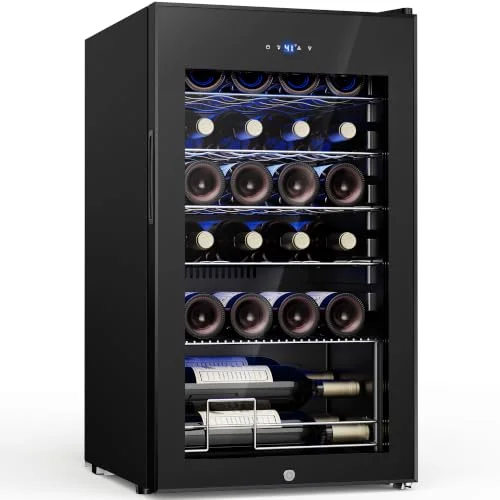
The Feelfunn 25 Bottle Wine Cooler Refrigerator, Freestanding Wine Fridge (ASIN B0HG9YF1GS) is priced at $189.99 in black, and its listing gives two specifics the other two do not state as plainly: an R600a compressor and a double-door design, with confirmed dimensions of 17.5 x 18.9 x 31.2 inches.
R600a is isobutane, the refrigerant that has largely replaced older HFC refrigerants across small and mid-size compressor appliances because it is far less harmful to the atmosphere if it leaks, and it is also a genuinely efficient refrigerant for small compressor loads like this one. Stating it by name on the listing is not unusual for a modern compressor wine fridge — most units built in the last several years use it — but Feelfunn is the one of these three that confirms it explicitly rather than leaving the refrigerant unspecified, which at least tells a buyer who cares about that detail where they stand without having to guess.
The "double-door" detail in Feelfunn's listing is worth pausing on, because it is easy to misread. Based on the specification we have, this describes a double-layer door construction — the same insulating principle as EUHOMY's double-layer glass, two panes with an air gap — rather than two separate doors on the cabinet. If a genuinely dual-compartment, two-door cabinet matters to your installation, confirm that distinction on the current listing before ordering; we are not in a position to assert which interpretation is correct without the full product page in front of us, and conflating "double door" with "dual zone" is an easy mistake to make from the title alone.
What Feelfunn does not state, in the data we have, is a UV-protection claim or an interior cubic-foot figure the way the other two do. At $189.99 — $40 less than either competitor — that is a reasonable trade: a named, modern refrigerant and a double-layer door, without the UV-filtering or LED-lighting bullets the other two lead with. For a buyer who cares most about refrigerant type and insulated door construction and least about UV filtering or interior lighting, Feelfunn is the one that spends the least to deliver what it does confirm.
What is genuinely identical across all three, and where the real difference hides
This is the section that actually decides the purchase, because it is longer — in terms of what it rules out — than the differences above.
All three units share: a 25-bottle stated capacity, freestanding-only installation (none of the three listings in our data confirms a built-in rating), a glass door of some construction, and a price inside a $40 band. None of the three listings we have confirms a temperature range, a zone count, a lock, or energy-consumption figures. That last point matters more than it looks: the single most important specification for any wine fridge — how cold it can actually get, and how consistently — is unconfirmed for all three. If temperature range is what decides your purchase, as it should be for most buyers, none of these three listings currently answers that question, and checking the current listing before buying is not optional here.
That gap is not unusual at this price and size — it is the norm for the 25-bottle freestanding tier, and it is exactly why the marketing differentiates on doors and lighting instead. A double-layer glass door, a UV-filtering claim, and a named refrigerant are all real, checkable facts. A precise temperature range that Google-level scrutiny would hold a brand to is a bigger commitment to publish, and plenty of listings at this price simply don't.
So where does the real difference hide? In the three specifics each brand chose to lead with, because a brand's headline claim is usually the one thing in the listing it is most confident differentiates it from the identical-looking competitor next to it on the page. EUHOMY leads with door insulation and interior volume. Icyglee leads with UV filtering and lighting. Feelfunn leads with refrigerant chemistry and a $40 lower price. None of those three claims overlaps with either of the other two — which is itself informative. If all three genuinely competed on the same spec, at least one would say so.
The honest summary: we do not run a testing lab and have not physically compared these three units side by side. What follows is a comparison of the specifications in the data we have, current prices, and general refrigeration principles — not a lab verdict, and not a star rating, because none of the three listings in our data carries a verified rating or review count we can responsibly publish.
How the three compare
Capacity and price figures below are drawn from each listing as of the dates noted. Prices move often — confirm the current figure before buying.
| Model | Best for | Capacity | Headline spec | Door | Finish | Price | Get it |
|---|
 Feelfunn 25 Bottle |
Lowest price |
25 bottles |
R600a compressor |
Double-layer |
Black |
$189.99 |
Get it |
 Icyglee 25 Bottle |
UV filtering + lighting |
25 bottles |
UV protection, LED lighting |
Glass |
Silver |
$229.99 |
Get it |
 EUHOMY 25 Bottle |
Insulated door + stated volume |
25 bottles (3.2 cu ft) |
Double-layer glass door |
Glass |
Silver |
$230.99 |
Get it |
The picks, and how to break a tie between near-identical listings
There is no single "best overall" here — the honest finding of this comparison is that three listings this close should be decided on the one or two specifics that matter to your installation, not on an overall ranking.
How to actually break the tie
Given how close these three sit on paper, the fastest way to decide is to rule out, in order, rather than try to rank all three holistically.
- Will the cabinet sit near a window, a skylight, or anywhere it gets direct sun for part of the day? If yes, the Icyglee's confirmed UV protection is the one specific advantage in this comparison that directly addresses that condition. Neither of the other two listings makes the same claim.
- Do you want a confirmed interior cubic-foot figure rather than just a bottle count? The EUHOMY is the only one of the three that states one — 3.2 cubic feet — which is useful if you are checking the unit against a specific gap in your kitchen rather than just trusting "25 bottles" to mean a particular footprint.
- Is $40 meaningful to you, and are UV filtering and interior lighting not? Take the Feelfunn. It is the only one of the three with a named modern refrigerant on the listing, and the double-layer door covers the same thermal-insulation ground as the EUHOMY's glass claim, at the lower price.
- Does the exact temperature range matter more than any of the above? Then none of these three listings currently answers that question with the confidence this comparison requires, and the right move is to check the current product page for each before buying — not to assume parity because the price tags are nearly identical.
One rule applies to all three regardless of which you choose: these are freestanding units, not built-in-rated cabinets. Enclosing a freestanding compressor in a cabinet run without side and rear clearance for heat rejection is the most common expensive mistake in this category — the compressor runs continuously trying to reach a setpoint it can no longer hit, and fails early. Our electrical requirements guide covers the other installation check worth doing before the unit arrives: confirming the outlet and circuit can handle a dedicated compressor load.
And whichever you buy, plan on the stated 25-bottle figure being optimistic. Advertised capacities are calculated with slim Bordeaux bottles stacked to the millimeter; Burgundy, Pinot and Champagne bottles are wider and shorter, and a punted base or a wax capsule wastes rack space none of these three listings accounts for. A realistic planning number across this entire 25-bottle tier is closer to 18-20 bottles once your actual collection is loaded in. If you are weighing one of these against a pair of smaller units instead, our two small fridges or one big one guide works through that math, and if frost on the back panel shows up after a humid week, our frost and ice buildup guide explains when that is normal and when it isn't.
How we compared these — and what we can't tell you
We compared the specifications given to us for all three listings, their current Amazon prices, and general, publicly known facts about compressor refrigeration, insulated glass, UV filtering and refrigerant chemistry. Where a specification was not available to us — temperature range, zone count, lock, energy consumption, and in Feelfunn's case a UV claim or interior volume figure — we said so rather than guessing or assuming parity with a competitor's listing.
We do not run a testing lab. We have not physically installed, operated or compared these three units side by side, and we do not publish an invented score out of ten for any of them. You will also not find a star rating or review count on this page: none of the three listings in our data carries a verified figure we can responsibly publish, so we left it out rather than estimate one. What we can do is read each spec sheet carefully, track the prices, and explain what each confirmed claim actually means mechanically — which is where most of the useful differentiation between near-identical listings actually lives.
Prices quoted here were correct as of the dates shown and change frequently on Amazon. Confirm the current price on each listing before buying.
Frequently asked questions
If the EUHOMY and Icyglee cost exactly the same, why isn't one just better?
Because they are not competing on the same specification. The EUHOMY's listing leads with a double-layer glass door and a stated 3.2 cubic foot interior; the Icyglee's leads with UV protection and LED lighting. At identical price, which one is "better" depends entirely on whether sun exposure or a confirmed interior volume matters more to your installation — there is no objective tiebreaker in the data we have.
Does Feelfunn's "double-door" design mean it has two separate compartments?
Based on the specification we have, it most likely refers to a double-layer door construction for insulation — the same principle as a double-paned window — rather than two physically separate doors or compartments. We cannot confirm that distinction with certainty from the data available, so check the current listing directly if a genuinely compartmentalized cabinet is what you are shopping for.
Does the R600a compressor in the Feelfunn cool better than the other two?
Not necessarily. R600a is simply the refrigerant most modern small and mid-size compressor appliances use, because it is efficient and far less environmentally harmful than older refrigerants if it leaks. Feelfunn's listing names it explicitly; the EUHOMY and Icyglee listings in our data do not state a refrigerant, which does not mean they use something worse — only that the detail is unconfirmed for those two.
Why doesn't this comparison give a temperature range for any of the three?
Because none of the three listings in the data we have confirms one. That is a genuine gap, not an oversight on our part, and it is common enough at this price and capacity that we flagged it as the single most important thing to check on the current listing before buying — more important than any of the headline claims each brand leads with.
Written by Ilane Tall. Research-based comparisons of published specifications and current prices — we do not physically test these units and we do not publish invented scores.