By Ilane Tall · Updated November 25, 2026 · Research-based.
Reader-supported: we may earn a commission when you buy through the links on this page, at no additional cost to you. It never changes which product we recommend. Prices quoted below were correct at the time of writing and move often.
The short version
Bottle count tells you almost nothing about what you'll be carrying. The four cabinets we use as reference points below are listed by their own manufacturers at 19.1, 28.3, 47 and 74 pounds empty — and the jump between the second and third number is where a compressor and a more rigid cabinet replace a lightweight thermoelectric module.
Anything under about 30 pounds is a one-person, two-hands job, the same as carrying a full case of wine. Past 50 pounds, a second person makes stairs and doorway turns meaningfully safer. Past about 70 pounds, treat it like an appliance delivery rather than a furniture move.
Before any of that: measure the doorway and stairwell path the cabinet actually has to travel. A fridge that's light enough to carry alone can still get stuck on a turn a heavier, narrower one would clear.
The four weight classes, at a glance
These are the manufacturers' own figures for the four cabinets used as reference points throughout this guide — not estimates, not averages across a category, just what's printed on the listing for each specific model.
Why bottle count tells you so little about weight
It's natural to assume a 24-bottle fridge weighs roughly twice what a 12-bottle fridge weighs, because it holds roughly twice the wine. That assumption breaks down the moment you compare two cooling technologies instead of two sizes of the same one.
A thermoelectric unit — like both BLACK+DECKER models above — cools with a Peltier module: a flat electronic plate with no moving parts, paired with a small fan. There's no compressor, no sealed refrigerant loop, and no need for the heavy-gauge housing that absorbs compressor vibration without rattling itself apart. The cabinet itself is usually a lighter sheet-metal shell with a foam insulation layer, built to hold its shape rather than to dampen the operating noise and vibration of a pump.
A compressor unit — like both Wine Enthusiast models above — is built around the same technology as a kitchen refrigerator: a sealed compressor, a loop of refrigerant tubing, and a condenser coil, usually with a small fan to move air across it. That hardware alone adds several pounds before a single wine rack goes in, and it needs a more rigid cabinet around it. A compressor that isn't well seated will buzz against a thin metal shell for years; manufacturers compensate with heavier gauge steel, more internal bracing, or both. None of that shows up in the bottle count. All of it shows up on the loading dock.
Shelving material is the other variable that bottle count hides completely. None of the four reference cabinets here use wood — all four use chrome wire racks, which is part of why their weights stay close to what the cooling hardware alone would suggest. Step up to a cabinet with solid wood shelving, which some pricier compressor units use for a cellar look, and the frame has to support real weight at each shelf level rather than just a few wire bars — another several pounds that two otherwise-similar 24-bottle units can differ by, with nothing on the spec sheet pointing to it except the word "wood."
The practical takeaway: don't estimate a wine fridge's weight from its bottle count. Check the cooling type first — thermoelectric or compressor — and then look for the manufacturer's actual listed weight, the same way you'd check for any other appliance before delivery day.
What changes structurally at each step: 19, 28, 47, 74 lbs
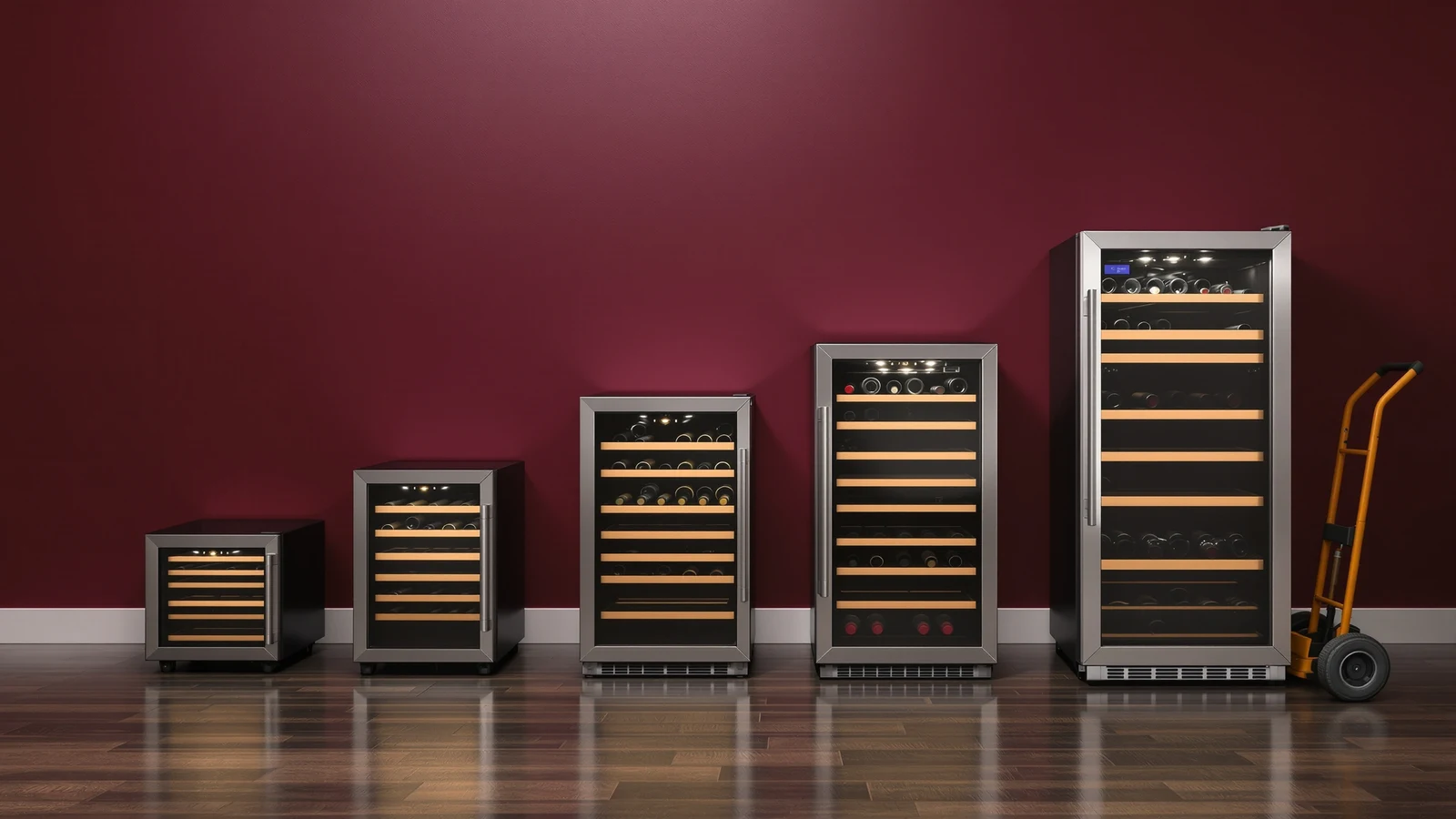
Lined up by their own manufacturers' figures, these four cabinets trace the exact point where the underlying engineering changes, not just the size.
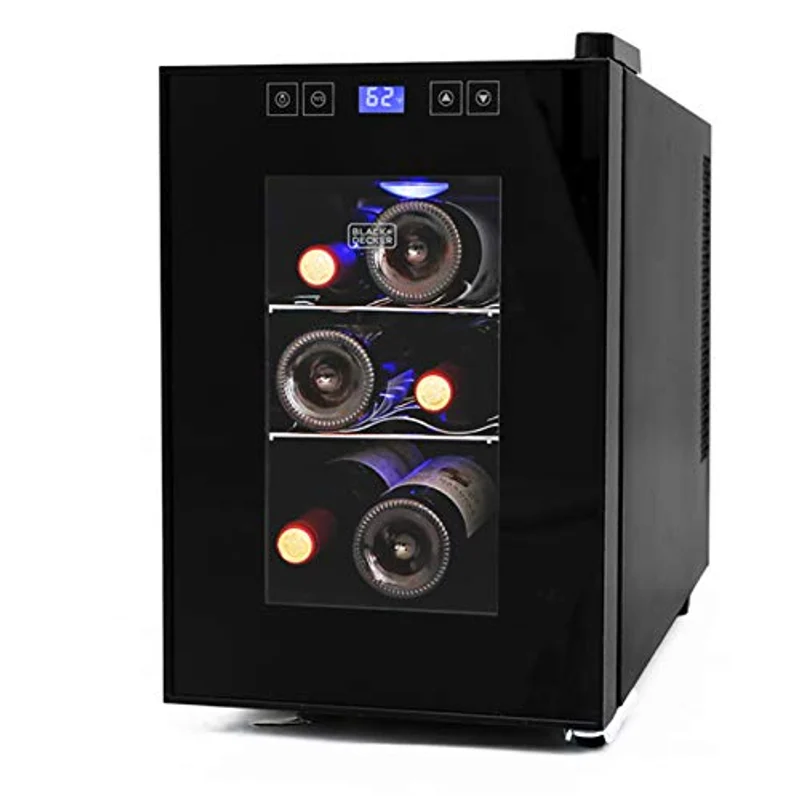
19.1 lbs — BLACK+DECKER BD60016, 6 bottles. The smallest and lightest of the four, with a footprint the manufacturer lists at roughly 10.24 by 20.08 by 15.28 inches. Thermoelectric cooling, two chrome racks, no compressor. Empty, it's lighter than most people expect a "fridge" to be — closer to a large cooler bag than an appliance.
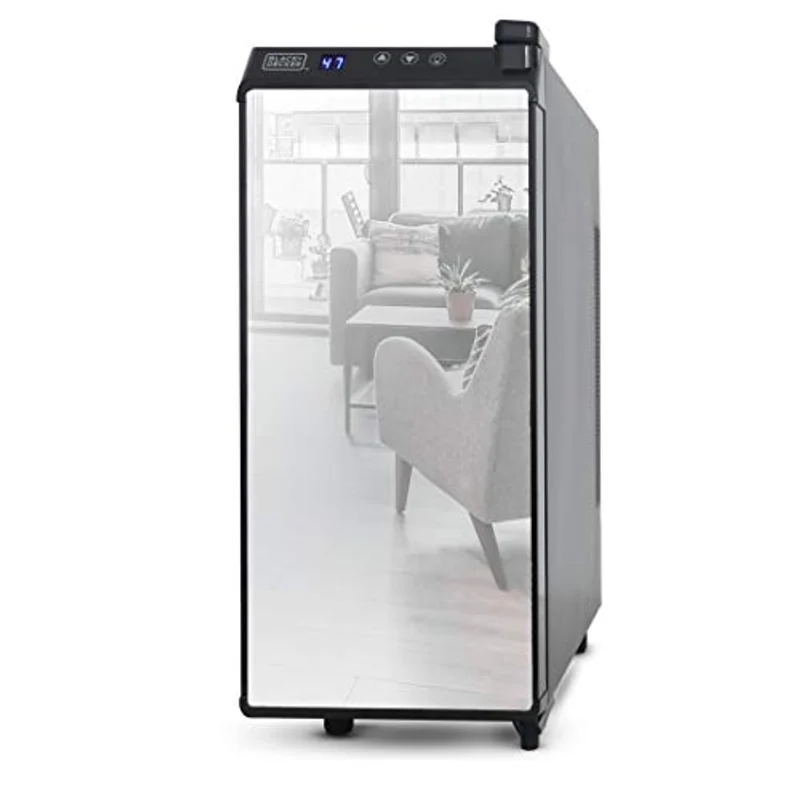
28.3 lbs — BLACK+DECKER BD60336, 12 bottles. Same cooling principle as the BD60016, in a taller cabinet — the manufacturer's footprint runs roughly 10 by 20.4 by 24.9 inches — with five chrome racks instead of two. Doubling the bottle count here adds about nine pounds, not nineteen, because the added weight is almost entirely more cabinet and more shelving, not a bigger or heavier cooling mechanism.
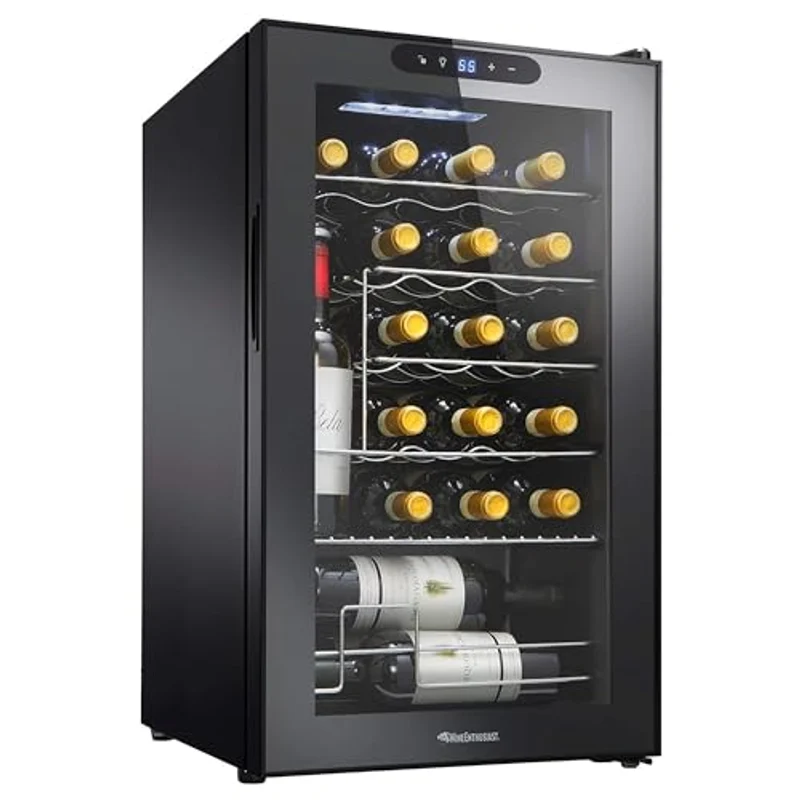
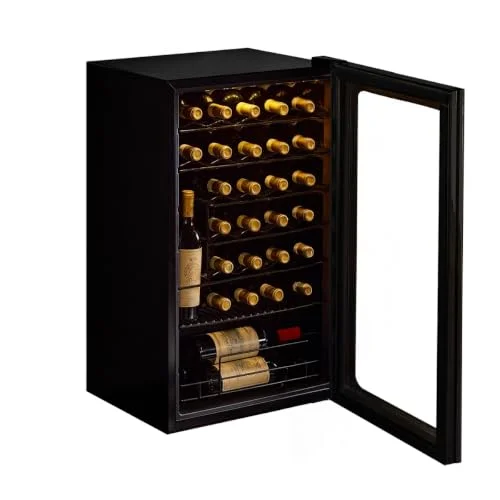
47 lbs — Wine Enthusiast 24-Bottle Compressor Cooler, 2.4 cu. ft. The manufacturer's own dimensions are specific: 30-1/2 inches high, 17 inches wide, 17-3/4 inches deep. This is the step where the jump isn't about bottle count at all — it's the compressor, the refrigerant loop, and a cabinet built to carry that hardware without buzzing. Going from 12 bottles to 24 bottles doubles the rack capacity; it nearly doubles the weight too, but for a different reason than more wine storage.
74 lbs — Wine Enthusiast 33-Bottle Compressor Cooler, 3.3 cu. ft. The same compressor platform, scaled up: 33 inches high, 20 inches wide, 16.9 inches deep, per the manufacturer's listing. From the 24-bottle model, that's nine more bottles of rack space for 27 more pounds — a smaller jump this time, because the compressor and the core cabinet construction are already the heavy part, and this step is mostly more insulated volume around the same mechanism.
One more number worth having in your head before delivery day: a standard full 750ml wine bottle weighs a little under 3 pounds, glass included. Load the 33-bottle cabinet to capacity and you're adding roughly 90 pounds of wine on top of its own 74 — which is also the practical reason every moving guide tells you to empty a wine fridge completely before it goes anywhere.
One person, two people, or a dolly
There's no official threshold for when a second pair of hands becomes necessary — the honest answer depends on the stairs, the turns, and how the person carrying it feels about their lower back. But the four weight classes above do suggest a sensible, conservative line.
- Under about 30 lbs (the two BLACK+DECKER units here): a one-person carry, the same way you'd carry a fully loaded case of wine or a small television. Lift with your legs, keep it upright, and you're done in one trip.
- 30 to 50 lbs (the 24-bottle Wine Enthusiast): still a reasonable solo carry on flat, clear ground. On stairs, through a narrow turn, or if the person carrying it isn't used to lifting appliance-sized boxes, a second person on the base makes the awkward moments — a step edge, a doorframe — far less likely to end in a dropped corner.
- 50 to 80 lbs (the 33-bottle Wine Enthusiast): doable solo for a short, flat distance, but this is the range where a second person stops being a nice-to-have. Two people carrying together, one on each side at the base, is both safer and noticeably less tiring than one person white-knuckling it alone.
- Past about 80 lbs, or any weight combined with more than one flight of stairs: this is where a furniture dolly or an appliance hand truck with a strap earns its place. It's not about whether a person can carry it — it's that a dolly turns a controlled, repeatable motion into the job, instead of a one-shot lift where something going wrong means a dropped fridge, a bruised shin, or both.
Whatever the weight class, keep the cabinet upright for the entire carry if it has a compressor. Laying a compressor unit on its side — even briefly, to get it through a tight turn — is the single most common way people damage a wine fridge during a move, and it has nothing to do with how heavy it was. More on that in the section below.
Measure the path before the truck arrives
Weight is only half the problem. The other half is whether the cabinet physically fits through the route it has to travel, and that's worth checking with a tape measure before delivery day, not during it.
Start with the widest point of the cabinet — for the four reference units here, that's 20.08 inches for the BD60016, 20.4 inches for the BD60336, 17 inches for the 24-bottle Wine Enthusiast, and 20 inches for the 33-bottle version, per their own listed dimensions. A standard interior door opening is roughly 28 to 32 inches, so a straight carry through a normal doorway clears easily for all four. The problem is almost never the doorway itself — it's what happens at the turn just before or after it.
Stairwells are where a path that looked fine on paper actually fails. A straight staircase with a landing at the bottom is simple: the cabinet goes up or down at the same angle it would sit on the floor. A staircase with a 90-degree turn partway up — extremely common in older homes — forces the cabinet to pivot in a confined space, and that pivot needs more clearance than the stairwell's raw width suggests, because the cabinet has to rotate diagonally for a moment to clear the corner. Measure the diagonal distance across the landing at the turn, not just the width of the stairs, and compare it to the cabinet's height plus a few inches of margin.
Hallway corners work the same way. A fridge that's 33 inches tall and 20 inches wide doesn't need a 33-inch-wide hallway to get around a corner — it needs enough diagonal room to swing through the turn without the top corner catching a doorframe or a light fixture. Walk the actual path with a tape measure (or a cardboard box cut to the cabinet's dimensions, which is a cheap way to physically test a tight spot) before the delivery truck is idling outside.
One more thing worth checking in advance: the final resting spot. If the cabinet is going into a cabinet cut-out or against a wall, confirm there's enough clearance behind and beside it for airflow — that's a separate question from weight, but it's the kind of thing that's much easier to fix before the last ten feet of the carry than after.
Protecting hardwood and vinyl during the carry
Floor protection matters for the entire path the cabinet travels, not just the spot where it finally sits. A 74-lb compressor cabinet dragged even a few feet across hardwood or vinyl plank flooring can scuff, scratch, or dent the surface — and because most of these cabinets have hard plastic or unpadded metal feet, the risk is real even for a short slide.
- Don't drag it — carry or roll it. Dragging concentrates the full weight on a few small contact points moving under friction, which is exactly the combination that scores a floor. If the distance is too far to carry comfortably, a furniture dolly with soft rubber wheels spreads the weight and rolls instead of scraping.
- Pad the final resting spot before the fridge lands on it. Felt furniture pads or a thin rubber mat under each foot prevent slow, invisible damage from vibration and the compressor's own motion over months of use — a different problem from the one-time risk during the carry, but one that's easiest to solve at the same time.
- Use moving blankets or a flattened cardboard path on the floor for the specific stretch where the cabinet has to be set down and repositioned, such as lining it up against a wall or a cabinet opening. A brief setdown on an unprotected hardwood floor, even just to catch your breath, is a common way a corner gets chipped.
- On vinyl plank flooring specifically, avoid pivoting the cabinet in place on its feet to square it against a wall — twisting under load is what tears or shifts individual planks. Lift and reposition instead of rotating in contact with the floor.
None of this is unique to wine fridges — it's the same care any appliance delivery deserves — but wine fridges are disproportionately likely to be moved by the homeowner rather than a professional delivery crew, simply because they're light enough to seem like a DIY job even at 74 lbs.
What a delivery or moving service actually charges for a job this small
Because every cabinet in this guide falls well under the weight of a washing machine or a full-size refrigerator, it almost never needs a specialized appliance mover — but there are still a few realistic options if you'd rather not carry it yourself.
General local movers typically charge by the hour with a minimum call-out, commonly in the range of one to two hours for a two-person crew — a cost structure built around the time and the truck, not the specific item, so a single wine fridge usually costs close to whatever that minimum is, whether it's a quick in-and-out job or not. That makes a dedicated mover the least efficient option for a single appliance unless it's bundled with other items already being moved.
On-demand labor and delivery apps that specialize in single-item jobs — the kind built for moving one couch or one appliance rather than a whole household — are usually the better fit for a job this size, since their pricing scales to the item rather than charging a full moving-crew minimum. For something in the 20-to-80-lb range with no stairs involved, this tends to land well under what a traditional moving company's minimum call-out would cost.
Big-box retailers and some Amazon listings offer paid delivery or "white glove" placement for larger appliances at checkout, but it's worth checking the listing specifics — this tier of service is usually built around full-size refrigerators and washers, and a 19-to-74-lb wine fridge frequently ships as a standard parcel instead, left at the door like any other package. If the specific listing you're buying from doesn't mention installation or placement, assume it's curbside or doorstep delivery and plan the carry yourself.
The practical bottom line: for every cabinet in this guide, paying for professional help is about convenience and avoiding the stairwell risk discussed above, not necessity. None of these four units needs specialized equipment to move — a dolly, a second person, and the floor protection covered above handle all four weight classes.
Once it's in place
Getting the cabinet to its final spot is only the first half of the job if it's a compressor unit. The other half is timing — specifically, how long to wait before plugging it in if it was ever tipped on its side during the move, even briefly to clear a tight turn.
A compressor relies on a reservoir of lubricating oil that settles at the bottom of its housing when the unit is upright. Tip it on its side and that oil migrates into the refrigerant lines; it doesn't drain back the moment the fridge is standing again, and plugging it in before it does risks running the compressor dry. Both Wine Enthusiast models here use compressor cooling, so this applies directly to them — the two BLACK+DECKER thermoelectric units don't have this concern, since there's no compressor or refrigerant oil involved, and can be plugged in as soon as they're placed.
Our full guide to moving and restarting a wine fridge covers the exact wait time to use if the compressor unit was ever laid flat, plus the rest of the pre-move prep — emptying it, securing the shelves, and taping the door. It's worth reading in full before the restart, not after the cabinet has already been plugged in.
How we compared these numbers
What we did
Manufacturer-listed weights and dimensions
Every weight and dimension cited in this guide — 19.1 lbs, 28.3 lbs, 47 lbs and 74 lbs, along with the height, width and depth figures for each unit — comes directly from the manufacturer's own product listing. We did not estimate, average, or round any of these figures ourselves.
What we didn't
We don't run a testing lab
We did not physically carry these cabinets through a doorway or down a staircase to time or score the experience. What we can do honestly is read the published specifications carefully, apply general facts about appliance moving and floor protection that hold true regardless of brand, and tell you what the numbers actually say before you lift anything.
Frequently asked questions
How much does a 24-bottle wine fridge weigh?
The Wine Enthusiast 24-Bottle Compressor Wine Cooler used as a reference point in this guide is listed by the manufacturer at 47 lbs. That figure reflects a compressor-cooled cabinet; a thermoelectric model holding a similar bottle count would weigh meaningfully less, since it has no compressor or refrigerant loop to carry.
Can one person carry a wine fridge up a flight of stairs alone?
For the lighter two reference units here — 19.1 lbs and 28.3 lbs — yes, the same way you'd carry a full case of wine up a staircase. For the 47-lb and 74-lb compressor units, a solo carry on a straight, clear staircase is possible for a short distance, but a second person reduces the real risk at any turn or landing, and is worth arranging in advance rather than improvising mid-carry.
Do I need a dolly to move a wine fridge?
Not for the lighter two weight classes in this guide. Past roughly 50 to 80 lbs, or whenever more than one flight of stairs is involved, a furniture dolly or an appliance hand truck with a strap turns a one-shot lift into a controlled, repeatable motion — worth using even if the weight alone feels manageable, because it also protects the floor along the way.
How much does wine fridge delivery or moving help cost?
For every weight class covered here, a single-item delivery or moving app built for one piece of furniture or one appliance is typically the better value than a general moving company's hourly minimum, since the pricing scales to the size of the job rather than a full crew's call-out fee. Confirm with the specific service, since rates vary by region and by how far the cabinet has to travel once it's off the truck.
Written by Ilane Tall. Research-based comparisons of published specifications and current prices — we do not physically test these units and we do not publish invented scores.